Ariane 5's third launch of 2011
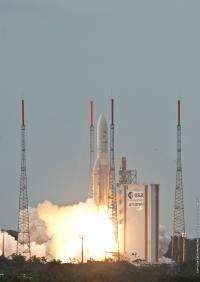
On 20 May 2011, an Ariane 5 launcher lifted off from Europe’s Spaceport in French Guiana on its mission to place two telecommunications satellites, GSAT-8 and ST-2, into their planned transfer orbits. Flight VA202 was the third Ariane 5 launch of 2011. Liftoff of the 58th Ariane 5 mission came at 22:38 CEST (20:38 GMT; 17:38 French Guiana). Credits: ESA / CNES / Arianespace / Photo Optique vidéo du CSG - S. Martin
An Ariane 5 launcher lifted off this evening from Europes Spaceport in French Guiana on its mission to place two telecommunications satellites, ST-2 and GSAT-8, into their planned transfer orbits. Flight VA202 was the third Ariane 5 launch of 2011.
Liftoff of the 58th Ariane 5 mission came at 22:38 CEST (20:38 GMT; 17:38 French Guiana). The target injection orbit had a perigee altitude of 249 km, an apogee altitude at injection of 35 947 km and an inclination of 2.5º.
The satellites were accurately injected into their transfer orbits about 27 minutes and 31 minutes after liftoff, respectively.
ST-2 will be positioned above the equator at 88°E. It will provide Internet-based fixed and mobile, voice and data transmission satellite services to businesses, in particular direct broadcast TV operators and maritime companies in Asia and the Middle East.
GSAT-8, to be positioned over 55°E, will provide mainly direct-to-home TV broadcast and radionavigation services to the Indian subcontinent.
The payload mass for this launch was 9013 kg; the satellites totalled 8190 kg, with payload adapters and dispensers making up the additional 823 kg.
VA202 flight timeline
The Ariane 5s cryogenic, liquid-propellant main engine was ignited first. Seven seconds later, the solid-propellant boosters also fired, and the vehicle lifted off a fraction of a second later.
The solid boosters were jettisoned 2 min 21 sec after main engine ignition, and the fairing protecting the payload during the climb through Earths atmosphere was discarded at 3 min 09 sec.
The launchers main engine was shut down at 8 min 54 sec; six seconds later, the main cryogenic stage separated from the upper stage and its payload.
Four seconds after main stage separation, the engine of the cryogenic upper stage was ignited to continue the journey. The engine was shut down at 24 min 51 sec into the flight, at which point the vehicle was travelling at 9350 m/s (33 660 km/h) at an altitude of 658.4 km. The conditions for geostationary transfer orbit injection had been achieved.
At 27 min 08 sec after main engine ignition, ST-2 separated from the upper stage, followed by GSAT-8 at 31 min 17 sec. Ariane 5s flight operations were completed 46 min 08 sec after main engine ignition.
Provided by
European Space Agency
-
From lemons to lemonade: Reaction uses carbon dioxide to make carbon-based semiconductor,
32 comments
-
Thioridazine kills cancer stem cells in human while avoiding toxic side-effects of conventional cancer treatments,
3 comments
-
SpaceX private rocket blasts off for space station (Update),
42 comments
-
Climate scientists say they have solved riddle of rising sea,
31 comments
-
SpaceX capsule has 'new car' smell, astronauts say (Update),
2 comments
-
revamping general concept and cosmological principle
May 25, 2012
-
Transiting Exoplanet Light Curve
May 25, 2012
-
Math behind Theoretical Physics
May 24, 2012
-
Do we know whats at the center of galaxies yet?
May 23, 2012
-
Structure of the Milky Way?
May 20, 2012
-
What would it take to terraform Pluto and Charon?
May 19, 2012
- More from Physics Forums - General Astronomy
More news stories
SpaceX capsule has 'new car' smell, astronauts say (Update)
SpaceX's Dragon cargo vessel smells like a new car, said astronauts at the International Space Station after opening the hatches Saturday following the spacecraft's landmark mission to the orbiting lab.
Space & Earth / Space Exploration
23 hours ago |
4.5 / 5 (21) |
2
Australia hails surprise super-telescope decision
Australia has hailed a surprise decision giving it a role in a radio telescope project aimed at revolutionising astronomy, vowing to draw on its decades of experience in space science.
23 hours ago |
5 / 5 (4) |
2
Astronomers seize last chance in lifetime for Venus Transit
Astronomers are gearing for one the rarest events in the Solar System: an alignment of Earth, Venus and the Sun that will not be seen for another 105 years.
23 hours ago |
5 / 5 (3) |
2
Astronauts enter world's 1st private supply ship
(AP) -- Space station astronauts floated into the Dragon on Saturday, a day after its heralded arrival as the world's first commercial supply ship.
Space & Earth / Space Exploration
23 hours ago |
5 / 5 (6) |
0
Sophisticated simulations predict future warming
The chances of our planet being hit by a global warming of 3 degrees Celsius by 2050 is as likely as it being hit by an increase of 1.4 degrees, new research shows. Presented in the journal Nature Geoscience, the British study ...
Space & Earth / Earth Sciences
May 22, 2012 |
4.4 / 5 (9) |
51
Nvidia trumpets Tegra 3 phone design wins for 2012
(Phys.org) -- Nvidias competitive war paint has a name, Tegra 3. On the heels of Nvidia announcements about lowering costs of its Tegra 3 processors and Nvidia-enabled tablets running Android Ice Cream ...
Browser wars flare in mobile space
The browser wars are heating up again, but this time the fight is for dominance of the mobile Internet.
Scientist: Evolution debate will soon be history
(AP) -- Richard Leakey predicts skepticism over evolution will soon be history. Not that the avowed atheist has any doubts himself.
Dell tablet leak: 10.1-inch display, two-battery choice
(Phys.org) -- Headline after headline talks about vendors tablets in the wings as likely number-one contenders for the iPad. Such claims have justifiably been taken with a grain of salt, considering ...
SpotterRF debuts Radar Backpack Kit (w/ Video)
(Phys.org) -- SpotterRF has announced a special radar backpack kit designed to enhance situational awareness for soldiers on the ground. The company says its special radar is designed for warfighters as part ...
Thousands of shellfish found dead in Peru
Thousands of crustaceans were found dead off the coast of Lima following the mystery mass death of dolphins and pelicans, the Peruvian Navy said Friday.