Ultra-fast magnetic reversal observed
April 13, 2011

Ultra-fast magnetic reversal observed

A newly discovered magnetic phenomenon could accelerate data storage by several orders of magnitude.

With a constantly growing flood of information, we are being inundated with increasing quantities of data, which we in turn want to process faster than ever. Oddly, the physical limit to the recording speed of storage media has remained largely unresearched. In experiments performed on the BESSY II of Helmholtz-Zentrum Berlin, Dutch researchers have now achieved ultrafast magnetic reversal and discovered a surprising phenomenon.

In magnetic memory, data is encoded by reversing the magnetization of tiny points. Such memory works using the so-called magnetic moments of atoms, which can be in either "parallel" or "antiparallel" alignment in the storage medium to represent to "0" and "1".

The alignment is determined by a quantum mechanical effect called "exchange interaction". This is the strongest and therefore the fastest "force" in magnetism. It takes less than a hundred femtoseconds to restore magnetic order if it has been disturbed. One femtosecond is a millionth of a billionth of a second. Ilie Radu and his colleagues have now studied the hitherto unknown behaviour of magnetic alignment before the exchange interaction kicks in. Together with researchers from Berlin and York, they have published their results in Nature.

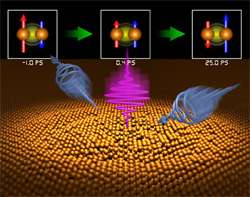
For their experiment, the researchers needed an ultra-short laser pulse to heat the material and thus induce magnetic reversal. They also needed an equally short X-ray pulse to observe how the magnetization changed. This unique combination of a and circular polarized, femtosecond X-ray light is available in one place in the world: at the synchrotron radiation source BESSY II in Berlin, Germany.

In their experiment, the scientists studied an alloy of gadolinium, iron and cobalt (GdFeCo), in which the magnetic moments naturally align antiparallel. They fired a laser pulse lasting 60 femtoseconds at the GdFeCo and observed the reversal using the circular-polarized X-ray light, which also allowed them to distinguish the individual elements. What they observed came as a complete surprise: The Fe atoms already reversed their magnetization after 300 femtoseconds while the Gd atoms required five times as long to do so. That means the atoms were all briefly in parallel alignment, making the material strongly magnetized. "This is as strange as finding the north pole of a magnet reversing slower than the south pole," says Ilie Radu.

With their observation, the researchers have not only proven that magnetic reversal can take place in femtosecond timeframes, they have also derived a concrete technical application from it: "Translated to magnetic data storage, this would signify a read/write rate in the terahertz range. That would be around 1000 times faster than present-day commercial computers," says Radu.

More information: Nature, DOI: 10.1038/nature09901 , 2011

Provided by Helmholtz Association of German Research Centres search and more info website

4.9 /5 (9 votes)  

Filter


Move the slider to adjust rank threshold, so that you can hide some of the comments.


Display comments: newest first

El_Nose
Apr 13, 2011

Rank: 1 / 5 (1)
to bad traditional disc storage mediums still use a rotating platter -- meaning that on you regular cheap harddrive you buy at best buy is bounded on the read write side purley by the spin speed, rotational speed, of the disc itself --- this article is therefore addressing SSD, or solid state drives that operate digitally meaning that the read write can be as fast as the closk speed of the controlling microprocessor on the ssd board. Which i believe is in the low Ghz range. Please double check me and comment.
axemaster
Apr 13, 2011

Rank: 3 / 5 (1)
But wait... how would you store any information with this, if the state only lasts a few femptoseconds? I don't understand.
Quantum_Conundrum
Apr 13, 2011

Rank: 3 / 5 (1)
But wait... how would you store any information with this, if the state only lasts a few femptoseconds? I don't understand.


Well, presumably the write head would be working that fast, and it would pass over a storage media (tape, disk, or something else,) changing the magnetic state of said media.
gunslingor1
Apr 13, 2011

Rank: 5 / 5 (1)
this article is therefore addressing SSD

-SSDs are solid state drives. They're not magnetic, they are just a bunch of RAM chips.

But wait... how would you store any information with this, if the state only lasts a few femptoseconds? I don't understand.

-You misunderstood. The states don't last femtoseconds, they last decades. What lasts femtoseconds is the CHANGE of states. So, to go from on to off or visa versa takes femto seconds while the on or off state lasts indefinitely, for all intense and purposes.
-They aren't proposing a new type of storage or any new theory regarding storage. But what they have done is very important and could increase performance. They've measured the time required to store a bit and found that the time varies depending on the element used (undoubted the more massive elements take longer since it takes more energy to flip them). Now we can start picking the fastest switching elements, spin speed is still limited --> more heads=solved.
holoman
Apr 13, 2011

Rank: not rated yet
circular polarized light, nice. Will only work in 2D.
unknownorgin
Apr 14, 2011

Rank: not rated yet
This means a giant hard drive with a 100 foot diameter disk in a vacume traveling at the speed of sound at the outer edge could store the planets data and access it at main frame speeds using muliple GMRD read/write heads.
Rank 4.9 /5 (9 votes)
Relevant PhysicsForums posts
  • A Question relating Power
    created1 hour ago
  • Writing a book so im learning about things, i have some general questions please read
    created3 hours ago
  • Question about induced E field.
    created4 hours ago
  • Charging a capacitor in a tesla coil
    created4 hours ago
  • Water Rocket
    created8 hours ago
  • why do trucks have bigger brakes?
    created12 hours ago
  • More from Physics Forums - General Physics

More news stories

Is a classical electrodynamics law incompatible with special relativity?

(Phys.org) -- The laws of classical electromagnetism that were developed in the 19th century are the same laws that scientists use today. They include Maxwell’s four equations along with the Lorentz la ...

Physics / General Physics

created May 24, 2012 | popularity 4.7 / 5 (15) | comments 39 | with audio podcast feature

Landmark calculation clears the way to answering how matter is formed

(Phys.org) -- An international collaboration of scientists, including Thomas Blum, associate professor of physics, is reporting in landmark detail the decay process of a subatomic particle called a kaon – ...

Physics / General Physics

created May 25, 2012 | popularity 4.2 / 5 (21) | comments 47 | with audio podcast

Lying in wait for WIMPs: Researchers seek to dramatically increase sensitivity of Large Underground Xenon detector

Although it's invisible, dark matter accounts for at least 80 percent of the matter in the universe. No one knows what it is, but most scientists would bet on weakly interacting massive particles, or WIMPs.

Physics / General Physics

created May 23, 2012 | popularity 4 / 5 (7) | comments 15 | with audio podcast

Hall effect at the speed of light: How can you demonstrate relativistic effects with your mobile phone?

The relativistic Hall effect describing objects rotating at speeds comparable with the speed of light has been reported.

Physics / General Physics

created May 21, 2012 | popularity 4.3 / 5 (3) | comments 8

Cloak of invisibility: Engineers use plasmonics to create an invisible photodetector

A team of engineers at Stanford and the University of Pennsylvania has for the first time used "plasmonic cloaking" to create a device that can see without being seen - an invisible machine that detects light. It is the first ...

Physics / General Physics

created May 21, 2012 | popularity 4.8 / 5 (16) | comments 7 | with audio podcast


Scientist: Evolution debate will soon be history

(AP) -- Richard Leakey predicts skepticism over evolution will soon be history. Not that the avowed atheist has any doubts himself.

Dell tablet leak: 10.1-inch display, two-battery choice

(Phys.org) -- Headline after headline talks about vendors’ tablets in the wings as likely number-one contenders for the iPad. Such claims have justifiably been taken with a grain of salt, considering ...

SpotterRF debuts Radar Backpack Kit (w/ Video)

(Phys.org) -- SpotterRF has announced a special radar backpack kit designed to enhance situational awareness for soldiers on the ground. The company says its special radar is designed for warfighters as part ...

SpaceX capsule has 'new car' smell, astronauts say (Update)

SpaceX's Dragon cargo vessel smells like a new car, said astronauts at the International Space Station after opening the hatches Saturday following the spacecraft's landmark mission to the orbiting lab.

Thousands of shellfish found dead in Peru

Thousands of crustaceans were found dead off the coast of Lima following the mystery mass death of dolphins and pelicans, the Peruvian Navy said Friday.

Astronomers seize last chance in lifetime for Venus Transit

Astronomers are gearing for one the rarest events in the Solar System: an alignment of Earth, Venus and the Sun that will not be seen for another 105 years.