Transmission lines for nanofocusing of infrared light
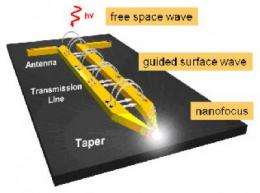
A joint cooperation between three research groups at nanoGUNE reports an innovative method to focus infrared light with tapered transmission lines to nanometer-size dimensions. This device could trigger the development of novel chemical and biological sensing tools, including ultra-small infrared spectrometers and lab-on-a-chip integrated biosensors.
In conventional optical instruments, light cannot be focused to spot sizes smaller than half the wavelength because of diffraction effects. An important approach to beat this diffraction limit is based on optical antennas, their name being an allusion to their radiofrequency counterparts. They have the ability to concentrate (focus) light to tiny spots of nanometer-scale dimensions, which are orders of magnitude smaller than what conventional lenses can achieve. Tiny objects such as molecules or semiconductor nanoparticles that are placed into these so-called "hot spots" of the antenna can efficiently interact with light. Thus, optical antennas boost single molecule spectroscopy or the sensitivity of optical detectors. However, the hot spot is bound to the antenna structure, which limits flexibility in designing nanooptical circuits.
The experiments conducted at nanoGUNE now show that infrared light can be transported and nanofocused with miniature transmission lines, consisting of two closely spaced metal nanowires. While lenses and mirrors manipulate light in its form of a free-space propagating wave, transmission lines guide the infrared light in form of a tightly bound surface wave (Nature Photonics, 03 April 11).
The researchers at nanoGUNE adapted the concept of classic transmission lines to the infrared frequency range. Transmission lines are specialized cables for carrying for example radio frequency signals. A simple form consists of two metal wires running closely in parallel, also called ladder line. This structure was widely used in former times for connecting the radio receiver or television set to the rooftop antenna. Applied at MHz frequencies, where typical wavelengths are in the range of centimeters to several meters, it is a prime example for transport of energy in waveguides of strongly subwavelength-scale diameter.
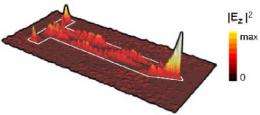
In their experiments, the researchers demonstrated that infrared light can be transported in the same way, by scaling down the size of the transmission lines to below 1 micrometer (left panel of the figure). To that end, they fabricated two metal nanowires connected to an infrared antenna. The antenna captures infrared light and converts it into a propagating surface wave traveling along the transmission line. By gradually reducing the width of the transmission line ("tapering"), the researchers demonstrate that the infrared surface wave is compressed to a tiny spot at the taper apex with a diameter of only 60 nm (see right panel of the figure). This tiny spot is 150 times smaller than the free-space wavelength, emphasizing the extreme subwavelength-scale focus achieved in the experiments. The researchers applied their recently introduced near-field microscopy technique (Schnell et al., Nano Lett. 10 3524 (2010)) to map the different electrical field components of the infrared focus with nanoscale resolution.
Nanofocusing of infrared light with transmission lines has important implications in spectroscopy and sensing applications. Connecting a transmission line to the antenna, the infrared light captured by the nanoantenna can be transported over significant distances and nanofocused in a remote place. "This opens new pathways for the development of infrared nanocircuits" says Rainer Hillenbrand leader of the Nanooptics Group at the nanoscience institute nanoGUNE. "It is amazing that the classical radiofrequency concepts still work at infrared frequencies. That is 30 THz!" adds Martin Schnell who performed the experiments.
"Near-field optical microscopy techniques urgently seek for new ways to confine light down to the nanometer scale" explains Rainer Hillenbrand. "The concept of tapered transmission lines is a promising way to do achieve this. Acting as an ultra-small torch, it conducts infrared light exactly to the spot under analysis" says Martin Schnell.
The CIC nanoGUNE Consolider, nanoGUNE in short, is the Basque nanoscience and nanotechnology research center, inaugurated in 2009 in Donostia – San Sebastián, Spain. The collaborative environment at the center has been one of the keys to the success of the idea. The fabrication of the transmission lines was carried out by members of the Nanodevices Group and the TEM Laboratory, while the infrared transport and focusing functionality was designed and verified in the Nanooptics Group. "It's great having the tools and expertise you need in the labs right next to yours" says Hillenbrand.
Provided by Elhuyar Fundazioa


