STEREO turns its steady gaze on variable stars
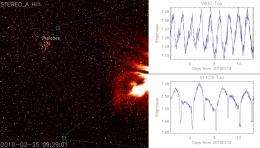
Image caption: A STEREO/HI-1A image taken on 7th March 2010 (left) with two variable stars highlighted in the image. The varying brightness of the two stars, V837 Tau and V1129 Tau are shown (right top and bottom, respectively). Credit: Image produced by D. Bewsher (UCLan). Data courtesy of NASA/STEREO and the HI instrument team.
(PhysOrg.com) -- Researchers have discovered 122 new eclipsing binary stars and observed hundreds more variable stars in an innovative survey using NASA's two STEREO solar satellites. The survey has been carried out by team from the Open University, University of Central Lancashire and the STFC Rutherford Appleton Laboratory. Dr Danielle Bewsher presented highlights at the RAS National Astronomy Meeting in Llandudno, Wales on Tuesday 19th April.
STEREO was launched in 2006 to study the Sun in 3D and coronal mass ejections, the cause of space weather. Each STEREO spacecraft carries a Heliospheric Imager (HI), each instrument comprising two cameras (HI-1 and HI-2) built and developed at the STFC's Rutherford Appleton Laboratory and the University of Birmingham. The HI cameras are able to make such stable measurements that researchers can accurately monitor the brightness of stars in the background.
"Although STEREO is primarily a solar mission, we recognised that the stability of the HI cameras could also be used to monitor variations of the brightness of stars," said Bewsher, of the University of Central Lancashire. "To date, 893 000 stars have passed through the HI-1 field-of-view alone, producing an unexpected resource of scientific data about the variability of stars that is currently being data mined."
The lead author, Karl Wraight, an STFC PhD student at the OU, has found the 122 new eclipsing binaries during an initial analysis of the data, and expects many more to be discovered.
"STEREO's ability to sample continuously for up to 20 days, coupled with repeat viewings from the twin spacecraft during the year, makes it an invaluable resource for researching variable stars. As well as making discoveries, observations from HI are enabling us to pin down the periods of known variables with much greater accuracy," said Wraight.
In addition to studying variable stars, the team believes that HI measurements may be used for exoplanet and astroseismology research.
"Very small changes to the brightnesses of stars can be detected, which could reveal the presence of transiting exoplanets, or be used to trace a stars internal structure by measuring their seismic activity," said Professor Glenn White (RAL and OU).
Provided by
Royal Astronomical Society
-
From lemons to lemonade: Reaction uses carbon dioxide to make carbon-based semiconductor,
32 comments
-
Thioridazine kills cancer stem cells in human while avoiding toxic side-effects of conventional cancer treatments,
3 comments
-
SpaceX private rocket blasts off for space station (Update),
42 comments
-
Climate scientists say they have solved riddle of rising sea,
31 comments
-
Research team claims to have found evidence Lake Cheko is impact crater for Tunguska Event,
18 comments
-
revamping general concept and cosmological principle
May 25, 2012
-
Transiting Exoplanet Light Curve
May 25, 2012
-
Math behind Theoretical Physics
May 24, 2012
-
Do we know whats at the center of galaxies yet?
May 23, 2012
-
Structure of the Milky Way?
May 20, 2012
-
What would it take to terraform Pluto and Charon?
May 19, 2012
- More from Physics Forums - General Astronomy
More news stories
SpaceX capsule has 'new car' smell, astronauts say (Update)
SpaceX's Dragon cargo vessel smells like a new car, said astronauts at the International Space Station after opening the hatches Saturday following the spacecraft's landmark mission to the orbiting lab.
Space & Earth / Space Exploration
21 hours ago |
4.5 / 5 (20) |
1
Australia hails surprise super-telescope decision
Australia has hailed a surprise decision giving it a role in a radio telescope project aimed at revolutionising astronomy, vowing to draw on its decades of experience in space science.
21 hours ago |
5 / 5 (4) |
2
Dragon arrives at space station in historic 1st (Update 2)
The privately bankrolled Dragon capsule made a historic arrival at the International Space Station on Friday, triumphantly captured by astronauts wielding a giant robot arm.
Space & Earth / Space Exploration
May 25, 2012 |
5 / 5 (10) |
19
Astronomers seize last chance in lifetime for Venus Transit
Astronomers are gearing for one the rarest events in the Solar System: an alignment of Earth, Venus and the Sun that will not be seen for another 105 years.
21 hours ago |
5 / 5 (3) |
2
Organic carbon from Mars, but not biological
(Phys.org) -- Molecules containing large chains of carbon and hydrogen--the building blocks of all life on Earth--have been the targets of missions to Mars from Viking to the present day. While these molecules ...
Space & Earth / Space Exploration
May 24, 2012 |
4.4 / 5 (5) |
2
|
Nvidia trumpets Tegra 3 phone design wins for 2012
(Phys.org) -- Nvidias competitive war paint has a name, Tegra 3. On the heels of Nvidia announcements about lowering costs of its Tegra 3 processors and Nvidia-enabled tablets running Android Ice Cream ...
Browser wars flare in mobile space
The browser wars are heating up again, but this time the fight is for dominance of the mobile Internet.
Dell tablet leak: 10.1-inch display, two-battery choice
(Phys.org) -- Headline after headline talks about vendors tablets in the wings as likely number-one contenders for the iPad. Such claims have justifiably been taken with a grain of salt, considering ...
Scientist: Evolution debate will soon be history
(AP) -- Richard Leakey predicts skepticism over evolution will soon be history. Not that the avowed atheist has any doubts himself.
Of mice and mental models: Neuroscientific implications of risk-optimized behavior in the mouse
(Medical Xpress) -- Regardless of an organism’s biological complexity, every encephalized animal continuously makes under-informed behavioral choices that can have serious consequences. Despite its ubiquity, ...
SpotterRF debuts Radar Backpack Kit (w/ Video)
(Phys.org) -- SpotterRF has announced a special radar backpack kit designed to enhance situational awareness for soldiers on the ground. The company says its special radar is designed for warfighters as part ...
Apr 20, 2011
Rank: 3 / 5 (1)