Specialized invisible needles make us see surfaces at the nanoscale
April 19, 2011 by Annette Ostrand
We expect our electronic devices, such as mobile phones and computers, to work properly and become even better with time and seldom think about the amazing innovations making this possible. Scientists are developing a cantilever array that can have an important impact on synthesis and analysis of nanostructures that can improve the quality control of mobile phone camera lenses.
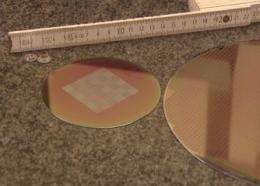
A cantilever is a very thin single needle currently used for quality control at the nanoscale, but to improve and speed up the process scientists are developing an array of needles, a cantilever array, functioning simultaneously. Except for finding defects on mircochips this array could benefit the optical industry by improving the quality control of mobile phone camera lenses.
Researchers use Scanning Proximity Probes (SPP) to analyze the quality of electronic devices by scanning their components surfaces at the atomic level. Presently, single probes are used and the scanning rate is very slow. Each probe, a cantilever consisting of a specialized silicon needle only a few microns wide which is invisible to the naked eye, vibrates when passing over a surface.These vibrations are transformed into electric signals and then interpreted by a computer that creates a three-dimensional scan. In this way the researchers can see how a certain surface looks in detail. Without these kinds of sensitive nanotools it would be impossible to see if all nanosized components were in the right place and the quality would therefore be poorer.The limitation to the scanning areas size and the scanning speed has been the SPP nanotools mechanical resonance frequencies.
To increase the scanning speed and analyze larger surfaces researchers from Germany, Poland, Sweden, the UK, Slovakia, Bulgaria, Switzerland and France have joined forces in the European Commission funded project PRONANO - Proceedings of the Integrated Project on Massively Parallel Intelligent Cantilever Probe Platforms for Nanoscale Analysis and Synthesis. They are developing a cantilever array for parallel operation that can have an important impact on synthesis and analysis of nanostructures.
Cantilevers are not only used for surface analysis but for nanolithography, critical dimensions control and data storage. The PRONANO cantilever array could also benefit areas such as the optical industry, where it has shown to be able to point out defects in certain types of lenses ten times faster than the technology used today, which could increase output from this industry.
When this cantilever array reaches the market it can improve performance and lower the price of computers and mobile phones, as well as improve quality control of lenses for cameras in mobile phones. In addition, when defective products are found and discarded earlier in the production process, it could mean this new cantilever array becomes a much more environmentally friendly alternative. However, this is dependent on for example the production procedure of the cantilever array.
Provided by Youris
-
From lemons to lemonade: Reaction uses carbon dioxide to make carbon-based semiconductor,
32 comments
-
Thioridazine kills cancer stem cells in human while avoiding toxic side-effects of conventional cancer treatments,
3 comments
-
SpaceX private rocket blasts off for space station (Update),
42 comments
-
Climate scientists say they have solved riddle of rising sea,
31 comments
-
Research team claims to have found evidence Lake Cheko is impact crater for Tunguska Event,
18 comments
-
distribution of molecules throughout the atmosphere
55 minutes ago
-
The Global Positioning System !
2 hours ago
-
A Question relating Power
3 hours ago
-
Writing a book so im learning about things, i have some general questions please read
5 hours ago
-
Question about induced E field.
6 hours ago
-
Charging a capacitor in a tesla coil
6 hours ago
- More from Physics Forums - General Physics
More news stories
In nanorod crystal growth, nanoparticles seen as artificial atoms
In the growth of crystals, do nanoparticles act as "artificial atoms" forming molecular-type building blocks that can assemble into complex structures? This is the contention of a major but controversial theory ...
May 24, 2012 |
4.8 / 5 (6) |
0
|
First direct observation of oriented attachment in nanocrystal growth
Berkeley Lab researchers have reported the first direct observation of nanoparticles undergoing oriented attachment, the critical step in biomineralization and the growth of nanocrystals. A better understanding ...
May 24, 2012 |
4.7 / 5 (3) |
0
|
Dopant gives graphene solar cells highest efficiency yet
(Phys.org) -- By taking advantage of graphenes favorable electrical and optical properties, and then adding an organic dopant, researchers have achieved the highest power conversion efficiency yet for ...
Synthetic nano-waste does not disappear
(Phys.org) -- Tiny particles of cerium oxide do not burn or change in the heat of a waste incineration plant. They remain intact on combustion residues or in the incineration system, as a new study by Swiss ...
Nanotechnology / Bio & Medicine
May 25, 2012 |
5 / 5 (2) |
1
|
'Metamaterials,' quantum dots show promise for new technologies
(Phys.org) -- Researchers are edging toward the creation of new optical technologies using "nanostructured metamaterials" capable of ultra-efficient transmission of light, with potential applications including ...
May 24, 2012 |
5 / 5 (7) |
1
|
Nvidia trumpets Tegra 3 phone design wins for 2012
(Phys.org) -- Nvidias competitive war paint has a name, Tegra 3. On the heels of Nvidia announcements about lowering costs of its Tegra 3 processors and Nvidia-enabled tablets running Android Ice Cream ...
Browser wars flare in mobile space
The browser wars are heating up again, but this time the fight is for dominance of the mobile Internet.
Dell tablet leak: 10.1-inch display, two-battery choice
(Phys.org) -- Headline after headline talks about vendors tablets in the wings as likely number-one contenders for the iPad. Such claims have justifiably been taken with a grain of salt, considering ...
Scientist: Evolution debate will soon be history
(AP) -- Richard Leakey predicts skepticism over evolution will soon be history. Not that the avowed atheist has any doubts himself.
SpaceX capsule has 'new car' smell, astronauts say (Update)
SpaceX's Dragon cargo vessel smells like a new car, said astronauts at the International Space Station after opening the hatches Saturday following the spacecraft's landmark mission to the orbiting lab.
Of mice and mental models: Neuroscientific implications of risk-optimized behavior in the mouse
(Medical Xpress) -- Regardless of an organism’s biological complexity, every encephalized animal continuously makes under-informed behavioral choices that can have serious consequences. Despite its ubiquity, ...
May 02, 2011
Rank: not rated yet