Crash sensor boosts safety in warehouses
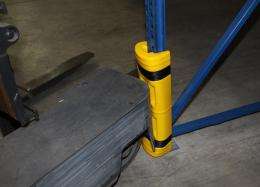
For reasons of workplace safety, storage shelves in warehouses are subjected to routine testing of their stability. These inspection rounds are time-consuming and deliver just a snapshot in time. Researchers have devised a wireless, sensor-based system to provide continuous monitoring of the condition of storage shelves.
At the end of a long day on the job, the warehouse employee wants to deposit the last palettes quickly before heading home. With a little too much momentum he steers his forklift toward the shelf and collides with a shelf support. This is an every- day situation in large warehouses in which employees often have to maneuver goods through the narrow aisles, often under time pressure. Even harmless-seeming collisions are not really safe though, because over time they may in fact destabilize the shelf supports. In the worst case, the high-rack storage can come crashing down – a serious hazard for the employees below. This is why the supports must be routinely checked for any damage. Up until now, an employee has to inspect each shelf individually – a laborious and time-consuming process. A further drawback: If a support is damaged immediately after an inspection, it goes undetected until the next round. A more effective and reliable protection is afforded by a new monitoring system developed by researchers at the Fraunhofer Institute for Microelectronic Circuits and Systems IMS in Duisburg, in collaboration with IWS Handling GmbH. With the aid of a network of wireless sensors, the condition of each individual support can be monitored around the clock. “Since DIN EN 15635 was introduced, the demands on the operation of shelf systems have increased significantly. Regular inspections have become indispensable as a result,” according to Dr. Weiner, managing director at IWS Handling.
Typically, to protect them from collisions, the supports are fitted with a kind of air cushion designed to absorb the impact. “We have integrated sensors in this protective fitting that measure the pressure within the air cushion,” explains Frederic Meyer, project manager at IMS. If an air cushion is collided with, the sensor registers the change in interior pressure and reports this via radio relay to a central control station. This is located in the warehouse manager’s office. Repeaters positioned at several points throughout the warehouse receive the messages from the sensor nodes and smoothly pass these along to the control station. All the warehouse manager needs to do is glance at the base station to know when and where the last collisions took place within the hall. The system automatically provides him or her a report of whether the impact was harmless, of medium strength or serious. While no immediate measures are required for light collisions, in the event of a category three incident the warehouse manager immediately will send an employee to the shelf in question.
Energy management played a central role in developing this new technology. “After all, the use of such a system only pays off if you aren’t constantly having to replace the batteries in the sensors,” Meyer adds. The researchers in Duisburg have configured the system so that the electronics spend most of their time in energy-saving sleep mode. Only when a fluctuation in pressure occurs do the sensor nodes “wake up” and switch to active status. At certain intervals, though – the settings can be varied individually – each sensor node sends a “sign of life” along with its current battery status to a repeater. This ensures that the failure of a signal node will not go unnoticed and is reported to the control station.
The scientists expect to have realized a first demonstrator model by the end of March, which they will then present at the Euro ID (April 5-7 in Berlin) and Sensor + Test (June 7-9 in Nuremberg) trade fairs. A field test is planned for a larger warehouse facility as well. The project is sponsored by the “Otto von Guericke” German Federation of Industrial Research Associations.
Provided by Fraunhofer-Gesellschaft


