Scientists demonstrate novel ionic liquid batteries
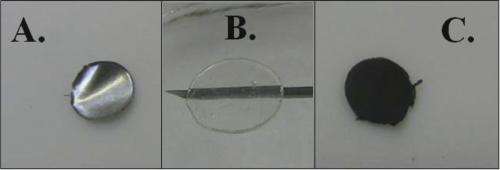
From left to right: (A) a Zn anode (1cm in diameter), (B) an EMIHSO4 - PVA separator (laying on a syringe needle to illustrate thickness and transparency), and (C) a PbO2 - carbon cathode. U.S. Naval Research Laboratory
(PhysOrg.com) -- Scientists at the NRL Materials Science and Technology Division are providing solid evidence that there is a new route towards developing novel, lightweight energy storage devices. By moving away from centuries of caustic, hazardous aqueous-based battery cells and instead using non-volatile, thermally-stable ionic liquids, scientists predict multiple new types of batteries. Rather than depend on highly acidic electrolytes, ionic liquids are used to create a solid polymer electrolyte composed of an ionic liquid and polyvinyl alcohol, developing novel types of solid state batteries with discharge voltages ranging up to 1.8 volts.
The unique properties of ionic liquids have fostered this explosive interest in battery applications. Ionic liquids are room temperature molten salts that possess many important characteristics, such as nearly no vapor pressure, non- flammability and lack of reactivity in various electrochemical or industrial applications. "It is the high thermal and electrochemical stability of the ionic liquids which has fostered the growing interest in ionic liquids for use in various electrochemical processes," said Dr. Thomas Sutto. "These new types of solid-state cells mimic standard alkaline cells, but without the need for caustic electrolytes."
Limits imposed by using corrosive electrolytes often result in severe restrictions to standard battery geometry and the need for special corrosive-resistant battery containers. The use of reactive ionic liquids in non-aqueous cells replaces the more hazardous highly alkaline electrolytes such as manganese oxide (MgO) and zinc (Zn) found in traditional batteries.
The root of this work began during standard corrosion studies of different metals in ionic liquids. While working with ionic liquids based on mineral acids, such as hydrogen sulphates, it was observed that Zn metal would react to form zinc sulphate. Since this is similar to that observed for the zinc anode in a standard alkaline cell, a series of experiments were then performed to determine how different metal oxides reacted in these types of ionic liquids.
Electrochemical experiments demonstrate that not only can these reactive ionic liquids act as the electrolyte/separator in both solid state and liquid batteries, but they can also act as a reactive species in the cell's electrochemical makeup. Using a non-aqueous approach to primary and secondary power sources, batteries are designed using standard cathode and anode materials such as magnesium dioxide (MgO2), lead dioxide (PbO2) and silver oxide (AgO). The ionic liquid that is the main focus of this work is 1-ethyl-3-methylimidazolium hydrogen sulphate (EMIHSO4), however, other ionic liquids such as those based on the nitrate and dihydrogen phosphate anions (negatively charged ions) have also been found to work well in this type of a battery design.
The use of these electrolytes suggests the potential for new types of rechargeable systems, such as replacement electrolytes in nickel-metal hydride (NiMH) batteries, or even the standard lead-acid battery. Experimental work is currently underway to develop such a rechargeable ionic liquid power source. The ability to create solid separators also allows for the formation of many new types of batteries via a number of fabrication techniques.
Provided by
Naval Research Laboratory
-
From lemons to lemonade: Reaction uses carbon dioxide to make carbon-based semiconductor,
32 comments
-
Thioridazine kills cancer stem cells in human while avoiding toxic side-effects of conventional cancer treatments,
3 comments
-
SpaceX private rocket blasts off for space station (Update),
42 comments
-
Climate scientists say they have solved riddle of rising sea,
31 comments
-
Research team claims to have found evidence Lake Cheko is impact crater for Tunguska Event,
18 comments
-
What's the rule to covalent character
1 hour ago
-
Schwartz reagent-- NMR/MS/IR
20 hours ago
-
High school chemistry EEI
May 25, 2012
-
oxidation of I- by KMnO4
May 25, 2012
-
Inversion temp
May 25, 2012
-
Hybridization of SnCl3 -
May 25, 2012
- More from Physics Forums - Chemistry
More news stories
Researchers demonstrate possible primitive mechanism of chemical info self-replication
(Phys.org) -- When scientists think about the replication of information in chemistry, they usually have in mind something akin to what happens in living organisms when DNA gets copied: a double-stranded molecule ...
May 25, 2012 |
5 / 5 (4) |
2
|
High-speed method to aid search for solar energy storage catalysts
Eons ago, nature solved the problem of converting solar energy to fuels by inventing the process of photosynthesis.
May 25, 2012 |
5 / 5 (3) |
4
|
Building a better solar panel -- one molecule at a time
(Phys.org) -- One of the fundamental building blocks in modern chemistry, an organometallic chemical compound called ferrocene, has never been structurally defined - until now.
May 25, 2012 |
5 / 5 (3) |
0
|
New CO2-removing catalyst can take the heat
(Phys.org) -- The current method of removing the greenhouse gas carbon dioxide (CO2) from the flues of coal-fired power plants uses so much energy that no one bothers to use it. So says Roger Aines, principal ...
May 24, 2012 |
5 / 5 (7) |
7
|
Discarded data may hold the key to a sharper view of molecules
(Phys.org) -- There's nothing like a new pair of eyeglasses to bring fine details into sharp relief. For scientists who study the large molecules of life from proteins to DNA, the equivalent of new lenses have come in the ...
May 24, 2012 |
4.7 / 5 (3) |
0
|
Nvidia trumpets Tegra 3 phone design wins for 2012
(Phys.org) -- Nvidias competitive war paint has a name, Tegra 3. On the heels of Nvidia announcements about lowering costs of its Tegra 3 processors and Nvidia-enabled tablets running Android Ice Cream ...
Browser wars flare in mobile space
The browser wars are heating up again, but this time the fight is for dominance of the mobile Internet.
Dell tablet leak: 10.1-inch display, two-battery choice
(Phys.org) -- Headline after headline talks about vendors tablets in the wings as likely number-one contenders for the iPad. Such claims have justifiably been taken with a grain of salt, considering ...
Scientist: Evolution debate will soon be history
(AP) -- Richard Leakey predicts skepticism over evolution will soon be history. Not that the avowed atheist has any doubts himself.
SpaceX capsule has 'new car' smell, astronauts say (Update)
SpaceX's Dragon cargo vessel smells like a new car, said astronauts at the International Space Station after opening the hatches Saturday following the spacecraft's landmark mission to the orbiting lab.
Of mice and mental models: Neuroscientific implications of risk-optimized behavior in the mouse
(Medical Xpress) -- Regardless of an organism’s biological complexity, every encephalized animal continuously makes under-informed behavioral choices that can have serious consequences. Despite its ubiquity, ...