Rotating sunspots spin up a super solar flare
Apr 21, 2011
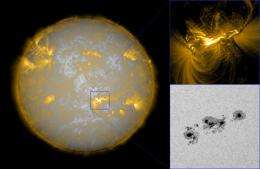
The Sun at 1.50am on 15th February 2011 using composite data of the Sun's surface from SDO/HMI and the Sun's million degree corona from SDO/AIA. The cutout region shows (bottom) the five rotating sunspots of the active region (AR 11158), and (top) the bright release of light from the X class flare. Credit: Image produced by D. Brown (UCLan). Data courtesy of NASA/SDO and the AIA, EVE, and HMI science teams.

(PhysOrg.com) -- The largest solar flare recorded in nearly five years was triggered by interactions between five rotating sunspots. Researchers at the University of Central Lancashire studied observations of the flaring region of the Sun taken by NASA's Solar Dynamics Observatory over a period of five days. Dr. Daniel Brown presented the findings at the RAS National Astronomy Meeting in Llandudno, Wales, on Wednesday 20th April 2011.

"Sunspots are features where generated in the Sun’s interior pushes through the surface and into the atmosphere," said Dr. Brown. "Twisting the Sun's magnetic field is like twisting an elastic band. At first you store energy in the elastic, but if you twist too much the elastic band snaps, releasing the stored energy. Similarly, rotating sunspots store energy in the Sun's atmospheric magnetic field. If they twist too much, the magnetic field breaks releasing energy in a flash of light and heat which makes up the ."
 
The flare occurred at 1.44am on 15th February 2011, when the released the largest recorded solar flare since December 2006 and the first flare of the current solar cycle to be classified as the most powerful “X-class”. Looking at five days of SDO observations that included this flare, Dr. Brown found that the active region that flared contained five newly emerged sunspots. All five of the sunspots rotated between 50 and 130 degrees, some in a clockwise and some in an anticlockwise direction, over the five days of observations.

This video is not supported by your browser at this time.
This movie shows the dynamics of the Sun's atmosphere over 6 days as seen by NASA's Solar Dynamics Observatory (SDO). It uses composite data from two instruments, the surface data is from SDO/HMI, and the atmospheric data (at around 1,000,000 degrees) is from SDO/AIA. The right-hand inset shows a close up of active region 11158 from both of these instruments. The sunspots are seen to emerge and undergo a twisting motion in the solar surface. The response fo the coronal loops in the atmosphere shows rapid brightenings throughout the movie which are the solar flares being released. Movie credit: Movie produce by D. Brown (UCLan). Data courtesy of NASA/SDO and the AIA, EVE, and HMI science teams.

“Rotating sunspots are an extremely efficient way to inject energy into the magnetic field of the Sun's atmosphere,” said Dr. Brown.  “With five rotating at the same time enough energy has been injected into the atmospheric magnetic field to produce the largest solar flare seen for almost 5 years.”

In addition to the large X-class flare, the same region also released over 40 smaller flares during the five days studied.

Explore further: Dark, massive asteroid to fly by Earth on May 31

Related Stories

Solar Fireworks Signal New Space Weather Mystery

May 24, 2005

The most intense burst of solar radiation in five decades accompanied a large solar flare on January 20. It shook space weather theory and highlighted the need for new forecasting techniques, according to several presentations ...

Watching the birth of a sunspot

Apr 20, 2011

(PhysOrg.com) -- Researchers at the University of Central Lancashire have monitored the birth of a sunspot over a period of eight hours using observations from NASA's Solar Dynamics Observatory (SDO). Dr. ...

A Massive Explosion on the Sun

Apr 25, 2007

Astronomers are calling the Japanese Hinode spacecraft a "Hubble for the sun." Watch this movie and you'll see why. ...

Sunspots could soon disappear for decades: study

Sep 15, 2010

(PhysOrg.com) -- Sunspot formation is triggered by a magnetic field, which scientists say is steadily declining. They predict that by 2016 there may be no remaining sunspots, and the sun may stay spotless ...

Explaining the mystery of the missing sunspots

Apr 05, 2011

Sunspots have been observed for about four centuries, since they were first reported by Galileo. Appearing in roughly eleven-year cycles of activity, sunspots are regions of strong and complex magnetic fields ...

3D Sun for the iPhone

Feb 17, 2010

Imagine holding the entire sun in the palm of your hand. Now you can. A new iPhone app developed by NASA-supported programmers delivers a live global view of the sun directly to your cell phone. Users can ...

Recommended for you

Dark, massive asteroid to fly by Earth on May 31

5 hours ago

It's 1.7 miles long. Its surface is covered in a sticky black substance similar to the gunk at the bottom of a barbecue. If it impacted Earth it would probably result in global extinction. Good thing it is ...

Research team explains 'Lazarus' comets

8 hours ago

Astronomers from the University of Antioquia have discovered a graveyard of comets. These once-dormant comets, dubbed by astronomers as "The Lazarus comets," are now rejuvenated.

NASA ships sensors for seafaring satellite to France

9 hours ago

(Phys.org) —Three NASA-built instruments that are integral components of the next in a series of U.S./European ocean altimetry satellites have arrived in France for integration with their spacecraft in ...

Trip into space with DiCaprio costs $1.55m

9 hours ago

Leonardo DiCaprio is going to get closer to stars of a different kind as he heads into space aboard the Virgin Galactic, and a well-heeled bidder at the Cannes Film Festival has paid 1.2 million euros (1.5 million) to be ...

User comments : 5

Adjust slider to filter visible comments by rank

Display comments: newest first

omatumr
1 / 5 (3) Apr 22, 2011
Thanks for this report and for evidence of increased interest in the Sun - Earth's heat source.

For anyone seriously interested in sunspots and the many ways that our stormy Sun impacts Earth, I recommend the following:

1. The book: "The Sun Kings: The Unexpected Tragedy of Richard Carrington and the Tale of How Modern Astronomy Began" by Stuart Clark

http://press.prin...370.html

2. These research papers: "The Sun's origin, composition and source of energy", 32nd Lunar Science Conf. (2001):

http://xxx.lanl.g.../0411255

3. "Superfluidity in the solar interior: Implications for solar eruptions and climate",
Journal of Fusion Energy 21, 193-198 (2002):

http://arxiv.org/.../0501441

4. "Earth's Heat Source - The Sun", Energy & Environment 20, 131-144 (2009);

http://arxiv.org/pdf/0905.0704

5. "Neutron Repulsion", The APEIRON Journal, in press, 19 pages (2011);

http://arxiv.org/...2.1499v1

omatumr
1 / 5 (4) Apr 22, 2011
This short video shows our conclusions about the Sun:

www.youtube.com/w...e_Qk-q7M

With kind regards,
Oliver K. Manuel
that_guy
5 / 5 (1) Apr 22, 2011
The sunspots are only going to get worse due to neutron repulsion as shown in nuclear experiments. solar flares are going to whip out from the sun and rape everyone up in here. Hide your kids, hide your wife. Solar flares gonna get you.

Without any kind of regards,

This_guy.
Shelgeyr
1 / 5 (1) Apr 24, 2011
"Sunspots are features where magnetic field generated in the Suns interior pushes through the surface and into the atmosphere," said Dr. Brown. "Twisting the Sun's magnetic field is like twisting an elastic band. At first you store energy in the elastic, but if you twist too much the elastic band snaps, releasing the stored energy.
Nonsense!

...the magnetic field breaks...
Utter, utter nonsense! Magnetic fields don't "break".

Rotating sunspots are an extremely efficient way to inject energy into the magnetic field of the Sun's atmosphere.

Both the sunspots and the increased strength of the magnetic field are due to an increase in the electric current creating those things. Remember, an electric current is the only thing which can create a magnetic field.
omatumr
1 / 5 (2) Apr 24, 2011
"Sunspots are features where magnetic field generated in the Sun's interior pushes through the surface and into the atmosphere"


1. I agree. The question is whether the magnetic fields were produced by a.) Bose-Einstein condensation of iron-rich material into a superconductor in the mantle surrounding the solar core, or b.) The neutron star at the Sun's core ["Superfluidity in the solar interior:
Implications for solar eruptions and climate," Journal of Fusion Energy 21, 193-198 (2002)].

http://arxiv.org/.../0501441

2. To understand the importance of solar flares on Earth, read Stuart Clark's book, "The Sun Kings: The Unexpected Tragedy of Richard Carrington and the Tale of How Modern Astronomy Began"

http://press.prin...370.html

More news stories

Galaxies fed by funnels of fuel

(Phys.org) —Computer simulations of galaxies growing over billions of years have revealed a likely scenario for how they feed: a cosmic version of swirly straws.

Source of life running out: water scientists

The majority of people on Earth people will face severe water shortages within a generation or two if pollution and waste continues unabated, scientists warned at a conference in Bonn Friday.

Dark, massive asteroid to fly by Earth on May 31

It's 1.7 miles long. Its surface is covered in a sticky black substance similar to the gunk at the bottom of a barbecue. If it impacted Earth it would probably result in global extinction. Good thing it is ...

Google eyes emerging markets networks

Google has become deeply involved in a series of projects to build and operate wireless networks in emerging markets including sub-Saharan Africa and Southeast Asia, a report said Friday.