Rings reveal extensive yearly climate record
April 18, 2011 By Phillip F. Schewe

Rings reveal extensive yearly climate record

Enlarge

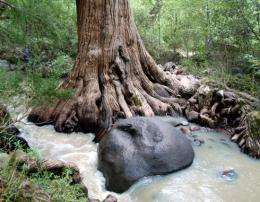
Montezuma bald cypress at Barranca de Amealco, Queretaro, Mexico. Credit: David Stahle

A new study of the oldest trees in Mexico provides the first ever detailed, year-by-year look at the climate of Mesoamerica over a thousand-year span. The data, gathered from the annual growth rings in trees, supplies precise dates for the duration of three historically important droughts, including one that was previously unknown.

Droughts are an important factor in the rise and fall of civilizations. One such , dated now by tree rings to the years A.D. 897-927, is thought to have hastened the decline of .

David Stahle, a geoscientist at the University of Arkansas, refers to this as the "Terminal Classic Drought," since it is perhaps one of the most significant milestones in the decline of what historians refer to as the Classic period in Mesoamerica -- a region that includes Mexico and Central America.

Tree rings are a sort of time capsule for climate since they reveal information about wetness for each year. Trees grow by adding new wood in a tiny outside layer each year. The width of each layer will depend on available moisture and soil nutrients. A dry year often results in a thin layer of growth, while a wet year results in a thicker layer. The cross section of a tree is in effect an album of past growth. The ring pattern --with the oldest layers at the center and newer layers at the outside edge -- tells the story of past wetness.

To make conclusions from the data, however, it's not enough to measure the width of the rings. Scientists calibrate the ancient tree-rings by comparing their width to and growth data measurements from recent decades. This science of dating things using tree rings is called dendrochronology.

The trees used in the new study are called Montezuma bald cypresses. Not only are they the oldest trees in Mexico but they are considered the country's national tree. The researchers took samples from 30 different trees in the canyon of Amealco, Queretaro. The scientists only conclude that a drought occurred when a thin ring from one tree measured for the year 900, say, lined up with rings measured in other trees.

Some of the trees are more than 1,200 years old. The trees are not felled in order to view their complement of rings. Instead augers remove narrow 5-millimeter (about one-fifth of an inch) cores.

Tree rings provide an annual dating system but are only as good as the oldest trees you can find. By comparison, carbon-dating, a technique which measures the slightly radioactive emissions from formerly-living objects, can only tell the age of a thing only to within an uncertainty of about 50 years. Carbon dating is good for looking at times from thousands of years ago, but not for the precision needed for more recent history.

The 10th century drought is as far back as this tree-ring study can go. Just a bit nearer in time is another drought, now precisely dated to the years 1149-1167. This era Stahle refers to as the "Toltec Drought," since it coincides with the decline of the powerful Toltec nation in central Mexico. A drought during this time was playing out in regions to the north now in the U.S.

"This was the worst drought in western North America that we know of over the last 1,200 years," said Stahle. "Our measurements are the first to tie this drought to one taking place in ."

A third drought, now dated to the years 1378-1404 by the tree-ring data, coincides with the years when the Aztecs were a relatively small power off to the side of more powerful, but weakening, nations in central Mexico. The drought, Stahle believes, might have worked to the Aztec's advantage in gaining more influence in the area.

The Aztecs eventually became paramount in Mexico. Later they were conquered by the Spaniards during still another dry period.

"This study is a landmark," said Edward R. Cook, the director of the Tree-Ring Laboratory at the Lamont-Doherty Earth Observatory of Columbia University in Palisades, N.Y. "All previous studies relating drought to the demise of those cultures have relied on less well resolved and less well dated sediment core records. Further north in the U.S., similar studies had been done, but it was not possible to extend those results into central Mexico until Stahle's results."

Cook reconstructs climate by poring over . He is currently building an atlas of droughts using tree-ring records from places around the world.

The new tree ring study appears in the journal Geophysical Research Letters.

More information: http://www.agu.org … 046472.shtml

Provided by Inside Science News Service search and more info website

Filter


Move the slider to adjust rank threshold, so that you can hide some of the comments.


Display comments: newest first

Mochica
Apr 18, 2011

Rank: not rated yet
Droughts in the 10-11th century CE are widespread in South America and have caused the collapse or modification of major civilizations in that time period. This climate phenomena was observed to have major effects on ancient Peruvian and Bolivian societies as well as North American societies; the current work in MesoAmerica adds to the observation that the Western Hemisphere was similarly affected by this long-term drought. Climate Details obtained from ice and lake core analysis and the effects on South American societies can be found in the Oxford Press book "Water Engineering in the Ancient World: Archaeological and Climate Perspectives on Ancient Societies of South America, the Middle East and South East Asia" by Charles R. Ortloff.
physyD
Apr 19, 2011

Rank: 3 / 5 (3)
CE? What's that? Oh yea, Common Era. What's the Common Era? When did that start? The same year when somebody named Jesus was born. Isn't that called AD (Anno Domini)? Use to be. But as the world is full of PC nazis so we are required to accomodate.
(Yes, there are those that claim that it was 4 BC, sorry BCE, but that is irrellevent for this as the dating is the same)
Appologies if this causes ill will but it is what it is. I just wanted to point out the absurdity.
Rohitasch
Apr 19, 2011

Rank: 1 / 5 (1)
CE? What's that? Oh yea, Common Era. What's the Common Era? When did that start? The same year when somebody named Jesus was born. Isn't that called AD (Anno Domini)? Use to be. But as the world is full of PC nazis so we are required to accomodate.
(Yes, there are those that claim that it was 4 BC, sorry BCE, but that is irrellevent for this as the dating is the same)
Appologies if this causes ill will but it is what it is. I just wanted to point out the absurdity.

CE is a secular way of counting days.
Rank 5 /5 (9 votes)
Relevant PhysicsForums posts

More news stories

SpaceX capsule has 'new car' smell, astronauts say (Update)

SpaceX's Dragon cargo vessel smells like a new car, said astronauts at the International Space Station after opening the hatches Saturday following the spacecraft's landmark mission to the orbiting lab.

Space & Earth / Space Exploration

created 21 hours ago | popularity 4.5 / 5 (20) | comments 1

Australia hails surprise super-telescope decision

Australia has hailed a surprise decision giving it a role in a radio telescope project aimed at revolutionising astronomy, vowing to draw on its decades of experience in space science.

Space & Earth / Astronomy

created 21 hours ago | popularity 5 / 5 (4) | comments 2

Astronomers seize last chance in lifetime for Venus Transit

Astronomers are gearing for one the rarest events in the Solar System: an alignment of Earth, Venus and the Sun that will not be seen for another 105 years.

Space & Earth / Astronomy

created 21 hours ago | popularity 5 / 5 (3) | comments 2

Astronauts enter world's 1st private supply ship

(AP) -- Space station astronauts floated into the Dragon on Saturday, a day after its heralded arrival as the world's first commercial supply ship.

Space & Earth / Space Exploration

created 21 hours ago | popularity 5 / 5 (6) | comments 0

Sophisticated simulations predict future warming

The chances of our planet being hit by a global warming of 3 degrees Celsius by 2050 is as likely as it being hit by an increase of 1.4 degrees, new research shows. Presented in the journal Nature Geoscience, the British study ...

Space & Earth / Earth Sciences

created May 22, 2012 | popularity 4.4 / 5 (9) | comments 51


Browser wars flare in mobile space

The browser wars are heating up again, but this time the fight is for dominance of the mobile Internet.

Scientist: Evolution debate will soon be history

(AP) -- Richard Leakey predicts skepticism over evolution will soon be history. Not that the avowed atheist has any doubts himself.

Dell tablet leak: 10.1-inch display, two-battery choice

(Phys.org) -- Headline after headline talks about vendors’ tablets in the wings as likely number-one contenders for the iPad. Such claims have justifiably been taken with a grain of salt, considering ...

SpotterRF debuts Radar Backpack Kit (w/ Video)

(Phys.org) -- SpotterRF has announced a special radar backpack kit designed to enhance situational awareness for soldiers on the ground. The company says its special radar is designed for warfighters as part ...

Thousands of shellfish found dead in Peru

Thousands of crustaceans were found dead off the coast of Lima following the mystery mass death of dolphins and pelicans, the Peruvian Navy said Friday.

Keep food safety in mind this memorial day weekend

(HealthDay) -- Picnics, parades and cookouts are as much a part of Memorial Day weekend as tributes to the United States' war veterans.