Keeping retinoic acid in check
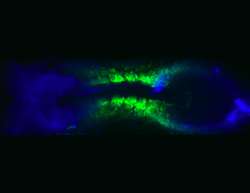
Neurobiologists from the Friedrich Miescher Institute for Biomedical Research (FMI) of the Novartis Research Foundation are the first to describe a mechanism that controls the synthesis of retinoic acid in the developing brain. This is of interest in view of the deleterious effect too much or too little retinoic acid - a derivative of vitamin A - can have in the developing brain during pregnancy. Their results are published in the latest issue of Developmental Cell.
While it is true that vitamins are healthy, for some of them the amount needs to be just right. Vitamin A is such an example. During early pregnancy too much - as well as too little - vitamin A has deleterious effects. A derivative of vitamin A called retinoic acid (RA) is the culprit. During early development retinoic acid tightly controls the development of the brain in a dose dependent way: crudely, cells seeing a lot of retinoic acid develop into the hindbrain and spinal cord, cells seeing less form more anterior brain regions, such as the midbrain and forebrain. Once this balance is disturbed, miscarriages or brain and craniofacial malformations occur.
In the embryo, retinoic acid is synthesized in the mesodermal cells next to the developing nervous system. It is in turn released into the space between neural progenitor cells, diffuses into their nuclei, and directly regulates gene expression through its specific nuclear receptors. Depending on its concentration, it starts a developmental program that in the end defines the spatial organisation of the brain. The genes activated by retinoic acid are the members of the Hox gene family of transcription factors.
One question that remained unanswered is how the synthesis of retinoic acid is controlled to start with.
Filippo Rijli, group leader at the Friedrich Miescher Institute for Biomedical Research (FMI) and his team have addressed this question in a publication in the latest issue of Developmental Cell. In their study, carried out in collaboration with researchers of the Weill Medical College of Cornell University (New York), they could reveal a feed-forward molecular mechanism by which the enzyme that synthesises RA, called Raldh2, is controlled by the same proteins that also define the developmental program of the nerve cells, the Hox proteins. In the absence of these proteins, the transcription of Raldh2 in mesodermal cells is significantly reduced and the developmental program in the hindbrain is disrupted such as to resemble a shortage of Vitamin A.
"This is the first time that we could show how the amount of synthesised retinoic acid is actually controlled during hindbrain development" comments Rijli. "Taking into consideration the broadly instructive role RA plays during the development of several tissues, the results may identify a general mechanism to control RA synthesis in the developing embryo."
More information: Vitobello A, et al. (2011) Hox and Pbx factors control retinoic acid synthesis during hindbrain segmentation. Dev Cell: 20, 469-482.


