Rare Pennsylvania fungus is named for Philadelphia botanist
April 27, 2011

Rare Pennsylvania fungus is named for Philadelphia botanist

Enlarge

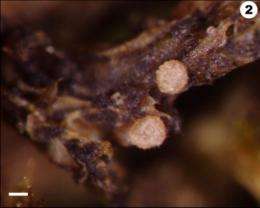
Vezdaea schuyleriana lichen is named for an Academy of Natural Sciences botanist. Credit: James Lendemer

A Philadelphia botanist who has studied rare plants for 50 years, but has never attained the honor of having a plant named for him is finally getting his due, but with a barely visible organism so rare it may never be seen again.

Dr. Alfred "Ernie" Schuyler, emeritus curator of at the Academy of Natural Sciences and a world expert on rare plants, recently was honored when a colleague discovered a new species of lichen and named it after him. The barely visible lichen (LIE kin), Vezdaea schuyleriana, is known to exist on a single boulder in rural central Pennsylvania, northwest of Lewisburg—and nowhere else in the world.

"This is indeed a rare honor," said Schuyler. "I love it!"

A lichen is a fungus that grows symbiotically with algae, a tiny plant. In other words, the fungus and the algae form a living partnership in which they survive together as a lichen. Lichens live on soil, rocks, walls, and trees all over the world. There are more than 14,000 known species of lichens in the world and more are being discovered.

James Lendemer, a doctoral student at The New York Botanical Garden and a research associate at the Academy, is among the relatively few scientists devoting their research to lichens. In the March 2011 issue of Notulae Natureae, Lendemer announced he named his newly discovered lichen after his Academy colleague and friend, Dr. Schuyler. Lendemer studied and curated lichens in the Academy's herbarium before going to New York. The Academy's lichen collection is among the oldest in North America and contains more than 25,000 specimens.
Rare Pennsylvania fungus is named for Philadelphia botanist
Enlarge

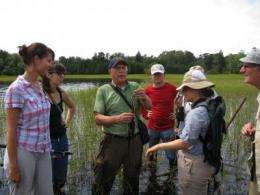
After 50 years of studying rare plants, the Academy of Natural Sciences' Dr. Alfred Schuyler (center), leading a field trip, finally has a new organism named for him. Vezdaea schuyleriana is a rare lichen found on only one boulder in Pennsylvania. Credit: Academy of Natural Sciences

Some lichens are important indicators of environmental quality. Because they are sensitive to air pollution, declining populations can be a clue to degraded air quality. Lichens also are a source of food for animals, and they help in the weathering process of turning rocks into soil.

"There is a lot we don't know about lichens because so few people study them, and minute lichens are rarely collected and studied," said Schuyler. "Who is going to search for more Vezdaea schuyleriana? It's so rare, it may never be seen again."

Provided by Academy of Natural Sciences


Rank not rated yet
Relevant PhysicsForums posts

More news stories

Scientist: Evolution debate will soon be history

(AP) -- Richard Leakey predicts skepticism over evolution will soon be history. Not that the avowed atheist has any doubts himself.

Biology / Evolution

created 10 hours ago | popularity 3.5 / 5 (11) | comments 23

Thousands of shellfish found dead in Peru

Thousands of crustaceans were found dead off the coast of Lima following the mystery mass death of dolphins and pelicans, the Peruvian Navy said Friday.

Biology / Ecology

created 20 hours ago | popularity 4.8 / 5 (4) | comments 6

More plant species responding to global warming than previously thought

(Phys.org) -- Far more wild plant species may be responding to global warming than previous large-scale estimates have suggested.

Biology / Ecology

created May 22, 2012 | popularity 4.6 / 5 (14) | comments 18 | with audio podcast

Totally rad: Scientists create rewritable digital data storage in DNA

(Phys.org) -- Scientists from Stanford's Department of Bioengineering have devised a method for repeatedly encoding, storing and erasing digital data within the DNA of living cells.

Biology / Biotechnology

created May 21, 2012 | popularity 4.9 / 5 (17) | comments 11 | with audio podcast

For monogamous sparrows, it doesn't pay to stray (but they do it anyway)

It's quite common for a female song sparrow to stray from her breeding partner and mate with the male next door, but a new study shows that sleeping around can be costly.

Biology / Plants & Animals

created May 22, 2012 | popularity 5 / 5 (1) | comments 7 | with audio podcast


Dell tablet leak: 10.1-inch display, two-battery choice

(Phys.org) -- Headline after headline talks about vendors’ tablets in the wings as likely number-one contenders for the iPad. Such claims have justifiably been taken with a grain of salt, considering ...

SpotterRF debuts Radar Backpack Kit (w/ Video)

(Phys.org) -- SpotterRF has announced a special radar backpack kit designed to enhance situational awareness for soldiers on the ground. The company says its special radar is designed for warfighters as part ...

SpaceX capsule has 'new car' smell, astronauts say (Update)

SpaceX's Dragon cargo vessel smells like a new car, said astronauts at the International Space Station after opening the hatches Saturday following the spacecraft's landmark mission to the orbiting lab.

Astronomers seize last chance in lifetime for Venus Transit

Astronomers are gearing for one the rarest events in the Solar System: an alignment of Earth, Venus and the Sun that will not be seen for another 105 years.

Australia hails surprise super-telescope decision

Australia has hailed a surprise decision giving it a role in a radio telescope project aimed at revolutionising astronomy, vowing to draw on its decades of experience in space science.

Keep food safety in mind this memorial day weekend

(HealthDay) -- Picnics, parades and cookouts are as much a part of Memorial Day weekend as tributes to the United States' war veterans.