Putin fires Russia space chief after mishaps
April 29, 2011 by Stuart Williams
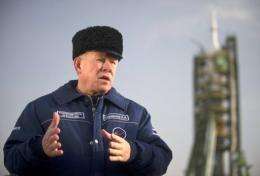
Russian space agency chief Anatoly Perminov is seen in front of a Soyuz TMA-20 spacecraft at Baikonur Cosmodrome in Baikonur, Kazakhstan. Prime Minister Vladimir Putin on April 29, 2011 fired Russian space agency chief Anatoly Perminov after a series of high-profile setbacks in the space programme.
Prime Minister Vladimir Putin on Friday fired the Russian space agency chief after a series of high-profile setbacks cast a shadow on the 50th anniversary year of Yuri Gagarin's first space flight.
Anatoly Perminov will be replaced as head of Roskosmos by First Deputy Defence Minister Vladimir Popovkin, the government said in a statement, quoting an order signed by Putin.
The order said Perminov had reached the maximum age for state employees but there have been clear indications for some time of growing frustration in the government with Roskosmos' performance.
Russia in December suffered one its most embarrassing space failures in recent times when three navigation satellites for the new Russian Glonass system crashed into the ocean off Hawaii instead of reaching orbit.
Officials later admitted that a simple fuel miscalculation was to blame. In February, Russia then put its new Geo-IK-2 military satellite into the wrong orbit, rendering it useless for defence purposes.
Reports have said that the last straw was when the latest manned launch for the International Space Station was delayed due to a technical problem just two weeks ahead of the Gagarin anniversary.
Russia on April 12 marked 50 years since Gargarin's historic first space flight with huge fanfare and President Dmitry Medvedev made clear in a Kremlin address that space exploration remained a priority for the country.
"It's quite clear what the cause is," leading defence analyst Alexander Goltz told Moscow Echo radio station, commenting on Perminov's departure.
"The most recent failures of Roskosmos like the failed Glonass launch and much else shows the clear worsening of technological discipline in its units."
Perminov has served as Roskosmos chief since March 2004.
Popovkin served at the Baikonur space station in Kazakhstan after finishing military academy and headed Russian missile and space defence forces between 2004 and 2008.
Goltz said that at the defence ministry Popovkin had shown himself to be a capable organiser with a good vision of the future.
"The question is to what extent there has been a degradation in Roskosmos' technological units and whether an organiser like Popovkin can change the situation," he said.
Deputy Prime Minister Sergei Ivanov in February issued a scathing assessment of Roskosmos' performance, saying that the Glonass mishap was characteristic of its problems.
"I won't go into details, this was a mistake, but a childish one and a mistake that had serious consequences," he said, describing any repeat satellite failure as "unacceptable".
The failed launch of the Glonass satellites alone had cost Russia 2.5 billion rubles ($86 million, 63 million euros).
The Russian space programme suffered from a sharp drop in funding after the fall of the Soviet Union, and Roskosmos has sent several paying space tourists to the International Space Station (ISS) to help make ends meet.
Yet the onus on Russia is set to grow when NASA takes the US shuttle out of service this year, leaving the Russian Soyuz rockets and spacecraft as the sole delivery systems for taking humans to the ISS.
According to Ivanov, Russia last year remained the world leader in the number of space launches, with 31, while the United States managed 16.
A crucial moment will come later this year with the launch of the much-delayed Fobos-Grunt probe to the Martian moon Phobos, Russia's first inter-planetary probe since its Mars-96 probe failed to enter orbit and broke up in 1996.
(c) 2011 AFP
-
From lemons to lemonade: Reaction uses carbon dioxide to make carbon-based semiconductor,
32 comments
-
Thioridazine kills cancer stem cells in human while avoiding toxic side-effects of conventional cancer treatments,
3 comments
-
SpaceX private rocket blasts off for space station (Update),
42 comments
-
Climate scientists say they have solved riddle of rising sea,
30 comments
-
Research team claims to have found evidence Lake Cheko is impact crater for Tunguska Event,
18 comments
-
revamping general concept and cosmological principle
May 25, 2012
-
Transiting Exoplanet Light Curve
May 25, 2012
-
Math behind Theoretical Physics
May 24, 2012
-
Do we know whats at the center of galaxies yet?
May 23, 2012
-
Structure of the Milky Way?
May 20, 2012
-
What would it take to terraform Pluto and Charon?
May 19, 2012
- More from Physics Forums - General Astronomy
More news stories
SpaceX capsule has 'new car' smell, astronauts say (Update)
SpaceX's Dragon cargo vessel smells like a new car, said astronauts at the International Space Station after opening the hatches Saturday following the spacecraft's landmark mission to the orbiting lab.
Space & Earth / Space Exploration
20 hours ago |
4.5 / 5 (20) |
1
Astronomers seize last chance in lifetime for Venus Transit
Astronomers are gearing for one the rarest events in the Solar System: an alignment of Earth, Venus and the Sun that will not be seen for another 105 years.
20 hours ago |
5 / 5 (3) |
2
Australia hails surprise super-telescope decision
Australia has hailed a surprise decision giving it a role in a radio telescope project aimed at revolutionising astronomy, vowing to draw on its decades of experience in space science.
20 hours ago |
5 / 5 (4) |
1
Astronauts enter world's 1st private supply ship
(AP) -- Space station astronauts floated into the Dragon on Saturday, a day after its heralded arrival as the world's first commercial supply ship.
Space & Earth / Space Exploration
20 hours ago |
5 / 5 (6) |
0
Sophisticated simulations predict future warming
The chances of our planet being hit by a global warming of 3 degrees Celsius by 2050 is as likely as it being hit by an increase of 1.4 degrees, new research shows. Presented in the journal Nature Geoscience, the British study ...
Space & Earth / Earth Sciences
May 22, 2012 |
4.4 / 5 (9) |
51
Scientist: Evolution debate will soon be history
(AP) -- Richard Leakey predicts skepticism over evolution will soon be history. Not that the avowed atheist has any doubts himself.
Dell tablet leak: 10.1-inch display, two-battery choice
(Phys.org) -- Headline after headline talks about vendors tablets in the wings as likely number-one contenders for the iPad. Such claims have justifiably been taken with a grain of salt, considering ...
SpotterRF debuts Radar Backpack Kit (w/ Video)
(Phys.org) -- SpotterRF has announced a special radar backpack kit designed to enhance situational awareness for soldiers on the ground. The company says its special radar is designed for warfighters as part ...
Thousands of shellfish found dead in Peru
Thousands of crustaceans were found dead off the coast of Lima following the mystery mass death of dolphins and pelicans, the Peruvian Navy said Friday.
Keep food safety in mind this memorial day weekend
(HealthDay) -- Picnics, parades and cookouts are as much a part of Memorial Day weekend as tributes to the United States' war veterans.
Family history of Alzheimer's affects functional connectivity
(HealthDay) -- Cognitively normal individuals with a family history of late-onset Alzheimer's disease (AD) may display lower resting state functional connectivity in the default mode network (DMN) of the brain, ...