Protein-devouring enzyme complex uses two different mechanisms to determine which targets to destroy
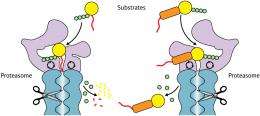
Figure 1: For intracellular proteins (yellow) tagged with ubiquitin chains (green), the tag and initiator region (red) must be close together for the tagged protein to be broken down (left). When the separation between these elements (orange) is too great, degradation becomes highly inefficient (right). Credit: 2011 Tomonao Inobe
The proteasome is the garbage-disposal system of the cell, enzymatically clearing away unwanted proteins. Since this requires the recognition of individual targets within the crowded cellular environment, it is critically important that molecules marked for death are appropriately flagged.
This signal, known as the degron, is composed of two components: an unstructured initiation region within the target protein and a proteasome recognition tag. This tag typically consists of a chain of ubiquitin molecules, but some proteins get steered to the proteasome with the help of ubiquitin-binding adaptor proteins. These two pathways work in parallel with and independently from each other, and converge at the initiation step, explains Tomonao Inobe of the RIKEN Brain Science Institute in Wako, Japan.
By analyzing the efficiency with which different synthetic protein constructs get degraded by the proteasome, Inobe and colleagues in Andreas Matouscheks laboratory at Northwestern University in Illinois, USA, have uncovered important structural details of the recognition mechanisms used by the proteasome to manage these distinct pathways.
The teams initial experiments showed that the minimum length for the initiation region is shorter in proteins tagged with ubiquitin alone (Ub4) than those tagged with an adaptor-derived ubiquitin-like (UbL) domain. Similarly, they found that Ub4mediated degradation was most efficient when these sites were close together, and was impaired by the insertion of rigid spacer protein segments between the two degron components. With UbL-tagged constructs, however, degradation was maximized when these components were moderately separated.
Based on their data, the researchers concluded that these physical constraints arise because Ub4- and UbL-tagged proteins bind to completely different sites on the proteasome; ubiquitin binds very near to the digestion machinery, requiring the initiation region to be close by (Fig. 1), while the UbL-binding site is considerably farther away, and thus accommodates greater separation. Inobe compares this to how an electrical plug must match its outlet. The proteasome can recognize different plugs, he says, but each one has to have the correct specific arrangement of prongs.
Inobe hopes to better characterize the functional role of this distance restriction in the future, but suggests that this mechanism may enable this protein complex to achieve both direct destruction of individual proteins and the targeted degradation of specific molecules nestled within larger complexes. The spacing rules fit well with the way these tags are used physiologically and help explain how substrates are selected for degradation or manage to escape the process, says Inobe.
More information: Inobe, T., et al. Defining the geometry of the two-component proteasome degron. Nature Chemical Biology 7, 161167 (2011). http://www.nature. … bio.521.html
Provided by
RIKEN
-
From lemons to lemonade: Reaction uses carbon dioxide to make carbon-based semiconductor,
32 comments
-
Thioridazine kills cancer stem cells in human while avoiding toxic side-effects of conventional cancer treatments,
3 comments
-
SpaceX private rocket blasts off for space station (Update),
42 comments
-
Climate scientists say they have solved riddle of rising sea,
30 comments
-
Research team claims to have found evidence Lake Cheko is impact crater for Tunguska Event,
18 comments
-
What's the rule to covalent character
59 minutes ago
-
Schwartz reagent-- NMR/MS/IR
19 hours ago
-
High school chemistry EEI
May 25, 2012
-
oxidation of I- by KMnO4
May 25, 2012
-
Inversion temp
May 25, 2012
-
Hybridization of SnCl3 -
May 25, 2012
- More from Physics Forums - Chemistry
More news stories
From lemons to lemonade: Reaction uses carbon dioxide to make carbon-based semiconductor
(Phys.org) -- A materials scientist at Michigan Technological University has discovered a chemical reaction that not only eats up the greenhouse gas carbon dioxide, it also creates something useful. And, by ...
May 21, 2012 |
4.7 / 5 (88) |
32
|
New CO2-removing catalyst can take the heat
(Phys.org) -- The current method of removing the greenhouse gas carbon dioxide (CO2) from the flues of coal-fired power plants uses so much energy that no one bothers to use it. So says Roger Aines, principal ...
May 24, 2012 |
5 / 5 (7) |
7
|
High-speed method to aid search for solar energy storage catalysts
Eons ago, nature solved the problem of converting solar energy to fuels by inventing the process of photosynthesis.
May 25, 2012 |
5 / 5 (3) |
4
|
Researchers demonstrate possible primitive mechanism of chemical info self-replication
(Phys.org) -- When scientists think about the replication of information in chemistry, they usually have in mind something akin to what happens in living organisms when DNA gets copied: a double-stranded molecule ...
May 25, 2012 |
5 / 5 (4) |
2
|
Castor oil: Action mechanism of one of the oldest drugs known to man elucidated
Castor oil is known primarily as an effective laxative; however, it was also used in ancient times with pregnant women to induce labour. Only now have scientists at the Max Planck Institute for Heart and Lung ...
May 21, 2012 |
3 / 5 (2) |
3
|
Scientist: Evolution debate will soon be history
(AP) -- Richard Leakey predicts skepticism over evolution will soon be history. Not that the avowed atheist has any doubts himself.
Dell tablet leak: 10.1-inch display, two-battery choice
(Phys.org) -- Headline after headline talks about vendors tablets in the wings as likely number-one contenders for the iPad. Such claims have justifiably been taken with a grain of salt, considering ...
SpotterRF debuts Radar Backpack Kit (w/ Video)
(Phys.org) -- SpotterRF has announced a special radar backpack kit designed to enhance situational awareness for soldiers on the ground. The company says its special radar is designed for warfighters as part ...
SpaceX capsule has 'new car' smell, astronauts say (Update)
SpaceX's Dragon cargo vessel smells like a new car, said astronauts at the International Space Station after opening the hatches Saturday following the spacecraft's landmark mission to the orbiting lab.
Thousands of shellfish found dead in Peru
Thousands of crustaceans were found dead off the coast of Lima following the mystery mass death of dolphins and pelicans, the Peruvian Navy said Friday.
Astronomers seize last chance in lifetime for Venus Transit
Astronomers are gearing for one the rarest events in the Solar System: an alignment of Earth, Venus and the Sun that will not be seen for another 105 years.