Physicists rotate beams of light
April 5, 2011 By Florian Aigner
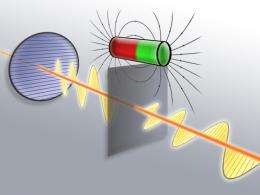
The magnetic field in the thin layer rotates the light waves.
Controlling the rotation of light this amazing feat was accomplished at the Vienna University of Technology (TU Vienna), by means of a ultra thin semiconductor. This can be used to create a transistor that works with light instead of electrical current.
Light waves can oscillate in different directions much like a string that can vibrate up and down or left and right depending on the direction in which it is picked. This is called the polarization of light. Physicists at the Vienna University of Technology have now, together with researchers at Würzburg University, developed a method to control and manipulate the polarization of light using ultra thin layers of semiconductor material. For future research on light and its polarization this is an important step forward and this breakthrough could even open up possibilities for completely new computer technology. The experiment can be viewed as the optical version of an electronic transistor. The results of the experiment have now been published in the renowned journal Physical Review Letters.
Controlling light with magnetic fields
The polarization of light can change, when it passes through a material in a strong magnetic field. This phenomenon is known as the Faraday effect. So far, however, this effect had only been observed in materials in which it was very weak, professor Andrei Pimenov explains. He carried out the experiments at the Institute for Solid State Physics of the TU Vienna, together with his assistant Alexey Shuvaev. Using light of the right wavelength and extremely clean semiconductors, scientists in Vienna and Würzburg could achieve a Faraday effect which is orders of magnitude stronger than ever measured before. Now light waves can be rotated into arbitrary directions the direction of the polarization can be tuned with an external magnetic field. Surprisingly, an ultra-thin layer of less than a thousandth of a millimeter is enough to achieve this. Such thin layers made of other materials could only change the direction of polarization by a fraction of one degree, says professor Pimenov. If the beam of light is then sent through a polarization filter, which only allows light of a particular direction of polarization to pass, the scientists can, rotating the direction appropriately, decide whether the beam should pass or not.
The key to this astonishing effect lies in the behavior of the electrons in the semiconductor. The beam of light oscillates the electrons, and the magnetic field deflects their vibrating motion. This complicated motion of the electrons in turn affects the beam of light and changes its direction of polarization.
An optical transistor
In the experiment, a layer of the semiconductor mercury telluride was irradiated with light in the infrared spectral range. The light has a frequency in the terahertz domain those are the frequencies, future generations of computers may operate with, professor Pimenov believes. For years, the clock rates of computers have not really increased, because a domain has been reached, in which material properties just dont play along anymore. A possible solution is to complement electronic circuits with optical elements. In a transistor, the basic element of electronics, an electric current is controlled by an external signal. In the experiment at TU Vienna, a beam of light is controlled by an external magnetic field. The two systems are very much alike. We could call our system a light-transistor, Pimenov suggests.
Before optical circuits for computers can be considered, the newly discovered effect will prove useful as a tool for further research. In optics labs, it will play an important role in research on new materials and the physics of light.
More information: Giant Magneto-Optical Faraday Effect in HgTe Thin Films in the Terahertz Spectral Range, Phys. Rev. Lett. 106, 107404 (2011)
Provided by Vienna University of Technology
-
From lemons to lemonade: Reaction uses carbon dioxide to make carbon-based semiconductor,
32 comments
-
Thioridazine kills cancer stem cells in human while avoiding toxic side-effects of conventional cancer treatments,
3 comments
-
SpaceX private rocket blasts off for space station (Update),
42 comments
-
Climate scientists say they have solved riddle of rising sea,
30 comments
-
Research team claims to have found evidence Lake Cheko is impact crater for Tunguska Event,
18 comments
-
A Question relating Power
1 hour ago
-
Writing a book so im learning about things, i have some general questions please read
4 hours ago
-
Question about induced E field.
5 hours ago
-
Charging a capacitor in a tesla coil
5 hours ago
-
Water Rocket
8 hours ago
-
why do trucks have bigger brakes?
13 hours ago
- More from Physics Forums - General Physics
More news stories
Is a classical electrodynamics law incompatible with special relativity?
(Phys.org) -- The laws of classical electromagnetism that were developed in the 19th century are the same laws that scientists use today. They include Maxwell’s four equations along with the Lorentz la ...
Landmark calculation clears the way to answering how matter is formed
(Phys.org) -- An international collaboration of scientists, including Thomas Blum, associate professor of physics, is reporting in landmark detail the decay process of a subatomic particle called a kaon ...
May 25, 2012 |
4.2 / 5 (21) |
47
|
Lying in wait for WIMPs: Researchers seek to dramatically increase sensitivity of Large Underground Xenon detector
Although it's invisible, dark matter accounts for at least 80 percent of the matter in the universe. No one knows what it is, but most scientists would bet on weakly interacting massive particles, or WIMPs.
May 23, 2012 |
4 / 5 (7) |
15
|
Hall effect at the speed of light: How can you demonstrate relativistic effects with your mobile phone?
The relativistic Hall effect describing objects rotating at speeds comparable with the speed of light has been reported.
May 21, 2012 |
4.3 / 5 (3) |
8
Cloak of invisibility: Engineers use plasmonics to create an invisible photodetector
A team of engineers at Stanford and the University of Pennsylvania has for the first time used "plasmonic cloaking" to create a device that can see without being seen - an invisible machine that detects light. It is the first ...
May 21, 2012 |
4.8 / 5 (16) |
7
|
Scientist: Evolution debate will soon be history
(AP) -- Richard Leakey predicts skepticism over evolution will soon be history. Not that the avowed atheist has any doubts himself.
Dell tablet leak: 10.1-inch display, two-battery choice
(Phys.org) -- Headline after headline talks about vendors tablets in the wings as likely number-one contenders for the iPad. Such claims have justifiably been taken with a grain of salt, considering ...
SpotterRF debuts Radar Backpack Kit (w/ Video)
(Phys.org) -- SpotterRF has announced a special radar backpack kit designed to enhance situational awareness for soldiers on the ground. The company says its special radar is designed for warfighters as part ...
SpaceX capsule has 'new car' smell, astronauts say (Update)
SpaceX's Dragon cargo vessel smells like a new car, said astronauts at the International Space Station after opening the hatches Saturday following the spacecraft's landmark mission to the orbiting lab.
Thousands of shellfish found dead in Peru
Thousands of crustaceans were found dead off the coast of Lima following the mystery mass death of dolphins and pelicans, the Peruvian Navy said Friday.
Astronomers seize last chance in lifetime for Venus Transit
Astronomers are gearing for one the rarest events in the Solar System: an alignment of Earth, Venus and the Sun that will not be seen for another 105 years.
Apr 05, 2011
Rank: 1 / 5 (1)
i read about it ( here on physorg) few days ago
Apr 05, 2011
Rank: not rated yet
Apr 05, 2011
Rank: not rated yet
Apr 06, 2011
Rank: not rated yet
May 13, 2011
Rank: not rated yet