Paper offers new insights into predator-prey relationships
April 7, 2011 By William G. Gilroy
(PhysOrg.com) -- For those old enough to remember Mutual of Omahas Wild Kingdom television series, the dynamics of predator-prey relationships seemed clear enough: predators thinned out prey populations, which enabled a smaller, but stronger, population to survive and reproduce.
However, a new paper by University of Notre Dame biologist Gary Belovsky appearing in the prestigious journal Ecology Letters suggests that predator-prey relationships are much more complex than originally thought.
The paper arose out of pioneering studies Belovsky, who also is director of the Notre Dame Environmental Research Center (UNDERC), has been conducting on grasshopper populations since 1978 at Montanas National Bison Range, now a location for one of UNDERCs national undergraduate programs.
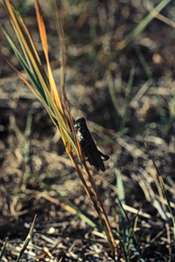
Belovsky conducted an experiment to examine how behavioral responses of grasshoppers to avian predators affected grasshopper survival and reproduction at different grasshopper population densities. A series of cages containing grasshoppers were enclosed within a tent constructed of aviary netting, creating a no threat area because its design prevented birds from approaching the cages and scarring the grasshoppers. A second set of cages provided a threat area because it was not enclosed in a tent, which allowed birds to feed around the cages, perch on top consuming grasshoppers caught outside the cages and scare the grasshoppers inside the cages.
The research demonstrated that grasshopper behavior changed with the threat of predators, reducing grasshopper feeding, and this was apparent at all grasshopper densities. The behavioral changes with the threat of predation increased survival at low grasshopper densities, as reduced feeding made food available to more individuals, while the changes decreased survival at higher densities, as severe food shortages were made worse by reduced feeding. However, the behavioral changes decreased per capita reproduction over all grasshopper population densities, as grasshoppers traded off survival and reproduction as competition among the grasshoppers increased with greater population densities.
This type of variable response is generally overlooked when prey behavioral changes with predation are considered in how predation affects prey populations, Belovsky said. Resource availability may need to be considered when assessing how prey behavioral changes with predation threat affect population and food web dynamics.
Belovsky also notes that the new paper reinforces the importance of his western prairie research, which is now the longest running experimental study at a site examining what controls grasshopper populations. Although it isnt feasible to conduct a population study like this with populations of larger animals, such as elk and wolves in far-flung areas such as Alaska, the more easily observable field work with grasshoppers and birds offers important predator-prey insights that can be applied to these types of populations.
Provided by
University of Notre Dame
-
From lemons to lemonade: Reaction uses carbon dioxide to make carbon-based semiconductor,
32 comments
-
Thioridazine kills cancer stem cells in human while avoiding toxic side-effects of conventional cancer treatments,
3 comments
-
SpaceX private rocket blasts off for space station (Update),
42 comments
-
Climate scientists say they have solved riddle of rising sea,
30 comments
-
Research team claims to have found evidence Lake Cheko is impact crater for Tunguska Event,
18 comments
-
What would stain as translucent on light-coloured fabric?
11 hours ago
-
How do I identify different bacteria on culture plates?
21 hours ago
-
Why Do Dogs do Strange things...
May 25, 2012
-
What does exophillic and endophillic mean in terms of mosquito and their control?
May 24, 2012
-
Semen stains glows under black lights (uv light)?
May 23, 2012
-
Question on Human Chromosome 2
May 23, 2012
- More from Physics Forums - Biology
More news stories
Scientist: Evolution debate will soon be history
(AP) -- Richard Leakey predicts skepticism over evolution will soon be history. Not that the avowed atheist has any doubts himself.
10 hours ago |
3.5 / 5 (11) |
23
Thousands of shellfish found dead in Peru
Thousands of crustaceans were found dead off the coast of Lima following the mystery mass death of dolphins and pelicans, the Peruvian Navy said Friday.
20 hours ago |
4.8 / 5 (4) |
6
More plant species responding to global warming than previously thought
(Phys.org) -- Far more wild plant species may be responding to global warming than previous large-scale estimates have suggested.
May 22, 2012 |
4.6 / 5 (14) |
18
|
Totally rad: Scientists create rewritable digital data storage in DNA
(Phys.org) -- Scientists from Stanford's Department of Bioengineering have devised a method for repeatedly encoding, storing and erasing digital data within the DNA of living cells.
May 21, 2012 |
4.9 / 5 (17) |
11
|
For monogamous sparrows, it doesn't pay to stray (but they do it anyway)
It's quite common for a female song sparrow to stray from her breeding partner and mate with the male next door, but a new study shows that sleeping around can be costly.
May 22, 2012 |
5 / 5 (1) |
7
|
Dell tablet leak: 10.1-inch display, two-battery choice
(Phys.org) -- Headline after headline talks about vendors tablets in the wings as likely number-one contenders for the iPad. Such claims have justifiably been taken with a grain of salt, considering ...
SpotterRF debuts Radar Backpack Kit (w/ Video)
(Phys.org) -- SpotterRF has announced a special radar backpack kit designed to enhance situational awareness for soldiers on the ground. The company says its special radar is designed for warfighters as part ...
SpaceX capsule has 'new car' smell, astronauts say (Update)
SpaceX's Dragon cargo vessel smells like a new car, said astronauts at the International Space Station after opening the hatches Saturday following the spacecraft's landmark mission to the orbiting lab.
Astronomers seize last chance in lifetime for Venus Transit
Astronomers are gearing for one the rarest events in the Solar System: an alignment of Earth, Venus and the Sun that will not be seen for another 105 years.
Australia hails surprise super-telescope decision
Australia has hailed a surprise decision giving it a role in a radio telescope project aimed at revolutionising astronomy, vowing to draw on its decades of experience in space science.
Keep food safety in mind this memorial day weekend
(HealthDay) -- Picnics, parades and cookouts are as much a part of Memorial Day weekend as tributes to the United States' war veterans.
Apr 07, 2011
Rank: not rated yet