Ozone reduces fungal spoilage of fruits and vegetables
April 11, 2011

Ozone reduces fungal spoilage of fruits and vegetables

Enlarge

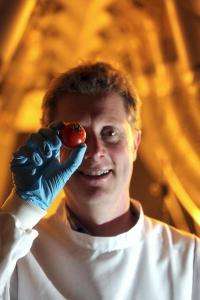
This is Dr. Ian Singleton in the ozone lab. Credit: Newcastle University

Storing fruits and vegetables in ozone-enriched environments reduces spoilage explains a scientist at the Society for General Microbiology's Spring Conference in Harrogate. Dr Ian Singleton explains how ozone treatment could be a safe, effective replacement for pesticides as it leaves no residue on foods.

It is estimated that up to 30% of fresh produce can be lost due to microbial spoilage. Dr Singleton from Newcastle University explains that low levels of gaseous ozone are able to prevent fungal spoilage in a wide range of stored fresh produce, including strawberries, tomatoes, grapes and plums. His work has shown that enriching the storage environment with ozone causes a substantial decline in fungal spore production as well as a reduction in visible lesions on fruits that are already infected. Fruit stored at low levels of ozone for up to 8 days prevented almost 95% of disease from developing, depending on the fruit and levels of .

Fungal contamination is the most common cause of spoilage of stored fruit, salads and and the risk of increases with longer storage periods. From the 1950s onwards, heat treatment was replaced with cheap and effective synthetic fungicides, often used in combination with pre-pack sanitation treatment containing chlorine or bromine.

Dr Singleton explains why alternative methods to reduce fungal spoilage are needed. "There are public concerns over pesticide residues on fresh produce. Ozone is a viable alternative to pesticides as it is safe to use and effective against a wide spectrum of micro-organisms. Importantly, it leaves no detectable residues in contrast to traditional methods of preserving fresh produce."

Interestingly, Dr Singleton's team found that exposing tomatoes to ozone before infecting them with fungus also reduced spoilage. "This suggests that exerts a 'memory' or 'vaccination' effect that protects from damage. It is unclear how this phenomenon works, but is certainly worthy of further, detailed investigation," suggested Dr Singleton.

Careful work is also needed to optimize levels of ozone and length of exposure for each variety of produce. "Different fruits have been shown to have different tolerances for ozone. We need to look carefully at how we control the atmospheric concentration of the gas in stores and transit containers, since levels of ozone that are too high can damage produce, causing financial losses"

Provided by Society for General Microbiology


Rank 5 /5 (1 vote)
Relevant PhysicsForums posts

More news stories

Scientist: Evolution debate will soon be history

(AP) -- Richard Leakey predicts skepticism over evolution will soon be history. Not that the avowed atheist has any doubts himself.

Biology / Evolution

created 10 hours ago | popularity 3.5 / 5 (11) | comments 23

Thousands of shellfish found dead in Peru

Thousands of crustaceans were found dead off the coast of Lima following the mystery mass death of dolphins and pelicans, the Peruvian Navy said Friday.

Biology / Ecology

created 20 hours ago | popularity 4.8 / 5 (4) | comments 6

More plant species responding to global warming than previously thought

(Phys.org) -- Far more wild plant species may be responding to global warming than previous large-scale estimates have suggested.

Biology / Ecology

created May 22, 2012 | popularity 4.6 / 5 (14) | comments 18 | with audio podcast

Totally rad: Scientists create rewritable digital data storage in DNA

(Phys.org) -- Scientists from Stanford's Department of Bioengineering have devised a method for repeatedly encoding, storing and erasing digital data within the DNA of living cells.

Biology / Biotechnology

created May 21, 2012 | popularity 4.9 / 5 (17) | comments 11 | with audio podcast

For monogamous sparrows, it doesn't pay to stray (but they do it anyway)

It's quite common for a female song sparrow to stray from her breeding partner and mate with the male next door, but a new study shows that sleeping around can be costly.

Biology / Plants & Animals

created May 22, 2012 | popularity 5 / 5 (1) | comments 7 | with audio podcast


Dell tablet leak: 10.1-inch display, two-battery choice

(Phys.org) -- Headline after headline talks about vendors’ tablets in the wings as likely number-one contenders for the iPad. Such claims have justifiably been taken with a grain of salt, considering ...

SpotterRF debuts Radar Backpack Kit (w/ Video)

(Phys.org) -- SpotterRF has announced a special radar backpack kit designed to enhance situational awareness for soldiers on the ground. The company says its special radar is designed for warfighters as part ...

SpaceX capsule has 'new car' smell, astronauts say (Update)

SpaceX's Dragon cargo vessel smells like a new car, said astronauts at the International Space Station after opening the hatches Saturday following the spacecraft's landmark mission to the orbiting lab.

Astronomers seize last chance in lifetime for Venus Transit

Astronomers are gearing for one the rarest events in the Solar System: an alignment of Earth, Venus and the Sun that will not be seen for another 105 years.

Australia hails surprise super-telescope decision

Australia has hailed a surprise decision giving it a role in a radio telescope project aimed at revolutionising astronomy, vowing to draw on its decades of experience in space science.

Keep food safety in mind this memorial day weekend

(HealthDay) -- Picnics, parades and cookouts are as much a part of Memorial Day weekend as tributes to the United States' war veterans.