Oyster shells are a scientific treasure trove
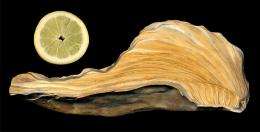
The breakdown of the seasonality pattern marked a period of dramatic climate change 16–12 million years ago. This is the finding of an analysis of fossil oyster shells from the area around Vienna. The growth in calcium carbonate, which these shells experience every year, means that they "store" information on climatic conditions in high temporal resolution. A project conducted by the Austrian Science Fund FWF has recently analysed this growth. The identified change in the annual seasonality pattern during that period is surprising, as scientists had only been aware of a major temperature decline to date.
Climate change is nothing new. Around 14 million years ago the global climate shifted once before. Understanding what happened back then can help interpret what’s going on with today’s climate. However, what exactly happened at that time? The lack of prehistoric climate records has led scientists to employ unusual methods to answer this question. Experts from Vienna’s Natural History Museum decided to take a particularly tough approach: oyster shells.
Oysters in The Service of Science
Dr. Mathias Harzhauser, who conducted the project in conjunction with colleagues from the University of Graz, Austria and the Senckenberg Institute in Germany, explains: "The shells of oysters are continually growing. Their growth is affected by environmental conditions, such as temperature and the salt content of the water. With an understanding of the way these aspects interact, conclusions can be drawn about the climate based on this growth. And if the oyster shells are fossilised, this also holds true for long-gone eras."
That is exactly what the team did using findings extracted from fossil giant oysters from the area around Vienna. In the process, they came upon with something very surprising for the period of climate change that occurred in the Miocene epoch, about 14 million years ago: not only did the average temperature fall 3 degrees Celsius, but there was also a breakdown of the seasonality pattern that was typical at the time. Dr. Harzhauser has little difficulty explaining why this fact has gone unnoticed until now: "Prior to these findings, much of the prehistoric climate data was obtained from geological drill cores. These enable the differentiation between lengthy periods, but a temporal resolution showing month-by-month changes, as the growth rate of the oyster shells offers, cannot be achieved by this method. So the two methods complement each other perfectly."
Proportionality
The scientists analysed in detail the proportion of the oxygen isotope 18O to isotope 16O and the carbon isotope 12C to isotope 13C in the calcium carbonate of the oyster shells. These values reflect the isotope proportions present in the seawater of that era, which, in turn, depend on the temperature and salt content. The method is so precise that temperature variations of less than 1 degree Celsius can be measured. The team therefore succeeded in demonstrating that the seasonal temperature variations in the period under examination declined from 9 degrees Celsius to 5–8 degrees Celsius.
For their analysis work, the team had five giant oysters of the species Crassostrea gryphoides at their disposal. These oysters tended to live in areas where fairly large rivers joined the sea and where there was a particular abundance of nutrients, creating ideal living conditions for the oysters. Some of the oysters from the Miocene epoch lived for more than 30 years, during which time their shell grew to more than 80 cm in length. Unlike the shells of other molluscs, oyster shells consist of calcite, not aragonite. The two forms of calcium carbonate differ in that calcite is less reactive and undergoes fewer chemical changes over millions of years than aragonite. It therefore provides a perfect archive for the storage of climate data.
In Vienna in particular, palaeontologists are sitting on a treasure trove – a fossil oyster reef situated near Vienna (the Korneuburg Basin) is the world’s largest, containing more than 15,000 oysters. And although the biggest fossilised pearl has already been found there – Dr. Harzhauser believes that the genuine treasure can be found there with the help of basic research: an understanding of our climate, then and now.
More information: M. Harzhauser, et al: Changing seasonality patterns in Central Europe from Miocene Climate Optimum to Miocene Climate Transition deduced from the Crassostrea isotope archive. Global and Planetary Change, doi:10.1016/j.gloplacha.2010.12.003
Provided by Austrian Science Fund


