Five things about NASA's Voyager mission
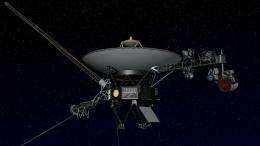
Artist concept of NASA's Voyager spacecraft. Image credit: NASA/JPL-Caltech
(PhysOrg.com) -- Here are five facts about NASA's twin Voyager 1 and 2 spacecraft, the longest continuously-operating spacecraft in deep space. The Voyagers were built by NASA's Jet Propulsion Laboratory in Pasadena, Calif., which continues to operate both spacecraft.
Long-Distance Space Runners
Voyager 2 launched on Aug. 20, 1977, and Voyager 1 launched about two weeks later, on Sept. 5. Since then, the spacecraft have been traveling along different flight paths and at different speeds. Now some 17.4 billion kilometers (10.8 billion miles) from the sun and hurtling toward interstellar space, Voyager 1 is the farthest human-made object from Earth. Voyager 2 is about 14.2 billion kilometers (8.8 billion miles) from the sun.
Can You Hear Me Now?
Both spacecraft are still sending scientific information about their surroundings through NASA's Deep Space Network. A signal from the ground, traveling at the speed of light, takes about 13 hours one way to reach Voyager 2, and 16 hours one way to reach Voyager 1.
Planetary Tour
The primary five-year mission of the Voyagers included the close-up exploration of Jupiter and Saturn, Saturn's rings and the larger moons of the two planets. The mission was extended after a succession of discoveries, and between them, the two spacecraft have explored all the giant outer planets of our solar system -- Jupiter, Saturn, Uranus and Neptune, 49 moons, and the systems of rings and magnetic fields those planets possess.
The current mission, the Voyager Interstellar Mission, was planned to explore the outermost edge of our solar system and eventually leave our sun's sphere of influence and enter interstellar space the space between the stars.
The Golden Record
Both Voyager spacecraft carry recorded messages from Earth on golden phonograph records 12-inch, gold-plated copper disks. A committee chaired by the late astronomer Carl Sagan selected the contents of the records for NASA. The records are cultural time capsules that the Voyagers carry with them to other star systems. They contain images and natural sounds, spoken greetings in 55 languages and musical selections from different cultures and eras.
Where No Spacecraft Has Gone Before
Voyager 1 has reached a distant point at the edge of our solar system, where the outward motion of solar wind ceases. The event is the latest milestone in Voyager 1's passage through the heliosheath, the outer shell of the sun's sphere of influence, before entering interstellar space. Interstellar space begins at the heliopause, and scientists estimate Voyager 1 will cross this frontier around 2015.
More information: For more information about the Voyager mission, visit: http://www.nasa.gov/voyager
Provided by
JPL/NASA
-
From lemons to lemonade: Reaction uses carbon dioxide to make carbon-based semiconductor,
32 comments
-
Thioridazine kills cancer stem cells in human while avoiding toxic side-effects of conventional cancer treatments,
3 comments
-
SpaceX private rocket blasts off for space station (Update),
42 comments
-
Climate scientists say they have solved riddle of rising sea,
30 comments
-
Research team claims to have found evidence Lake Cheko is impact crater for Tunguska Event,
18 comments
-
revamping general concept and cosmological principle
May 25, 2012
-
Transiting Exoplanet Light Curve
May 25, 2012
-
Math behind Theoretical Physics
May 24, 2012
-
Do we know whats at the center of galaxies yet?
May 23, 2012
-
Structure of the Milky Way?
May 20, 2012
-
What would it take to terraform Pluto and Charon?
May 19, 2012
- More from Physics Forums - General Astronomy
More news stories
SpaceX capsule has 'new car' smell, astronauts say (Update)
SpaceX's Dragon cargo vessel smells like a new car, said astronauts at the International Space Station after opening the hatches Saturday following the spacecraft's landmark mission to the orbiting lab.
Space & Earth / Space Exploration
18 hours ago |
4.5 / 5 (20) |
0
Astronomers seize last chance in lifetime for Venus Transit
Astronomers are gearing for one the rarest events in the Solar System: an alignment of Earth, Venus and the Sun that will not be seen for another 105 years.
18 hours ago |
5 / 5 (3) |
2
Australia hails surprise super-telescope decision
Australia has hailed a surprise decision giving it a role in a radio telescope project aimed at revolutionising astronomy, vowing to draw on its decades of experience in space science.
18 hours ago |
5 / 5 (4) |
1
Astronauts enter world's 1st private supply ship
(AP) -- Space station astronauts floated into the Dragon on Saturday, a day after its heralded arrival as the world's first commercial supply ship.
Space & Earth / Space Exploration
18 hours ago |
5 / 5 (5) |
0
Sophisticated simulations predict future warming
The chances of our planet being hit by a global warming of 3 degrees Celsius by 2050 is as likely as it being hit by an increase of 1.4 degrees, new research shows. Presented in the journal Nature Geoscience, the British study ...
Space & Earth / Earth Sciences
May 22, 2012 |
4.4 / 5 (9) |
51
Scientist: Evolution debate will soon be history
(AP) -- Richard Leakey predicts skepticism over evolution will soon be history. Not that the avowed atheist has any doubts himself.
Dell tablet leak: 10.1-inch display, two-battery choice
(Phys.org) -- Headline after headline talks about vendors tablets in the wings as likely number-one contenders for the iPad. Such claims have justifiably been taken with a grain of salt, considering ...
SpotterRF debuts Radar Backpack Kit (w/ Video)
(Phys.org) -- SpotterRF has announced a special radar backpack kit designed to enhance situational awareness for soldiers on the ground. The company says its special radar is designed for warfighters as part ...
Thousands of shellfish found dead in Peru
Thousands of crustaceans were found dead off the coast of Lima following the mystery mass death of dolphins and pelicans, the Peruvian Navy said Friday.
Keep food safety in mind this memorial day weekend
(HealthDay) -- Picnics, parades and cookouts are as much a part of Memorial Day weekend as tributes to the United States' war veterans.
Family history of Alzheimer's affects functional connectivity
(HealthDay) -- Cognitively normal individuals with a family history of late-onset Alzheimer's disease (AD) may display lower resting state functional connectivity in the default mode network (DMN) of the brain, ...
Apr 27, 2011
Rank: 5 / 5 (3)
Apr 27, 2011
Rank: 5 / 5 (4)
Apr 28, 2011
Rank: not rated yet
Apr 28, 2011
Rank: 5 / 5 (1)
To me, it would be much more interesting to let them go and then be put into a museum run by some alien civilization. ;)
I think they already know where it is from the fact that Voyager 2 already crossed it.