MIT class studies Kenyan slum's clinic quandary
(AP) -- The clinic's paperwork carried a common medical symbol - a snake coiling around a wooden rod. But that simple insignia sparked a rumor in Nairobi's largest slum: The U.S.-funded clinic was a center for snake worshipping.
For the poor residents of Kibera, who have little exposure to the medical community, that conclusion was logical. Africans sometimes turn to traditional healers or witch doctors.
But the false rumor was just a part of a puzzle for the clinic: If the clinic is high quality, close by and nearly free, why weren't more slum residents using it?
Students from one of America's most exclusive universities were called in to find out, as part of their class aimed at increasing efficiencies of health facilities in Third World countries. They soon found themselves in a crowded and fetid slum, one of the poorest in the world.
The clinic is run by Carolina for Kibera, an aid group co-founded by a University of North Carolina graduate and two Kenyans. The group turned to Massachusetts Institute of Technology professor Anjali Sastry, who sends graduate students across Africa and India for her Global Health Delivery Project class.
The aim is for students to identify and study systemic problems at clinics or hospitals and offer lasting solutions.
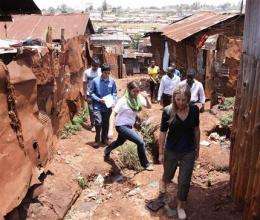
The four students who traveled to Nairobi last month squeezed through Kibera's muddy back alleys, past one-room tin shacks and jumped over slimy streams of sewage in search of ways to increase the clinic's client base.
The answer could be found only by entering Nairobi's most cast-down homes and listening to a poor but proud population. Many residents, the students heard, didn't even know about the CFK clinic. Others cited social stigmas, like the idea that if something is free it's low quality. For many, the clinic was simply a mystery.
"Someone said, 'They draw blood and we don't know what they do with it,'" said Nirav Patel, 29, one of the four researchers. He was so committed to finding out why the clinic wasn't attracting more patients that he intended to do interviews at night, when more men were at home. But the level of crime made walking around at night too risky.
Kibera is a maze of rusty shacks crammed between open sewers. Bags of human waste - dubbed "flying toilets" - are thrown from houses after dark because criminal attacks make public toilets too risky. Fly-covered fish heads discarded from upmarket establishments are a delicacy in a neighborhood where most people live on $1 a day.
The four MIT researchers visited 75 homes, learning how much people made (not much), what they valued in doctor visits (quality and respect) and why they didn't go to the clinic (many didn't know they could). The project energized the students, who hoped they could offer fixes that would truly help.
"We're walking away thinking, this is a lot more than just a project for a class. I think we were all touched and want to deliver a product that can really have an impact," said Sydney Atkins, 28.
Sastry has sent 36 MIT teams to projects across Africa and India since 2008. Her students prepare for months before spending two weeks on site, whether in a big-city doctor's office or a rural clinic with no running water.
Sastry, 46, is the daughter of a Pennsylvania Dutch mother and a father from south India who met in Afghanistan in the 1960s. She believes her students can't just study in a lab or by computer, but must go out and engage the world.
"My fondest hope is that we deliver an improvement to that organization that is sustained," she said. "Whether it's to increase scale and efficiency or improve quality."
The Global Health Delivery Project is so popular that students must sit for an interview and write an essay before enrolling. Sastry works year-round to find projects to partner with.
Rye Barcott, a North Carolina graduate and co-founder of Carolina for Kibera, had asked the MIT team to determine why the clinic sees large fluctuations in demand. Some days only 150 people visit CFK's clinic, which can handle 300.
The clinic has six doctors who serve a population of 27,000 located within an estimated one-mile (1.5-kilometer) radius of the clinic, though it welcomes others from beyond. Poverty, dirty water and poor sanitation cause many of the health problems it treats. HIV and tuberculosis are also common.
The U.S.-based Centers for Disease Control and Prevention runs a study out of the clinic, providing free care to those who live nearby. For others, a doctor's visit and medication typically cost $2.50 - a steep price in Kibera. If someone doesn't have the money, the clinic will quietly provide free treatment.
The MIT students, Barcott said, came with the right approach. They partnered with clinic volunteers and energized the clinic team about marketing their services. He noted that the snake-worshipping rumor over the medical insignia called the Rod of Asclepius hadn't been a problem in years, though the MIT team heard about the issue in its research.
"The finding is that we need to think through how we do outreach to other villages," said Barcott, whose group also runs a sports program and offers scholarship. A former Marine who served in Iraq, he recently published a book, "It Happened on the Way to War: A Marine's Path to Peace," chronicling his work in the military and Kibera.
"In my mind what they've done has been successful and now it's in the hands of our local team, all Kenyan, to take that finding and actually structure outreach into the other villages," Barcott said.
Sastry is assessing the impact of her projects. She knows that some small businesses have grown in size and revenue due to her teams' recommendations, or made upgrades like installing running water. Beyond that, she wants her teams to inspire changes that will cause projects like the Kibera clinic to flourish for years to come.
"I tell my students: I hope you do something small that is well grounded in what that community needs, that is well thought out, and you've given them a roadmap for what is next," she said.
©2011 The Associated Press. All rights reserved. This material may not be published, broadcast, rewritten or redistributed.


