Novel microorganism 'Nitrososphaera viennensis' isolated
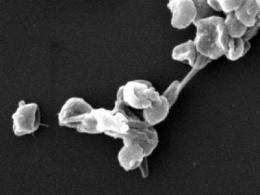
Microorganisms play an important role in global nutrient cycles. A research team led by Christa Schleper, head of the Department of Genetics in Ecology at the University of Vienna, has isolated the first ammonium oxidizing Archaeon from a soil in Vienna and thus proved its activity. The researchers present their results on "Nitrososphaera viennensis" in the newest edition of the Proceedings of the National Academy of Sciences.
Life on Earth would be impossible, without the metabolic capacities of the smallest of all living forms, the Bacteria and the Archaea. These microorganisms play a central role in global nutrient cycles, because they degrade organic matter to the smallest compounds, thus bringing them back to the atmosphere or recycling them for the synthesis of novel cells. "However, the great diversity and high numbers of Bacteria and Archaea in soils have only been detected relatively recently, with the help of molecular biological methods", says Christa Schleper, head of the department of Genetics in Ecology of the University of Vienna.
Already six years ago co-workers who are now working at the department have predicted the high abundance of archaea in soil with the help of such molecular techniques. Since then it was hypothesized that these archaea contribute significantly to the nitrogen cycle, based on their capability to oxidize ammonia to nitrite.
Co-workers of Christa Schleper, have now succeeded to obtain the first ammonia oxidizing archaeon from soil in pure culture and to directly demonstrate its physiological activity. It stems from the garden of the University Center at Althanstrasse in Vienna's 9th district and carries the name "Nitrososphaera viennensis" (the spherical ammonia oxidizer from soil). A single cells has a diameter of only 0.8 micrometers.
Most of the Archaea live in extreme environments, such as e.g. volcanic hot springs and are therefore often regarded as evolutionary relicts. "Nitrososphaera viennensis could also have evolutionary old traits, because different from its bacterial counterparts who like well-fertilized agricultural soils, it grows preferably under low nutrient conditions that are more reminiscient of pristine soils", says Schleper.
Different from bacterial ammonia oxidiziers "Nitrososphaera viennensis" needs low amounts of organic material for growth beside ammonia and carbon dioxide, as demonstrated with the help of a NanoSIMS. This highly modern secondary ion mass spectrometer which works at nano-scale resolution has only recently been installed through the Department of Microbial Ecology and with support of different faculties of the University. It is used by researchers of the faculty of Life Sciences, the faculties of Geology, Geography und Astronomy, and the faculty of Chemistry as well as the Max F. Perutz Laboratories.
"Nitrososphaera viennensis" is the first cultivated representative of archaeal ammonia oxidizers, and therefore a modell organisms of this ecologically relevant group of microorganisms. The study of this species will be of relevance in agriculture, because ammonia oxidation has a great influence on the availability of nitrogen for plants and on the accumulation of nitrate in groundwaters" says Schleper. She sees a wide field of upcoming research, e.g. to test Nitrososphaera viennensis for its capability to produce N2O (nitrous oxide). This gas which is produced in considerable amounts by the bacterial counterparts, contributes to the depletion of ozon and thus plays a role in global warming. "Since relatives of Nitrosophaera viennensis are broadly distributed and account for up to 10 million cells per gram of soil it will be of relevance to measure their contribution to such pocesses."
Provided by University of Vienna


