Meteors from Halley's comet
April 28, 2011 By Dauna Coulter

Meteors from Halley's comet

Enlarge

Looking for an adventure? Get up in the wee hours of the morning May 6th and head out into the country, far from the city lights. You won't be alone. The birds will be up and singing about the coming dawn, and, of course, about the eta Aquarid meteor shower. 

The eta Aquarids are best viewed from the southern hemisphere, but there's something special about them no matter where you live: "Each eta Aquarid meteoroid is a piece of Halley's Comet doing a kamikaze death dive into the atmosphere," explains NASA astronomer Bill Cooke. "Many people have never seen this famous comet, but on the morning of May 6th they can watch bits of it leave fiery trails across the sky."

This video is not supported by your browser at this time.

A messenger from the dawn of the universe, Halley's Comet orbits the sun once every 76 years. Each time it swings by the sun, intense solar heat vaporizes about 6 meters of ice and rock from the nucleus. The debris particles, about the size of sand grains, spread along the comet's orbit, filling it with tiny meteoroids.

"Although Halley's is deep in the outer solar system at the moment and won't return to Earth until 2061, it treats us to a twice a year as our planet passes by the debris cloud," says Cooke. "In May we have the eta Aquarids, and in October the Orionids."

And there is something especially significant about the 2011 eta Aquarids.

"This is your one chance this year to see meteors blaze across the sky without glaring moonlight dimming them."

A thin crescent moon will vacate the sky in the early evening, leaving a dark canvas for the display. Early risers are in luck, as the best viewing is an hour or two before dawn. Lie down where you can see as wide an expanse of sky as possible to catch more meteors with your peripheral vision. Look up into the darkness and relax.

This video is not supported by your browser at this time.

A NASA fireball camera at the Marshall Space Flight Center caught this eta Aquarid meteor in flight in May 2009.

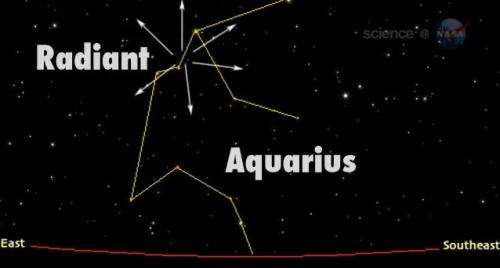
The radiant for the eta Aquarids is in the constellation Aquarius: see diagram above.  But you don't need to look toward the radiant to see the meteors.

"Meteors can appear in any part of the sky," says Cooke. "In fact their trails will tend to point back toward the radiant, so if you look that way the meteor may appear somewhat stubby. They'll appear much longer going by you than coming at you."

You won't need binoculars or a telescope to observe eta Aquarid meteors. The naked eye's field of view is usually best for seeing meteors, which frequently streak more than 45 degrees across the sky.

"Eta Aquarids are fast, moving at 66 km/s (148,000 mph!), and often trace long paths across the sky, sometimes leaving glowing, persistent trains. In the northern hemisphere, depending on your latitude [the closer to the equator the better], you should see from 10 to 40 meteors just before dawn."

Remember to pack a reclining chair or an old blanket to lie on, and a thermos of hot coffee would be nice. After all, you'll be up mighty early! The spring night air may be damp and chill, so bring along another blanket--or better yet, a big furry dog, both for warmth and company. Golden Retrievers work nicely.

It's sure to be a memorable experience. A night breeze caressing your cheek, the aroma of hot coffee in the predawn air, a gently rising chorus of birdsong accompanying your own personal light show -- and your greatest admirer by your side. It just doesn't get any better.

Provided by JPL/NASA search and more info website

3.7 /5 (3 votes)  

Filter


Move the slider to adjust rank threshold, so that you can hide some of the comments.


Display comments: newest first

LKD
Apr 28, 2011

Rank: not rated yet
"or better yet, a big furry dog, both for warmth and company. Golden Retrievers work nicely."

Dauna Coulter, you deserve a lot of praise for adding a faithful dog to your morning experience. Great article. I hope they ask you to write more on these topics.
Rank 3.7 /5 (3 votes)
Relevant PhysicsForums posts
  • revamping general concept and cosmological principle
    createdMay 25, 2012
  • Transiting Exoplanet Light Curve
    createdMay 25, 2012
  • Math behind Theoretical Physics
    createdMay 24, 2012
  • Do we know whats at the center of galaxies yet?
    createdMay 23, 2012
  • Structure of the Milky Way?
    createdMay 20, 2012
  • What would it take to terraform Pluto and Charon?
    createdMay 19, 2012
  • More from Physics Forums - General Astronomy

More news stories

SpaceX capsule has 'new car' smell, astronauts say (Update)

SpaceX's Dragon cargo vessel smells like a new car, said astronauts at the International Space Station after opening the hatches Saturday following the spacecraft's landmark mission to the orbiting lab.

Space & Earth / Space Exploration

created 18 hours ago | popularity 4.5 / 5 (20) | comments 0

Astronomers seize last chance in lifetime for Venus Transit

Astronomers are gearing for one the rarest events in the Solar System: an alignment of Earth, Venus and the Sun that will not be seen for another 105 years.

Space & Earth / Astronomy

created 18 hours ago | popularity 5 / 5 (3) | comments 2

Australia hails surprise super-telescope decision

Australia has hailed a surprise decision giving it a role in a radio telescope project aimed at revolutionising astronomy, vowing to draw on its decades of experience in space science.

Space & Earth / Astronomy

created 18 hours ago | popularity 5 / 5 (4) | comments 1

Astronauts enter world's 1st private supply ship

(AP) -- Space station astronauts floated into the Dragon on Saturday, a day after its heralded arrival as the world's first commercial supply ship.

Space & Earth / Space Exploration

created 18 hours ago | popularity 5 / 5 (5) | comments 0

Sophisticated simulations predict future warming

The chances of our planet being hit by a global warming of 3 degrees Celsius by 2050 is as likely as it being hit by an increase of 1.4 degrees, new research shows. Presented in the journal Nature Geoscience, the British study ...

Space & Earth / Earth Sciences

created May 22, 2012 | popularity 4.4 / 5 (9) | comments 51


Scientist: Evolution debate will soon be history

(AP) -- Richard Leakey predicts skepticism over evolution will soon be history. Not that the avowed atheist has any doubts himself.

Dell tablet leak: 10.1-inch display, two-battery choice

(Phys.org) -- Headline after headline talks about vendors’ tablets in the wings as likely number-one contenders for the iPad. Such claims have justifiably been taken with a grain of salt, considering ...

SpotterRF debuts Radar Backpack Kit (w/ Video)

(Phys.org) -- SpotterRF has announced a special radar backpack kit designed to enhance situational awareness for soldiers on the ground. The company says its special radar is designed for warfighters as part ...

Thousands of shellfish found dead in Peru

Thousands of crustaceans were found dead off the coast of Lima following the mystery mass death of dolphins and pelicans, the Peruvian Navy said Friday.

Keep food safety in mind this memorial day weekend

(HealthDay) -- Picnics, parades and cookouts are as much a part of Memorial Day weekend as tributes to the United States' war veterans.

Family history of Alzheimer's affects functional connectivity

(HealthDay) -- Cognitively normal individuals with a family history of late-onset Alzheimer's disease (AD) may display lower resting state functional connectivity in the default mode network (DMN) of the brain, ...