If plants generate magnetic fields, they're not sayin'
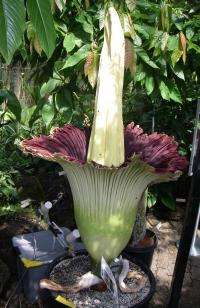
A titan arum nicknamed "Trudy" is fully opened after flowering in June 2009 in the UC Botanical Garden. Two sensors of a magnetomer are visible to the lower left. Credit: Eric Corsini, UC Berkeley
Searching for magnetic fields produced by plants may sound as wacky as trying to prove the existence of telekinesis or extrasensory perception, but physicists at the University of California, Berkeley, are seriously looking for biomagnetism in plants using some of the most sensitive magnetic detectors available.
In an article that appeared this week in the Journal of Applied Physics, ('Search for plant biomagnetism with a sensitive atomic magnetometer', J. Appl. Phys. 109, 074701), the UC Berkeley scientists describe the instruments they used to look for minuscule magnetic fields around a titan arum the world's largest flower during its brief bloom, the interference from local BART trains and traffic that bedeviled the experiment, and their ultimate failure to detect a magnetic field.
They established, however, that the plant generated no magnetic field greater than a millionth the strength of the magnetic field surrounding us here on Earth.
Why look for biomagnetism in plants?
"There is a lot of activity now by scientists studying biomagnetism in animals, but not in plants," said Dmitry Budker, UC Berkeley professor of physics. "It is an obvious gap in science right now."
In animals, for example, activity in the heart and brain produce tiny magnetic fields that can be measured by sensitive magnetometers.
"We feel like this is a first step in an interesting direction that we would like to pursue," he added.
Budker spends most of his time developing extremely sensitive magnetic field detectors in particular, atomic magnetometers based on nonlinear magnetooptical rotation (NMOR). These devices can measure magnetic fields as low as 10 femtotesla, nearly a billion times lower than Earth's magnetic field at the surface, which is usually between 20 and 50 microtesla, depending on the location.
Magnetic noise in the laboratory initially led the Budker team to the University of California Botanical Garden, which provided an isolated space for them to test their magnetometers. There, the researchers, including graduate student Eric Corsini, encountered the garden's famed titan arum (Amorphophallus titanium), a plant that every few years sends up a tall, thick stalk covered with thousands of small flowers enveloped by one large, flower-like calyx. During its brief flowering, the plant gives off a powerful odor of rotting flesh to attract the carrion beetles and flesh flies that pollinate it.
"This giant, skirt-like thing opens fairly quickly, over an hour or two, and the plant starts to heat up and get really warm, and then gives off this odor that is strongest for the first 12 hours," said Paul Licht, director of the UC Botanical Garden. "By the end of 24 hours, all the real action is over; the pollination cycle has a very brief window to succeed."
Because magnetic fields are created by moving electrical charges, such as a current of electrons, the researchers thought that rapid processes in the plant during the rapid heating might involve flowing ions that would create a magnetic field. In the titan arum, the rapid heating raises the plant temperature as high as 20 to 30 Celsius (70-85 degrees Fahrenheit).
"In principle, there shouldn't be a fundamental difference between animals and plants in this respect, but as for which plants might produce the highest magnetic fields, that is a question for biologists," Budker said.
In June 2009, one of the garden's arums was ready to erupt, so the Budker group, headed by Corsini, set up a sensitive, commercial magnetometer next to the plant in a hothouse and monitored it continually. During the day, visitors entering the hothouse generated magnetic signals, and the BART trains several miles away created .05 microtesla signals periodically.
"We were most disappointed in not being able to put a tighter tolerance on our measurement, because we couldn't find a way to cancel out the local ambient magnetic field noise," Corsini said.
He and Budker expect that they can increase their sensitivity by a factor of 10 or 100, however.
"We haven't given up," Corsini said. "The next step is to see whether we can get hold of a smaller plant and perhaps shield it from outside magnetic fields far from public viewing. So far, biomagnetism is a fun side project for me, but if we were to see something ."
"The hope is that, next time one flowers, we're going to get it," Licht said.
People who want their own titan arum can purchase offspring, some now three to four feet high, at the botanical garden. While these plants make fascinating and easy houseplants, however, the owner should be prepared to move out of the house for a night when the plant ultimately flowers, Licht said.
More information: Search for plant biomagnetism with a sensitive atomic magnetometer, J. Appl. Phys. 109, 074701 (2011); doi:10.1063/1.3560920
Provided by
University of California - Berkeley
-
From lemons to lemonade: Reaction uses carbon dioxide to make carbon-based semiconductor,
32 comments
-
Thioridazine kills cancer stem cells in human while avoiding toxic side-effects of conventional cancer treatments,
3 comments
-
SpaceX private rocket blasts off for space station (Update),
42 comments
-
Climate scientists say they have solved riddle of rising sea,
30 comments
-
Research team claims to have found evidence Lake Cheko is impact crater for Tunguska Event,
18 comments
-
Writing a book so im learning about things, i have some general questions please read
1 hour ago
-
Question about induced E field.
2 hours ago
-
Charging a capacitor in a tesla coil
2 hours ago
-
Water Rocket
6 hours ago
-
why do trucks have bigger brakes?
10 hours ago
-
Solar Sail Physics - Do they work on a large scale?
11 hours ago
- More from Physics Forums - General Physics
More news stories
Landmark calculation clears the way to answering how matter is formed
(Phys.org) -- An international collaboration of scientists, including Thomas Blum, associate professor of physics, is reporting in landmark detail the decay process of a subatomic particle called a kaon ...
May 25, 2012 |
4.4 / 5 (20) |
47
|
Is a classical electrodynamics law incompatible with special relativity?
(Phys.org) -- The laws of classical electromagnetism that were developed in the 19th century are the same laws that scientists use today. They include Maxwell’s four equations along with the Lorentz la ...
Lying in wait for WIMPs: Researchers seek to dramatically increase sensitivity of Large Underground Xenon detector
Although it's invisible, dark matter accounts for at least 80 percent of the matter in the universe. No one knows what it is, but most scientists would bet on weakly interacting massive particles, or WIMPs.
May 23, 2012 |
4 / 5 (7) |
15
|
Hall effect at the speed of light: How can you demonstrate relativistic effects with your mobile phone?
The relativistic Hall effect describing objects rotating at speeds comparable with the speed of light has been reported.
May 21, 2012 |
4.3 / 5 (3) |
8
Cloak of invisibility: Engineers use plasmonics to create an invisible photodetector
A team of engineers at Stanford and the University of Pennsylvania has for the first time used "plasmonic cloaking" to create a device that can see without being seen - an invisible machine that detects light. It is the first ...
May 21, 2012 |
4.8 / 5 (16) |
7
|
Scientist: Evolution debate will soon be history
(AP) -- Richard Leakey predicts skepticism over evolution will soon be history. Not that the avowed atheist has any doubts himself.
Dell tablet leak: 10.1-inch display, two-battery choice
(Phys.org) -- Headline after headline talks about vendors tablets in the wings as likely number-one contenders for the iPad. Such claims have justifiably been taken with a grain of salt, considering ...
SpotterRF debuts Radar Backpack Kit (w/ Video)
(Phys.org) -- SpotterRF has announced a special radar backpack kit designed to enhance situational awareness for soldiers on the ground. The company says its special radar is designed for warfighters as part ...
SpaceX capsule has 'new car' smell, astronauts say (Update)
SpaceX's Dragon cargo vessel smells like a new car, said astronauts at the International Space Station after opening the hatches Saturday following the spacecraft's landmark mission to the orbiting lab.
Thousands of shellfish found dead in Peru
Thousands of crustaceans were found dead off the coast of Lima following the mystery mass death of dolphins and pelicans, the Peruvian Navy said Friday.
Astronomers seize last chance in lifetime for Venus Transit
Astronomers are gearing for one the rarest events in the Solar System: an alignment of Earth, Venus and the Sun that will not be seen for another 105 years.
Apr 07, 2011
Rank: not rated yet
"'We were most disappointed in not being able to put a tighter tolerance on our measurement, because we couldn't find a way to cancel out the local ambient magnetic field noise,' Corsini said."
It's almost certainly there, however small.
Apr 07, 2011
Rank: not rated yet
Hell, even a wooden table or a rock produces a very small amount magnetic fields.
Apr 07, 2011
Rank: not rated yet
There are electrical potentials in photosynthesis and respiration. It may just be that the composition of plant fluids are not the same as animal fluids that may have an impact on the magnitude of the electrical field.
Apr 07, 2011
Rank: 1 / 5 (1)
Apr 07, 2011
Rank: not rated yet
So biomagnetism is a real phenomenon with real world potential applications.
Apr 08, 2011
Rank: not rated yet
so why not measure the currents? - they will be very small ionic currents - and, since there can be no nett current flow they will be in the form of small loops.
if one were to assume the xylem and phloem (??) channels were to carry the ion currents up and down there would be a very small multipolar magnetic field - it would drop fiercely with distance given the very small distance separation. One could do an order of magnitude calculation, femtoteslas or much less i would say.
Apr 08, 2011
Rank: 5 / 5 (2)