Record loss of ozone over Arctic
Arctic temperature field for 6 March 2011 when ozone depletion started. This field was derived from MIPAS measurements at 50 hPa. Credits: Karlsruher Institut für Technologie (KIT)
ESAs Envisat satellite has measured record low levels of ozone over the Euro-Atlantic sector of the northern hemisphere during March.
This record low was caused by unusually strong winds, known as the polar vortex, which isolated the atmospheric mass over the North Pole and prevented it from mixing with air in the mid-latitudes.
This led to very low temperatures and created conditions similar to those that occur every southern hemisphere winter over the Antarctic.
As March sunlight hit this cold air mass it released chlorine and bromine atoms ozone-destroying gases that originate from chlorofluorocarbons (CFCs) and break ozone down into individual oxygen molecules predominantly in the lower stratosphere, around 20 km above the surface.
This video is not supported by your browser at this time.
Average Arctic total ozone for the month of March between 1979 and 2011, based on assimilated observations of several satellite instruments: TOMS, SBUV, GOME, Sciamachy, OMI, GOME-2. Credits: KNMI
Ozone is a protective atmospheric layer found at around 25 km altitude that acts as a sunlight filter shielding life on Earth from harmful ultraviolet rays, which can harm marine life and increase the risk of skin cancer and cataracts.Stratospheric temperatures in the Arctic show strong variations from winter to winter. Last year, temperatures and ozone above the Arctic were very high. The last unusually low stratospheric temperatures over the North Pole were recorded in 1997.
Scientists are investigating why the 2011 and 1997 Arctic winters were so cold and whether these random events are statistically linked to global climate change.
"In a changing climate, it is expected that on average stratospheric temperatures cool, which means more chemical ozone depletion will occur," said Mark Weber from the University of Bremen.
"On the other hand, many studies show that the stratospheric circulation in the northern hemisphere may be enhanced in the future and, consequently, more ozone will be transported from the tropics into high latitudes and reduce ozone depletion."
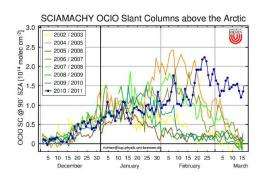
Time series of Arctic Chlorine Dioxide slant column measurements from 2002 to 2011 by Envisat's Sciamachy instrument. March 2011 values are clearly higher than in previous years. Credits: University of Bremen
Answering this question requires more research on ozone modelling and ozone trend monitoring, which is only possible because of the historic satellite data on record. ESAs Climate Change Initiative Programme has a project dedicated to this research."Measurements from the Envisats Sciamachy, MIPAS and GOMOS instruments are providing unique ozone information that is important in enabling scientists to separate chemical and dynamical changes and helping to identify the influence of climate change on the stratosphere. It is, therefore, essential to keep these instruments measuring for as long as possible," said Weber.
Banned under the Montreal Protocol, CFCs have still not vanished from the air but are on the decline. Nevertheless, strong chemical ozone depletion will continue to occur in the coming decades during unusually cold Arctic winters.
Provided by
European Space Agency
-
From lemons to lemonade: Reaction uses carbon dioxide to make carbon-based semiconductor,
32 comments
-
Thioridazine kills cancer stem cells in human while avoiding toxic side-effects of conventional cancer treatments,
3 comments
-
SpaceX private rocket blasts off for space station (Update),
42 comments
-
Climate scientists say they have solved riddle of rising sea,
30 comments
-
Research team claims to have found evidence Lake Cheko is impact crater for Tunguska Event,
18 comments
-
Hypothetical desert earth
4 hours ago
-
More human population = greater mass?
May 25, 2012
-
Conversion from aircraft bearing to normal degrees
May 23, 2012
-
Interpretation/Analysis of the Lab results(HEPA filter)
May 22, 2012
-
Has anyone here attended the The Urbino Summer School in Paleoclimatology?
May 22, 2012
-
Earthquakes: Mag 6 N. Italy and Mag 5.6 W. Bulgaria
May 21, 2012
- More from Physics Forums - Earth
More news stories
SpaceX capsule has 'new car' smell, astronauts say (Update)
SpaceX's Dragon cargo vessel smells like a new car, said astronauts at the International Space Station after opening the hatches Saturday following the spacecraft's landmark mission to the orbiting lab.
Space & Earth / Space Exploration
18 hours ago |
4.5 / 5 (20) |
0
Astronomers seize last chance in lifetime for Venus Transit
Astronomers are gearing for one the rarest events in the Solar System: an alignment of Earth, Venus and the Sun that will not be seen for another 105 years.
18 hours ago |
5 / 5 (3) |
2
Australia hails surprise super-telescope decision
Australia has hailed a surprise decision giving it a role in a radio telescope project aimed at revolutionising astronomy, vowing to draw on its decades of experience in space science.
18 hours ago |
5 / 5 (4) |
1
Astronauts enter world's 1st private supply ship
(AP) -- Space station astronauts floated into the Dragon on Saturday, a day after its heralded arrival as the world's first commercial supply ship.
Space & Earth / Space Exploration
18 hours ago |
5 / 5 (5) |
0
Sophisticated simulations predict future warming
The chances of our planet being hit by a global warming of 3 degrees Celsius by 2050 is as likely as it being hit by an increase of 1.4 degrees, new research shows. Presented in the journal Nature Geoscience, the British study ...
Space & Earth / Earth Sciences
May 22, 2012 |
4.4 / 5 (9) |
51
Scientist: Evolution debate will soon be history
(AP) -- Richard Leakey predicts skepticism over evolution will soon be history. Not that the avowed atheist has any doubts himself.
Dell tablet leak: 10.1-inch display, two-battery choice
(Phys.org) -- Headline after headline talks about vendors tablets in the wings as likely number-one contenders for the iPad. Such claims have justifiably been taken with a grain of salt, considering ...
SpotterRF debuts Radar Backpack Kit (w/ Video)
(Phys.org) -- SpotterRF has announced a special radar backpack kit designed to enhance situational awareness for soldiers on the ground. The company says its special radar is designed for warfighters as part ...
Thousands of shellfish found dead in Peru
Thousands of crustaceans were found dead off the coast of Lima following the mystery mass death of dolphins and pelicans, the Peruvian Navy said Friday.
Keep food safety in mind this memorial day weekend
(HealthDay) -- Picnics, parades and cookouts are as much a part of Memorial Day weekend as tributes to the United States' war veterans.
Family history of Alzheimer's affects functional connectivity
(HealthDay) -- Cognitively normal individuals with a family history of late-onset Alzheimer's disease (AD) may display lower resting state functional connectivity in the default mode network (DMN) of the brain, ...

Apr 05, 2011
Rank: 1 / 5 (1)
Apr 05, 2011
Rank: 5 / 5 (1)
Apr 05, 2011
Rank: 2 / 5 (4)
"Answering this question requires more research on ozone modelling and ozone trend monitoring, which is only possible because of the historic satellite data on record. ESAs Climate Change Initiative Programme has a project dedicated to this research."
"Scientists are investigating why the 2011 and 1997 Arctic winters were so cold and whether these random events are statistically linked to global climate change."
This sounds suspiciously like an attempt to salvage the budgets of agencies responsible for defective reports of climate change from serious cuts by the new Congress.
With kind regards,
Oliver K. Manuel
Apr 06, 2011
Rank: not rated yet
With kind regards,
Tony Heyward
Former BP CEO
Doush Bag for BP
Apr 09, 2011
Rank: not rated yet