Kepler helps astronomers update census of sun-like stars
April 7, 2011

NASA's Kepler helps Iowa State's Kawaler, astronomers update census of sun-like stars

Enlarge

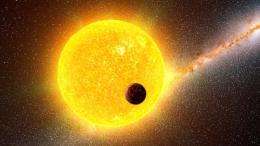
A star like our sun is shown with an orbiting planet in the foreground. NASA's Kepler Mission is studying sun-like stars by tracking changes in their brightness, or their oscillations. Credit: Illustration by Gabriel Perez Diaz, Instituto de Aastrofisica de Canarias (MultiMedia Service).

NASA's Kepler Mission has detected changes in brightness in 500 sun-like stars, giving astronomers a much better idea about the nature and evolution of the stars.

Prior to Kepler's launch in March 2009, had identified the changes in brightness, or oscillations, of about 25 similar to our sun in size, age, composition and location within the Milky Way galaxy.

The discoveries are reported in a paper, "Ensemble Asteroseismology of Solar-Type with the Kepler Mission," in the April 8 issue of the journal Science. The lead author of the paper is Bill Chaplin of the University of Birmingham in the United Kingdom.

The paper says Kepler is a big boost to asteroseismology, the study of stars by observations of their natural oscillations. Those oscillations provide clues about star basics such as mass, radius and age as well as clues about the internal structure of stars.

"This helps us understand more about the formation of stars and how they evolve," said Steve Kawaler, an Iowa State University professor of physics and astronomy, a co-author of the paper and a leader of the Kepler Asteroseismic Investigation. "These new observations allow us to measure the detailed properties of stars at an accuracy that wasn't possible before."

The Kepler spacecraft is orbiting the sun carrying a photometer, or light meter, to measure changes in . The includes a telescope 37 inches in diameter connected to a 95 megapixel . The instrument is continually pointed at the Cygnus-Lyra region of the . It is expected to continuously observe about 170,000 stars for at least three and a half years.

Kepler's primary job is to use tiny variations in the brightness of the stars within its view to find earth-like planets that might be able to support life.

The Kepler Asteroseismic Investigation is using Kepler data to study different kinds of stars. The investigation is led by a four-member steering committee: Kawaler, Chair Ron Gilliland of the Space Telescope Science Institute based in Baltimore, Jorgen Christensen-Dalsgaard and Hans Kjeldsen, both of Aarhus University in Denmark.

Kepler has provided astronomers with so much new information, the Science paper says they're "entering a golden era for stellar physics."

Data from 500 sun-like stars gives astronomers a much better understanding of the stars, their properties and their evolution. It also gives astronomers data to test their theories, models and predictions about the stars and the galaxy. And it gives astronomers enough data to make meaningful statistical studies of the stars.

"But this is just the start of things," Kawaler said. "This is a first broad-brush analysis of the data we've seen. This is a preview of this new tool and the kind of detailed census that we'll be able to do."

Among the projects to come, according to the Science paper, are studies to determine the ages of all these sun-like stars and studies of the host stars of the earth-like planets discovered by Kepler.

Provided by Iowa State University search and more info website

Filter


Move the slider to adjust rank threshold, so that you can hide some of the comments.


Display comments: newest first

omatumr
Apr 07, 2011

Rank: 1.9 / 5 (7)
Probably no study by astronomers could be more important to the tax payers who fund astronomers to study stars.

It is variability in the Sun, the variable star that heats planet Earth and sustains our lives, that most concerns us.

More than variations in brightness are needed. We need quantitative information on variations in the electric and magnetic fields, in the wavelength of light, in the energy of particles emitted, and in abundances of elements in the photosphere.

With kind regards,
Oliver K. Manuel
Former NASA Principal
Investigator for Apollo
omatumr
Apr 07, 2011

Rank: 1.4 / 5 (9)
These three papers show the impact of the Sun's variability on mankind:

1. "Superfluidity in the solar interior: Implications for solar eruptions and climate" [Journal of Fusion Energy 21 (2002) 193-198]

http://arxiv.org/...501441v1

2. "Earth's heat source - The Sun" [Energy & Environment 20 (2009) 131-144]

http://arxiv.org/pdf/0905.0704

3. Neutron Repulsion [The APEIRON Journal, in press (2011) 19 pages]

http://arxiv.org/...2.1499v1

Callmewhatuwant
Apr 08, 2011

Rank: not rated yet
Kinda very crucial in uderstanding and predicting solar behavious i guess...!!
Rank 5 /5 (9 votes)
Relevant PhysicsForums posts
  • revamping general concept and cosmological principle
    createdMay 25, 2012
  • Transiting Exoplanet Light Curve
    createdMay 25, 2012
  • Math behind Theoretical Physics
    createdMay 24, 2012
  • Do we know whats at the center of galaxies yet?
    createdMay 23, 2012
  • Structure of the Milky Way?
    createdMay 20, 2012
  • What would it take to terraform Pluto and Charon?
    createdMay 19, 2012
  • More from Physics Forums - General Astronomy

More news stories

SpaceX capsule has 'new car' smell, astronauts say (Update)

SpaceX's Dragon cargo vessel smells like a new car, said astronauts at the International Space Station after opening the hatches Saturday following the spacecraft's landmark mission to the orbiting lab.

Space & Earth / Space Exploration

created 18 hours ago | popularity 4.5 / 5 (20) | comments 0

Astronomers seize last chance in lifetime for Venus Transit

Astronomers are gearing for one the rarest events in the Solar System: an alignment of Earth, Venus and the Sun that will not be seen for another 105 years.

Space & Earth / Astronomy

created 18 hours ago | popularity 5 / 5 (3) | comments 2

Australia hails surprise super-telescope decision

Australia has hailed a surprise decision giving it a role in a radio telescope project aimed at revolutionising astronomy, vowing to draw on its decades of experience in space science.

Space & Earth / Astronomy

created 18 hours ago | popularity 5 / 5 (4) | comments 1

Astronauts enter world's 1st private supply ship

(AP) -- Space station astronauts floated into the Dragon on Saturday, a day after its heralded arrival as the world's first commercial supply ship.

Space & Earth / Space Exploration

created 18 hours ago | popularity 5 / 5 (5) | comments 0

Sophisticated simulations predict future warming

The chances of our planet being hit by a global warming of 3 degrees Celsius by 2050 is as likely as it being hit by an increase of 1.4 degrees, new research shows. Presented in the journal Nature Geoscience, the British study ...

Space & Earth / Earth Sciences

created May 22, 2012 | popularity 4.4 / 5 (9) | comments 51


Scientist: Evolution debate will soon be history

(AP) -- Richard Leakey predicts skepticism over evolution will soon be history. Not that the avowed atheist has any doubts himself.

Dell tablet leak: 10.1-inch display, two-battery choice

(Phys.org) -- Headline after headline talks about vendors’ tablets in the wings as likely number-one contenders for the iPad. Such claims have justifiably been taken with a grain of salt, considering ...

SpotterRF debuts Radar Backpack Kit (w/ Video)

(Phys.org) -- SpotterRF has announced a special radar backpack kit designed to enhance situational awareness for soldiers on the ground. The company says its special radar is designed for warfighters as part ...

Thousands of shellfish found dead in Peru

Thousands of crustaceans were found dead off the coast of Lima following the mystery mass death of dolphins and pelicans, the Peruvian Navy said Friday.

Keep food safety in mind this memorial day weekend

(HealthDay) -- Picnics, parades and cookouts are as much a part of Memorial Day weekend as tributes to the United States' war veterans.

Family history of Alzheimer's affects functional connectivity

(HealthDay) -- Cognitively normal individuals with a family history of late-onset Alzheimer's disease (AD) may display lower resting state functional connectivity in the default mode network (DMN) of the brain, ...