Dry ice lake suggests Mars once had a 'Dust Bowl' (Update)
April 21, 2011 by Guy Webster

Dry ice lake suggests Mars once had a 'Dust Bowl' (Update)

Enlarge

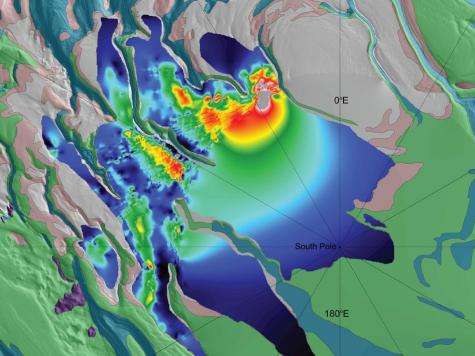
A newly found, buried deposit of frozen carbon dioxide -- dry ice -- near the south pole of Mars contains about 30 times more carbon dioxide than previously estimated to be frozen near the pole. Image credit: NASA/JPL-Caltech/Sapienza University of Rome/Southwest Research Institute

(PhysOrg.com) -- NASA's Mars Reconnaissance Orbiter has discovered the total amount of atmosphere on Mars changes dramatically as the tilt of the planet's axis varies. This process can affect the stability of liquid water, if it exists on the Martian surface, and increase the frequency and severity of Martian dust storms.

Researchers using the orbiter's ground-penetrating radar identified a large, buried deposit of frozen carbon dioxide, or , at the Red Planet's south pole. The scientists suspect that much of this carbon dioxide enters the planet's and swells the atmosphere's mass when Mars' tilt increases. The findings are published in this week's issue of the journal Science.

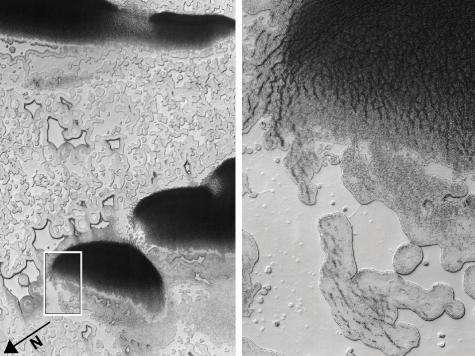
The newly found deposit has a volume similar to Lake Superior's nearly 3,000 cubic miles (about 12,000 cubic kilometers). The deposit holds up to 80 percent as much carbon dioxide as today's . Collapse pits caused by dry ice sublimation and other clues suggest the deposit is in a dissipating phase, adding gas to the atmosphere each year. Mars' atmosphere is about 95 percent carbon dioxide, in contrast to Earth's much thicker atmosphere, which is less than .04 percent carbon dioxide.

"We already knew there is a small perennial cap of carbon-dioxide ice on top of the water ice there, but this buried deposit has about 30 times more dry ice than previously estimated," said Roger Phillips of Southwest Research Institute in Boulder, Colo. Phillips is deputy team leader for the Mars Reconnaissance Orbiter's Shallow Radar instrument and lead author of the report.
Dry ice lake suggests Mars once had a 'Dust Bowl' (Update)
Enlarge

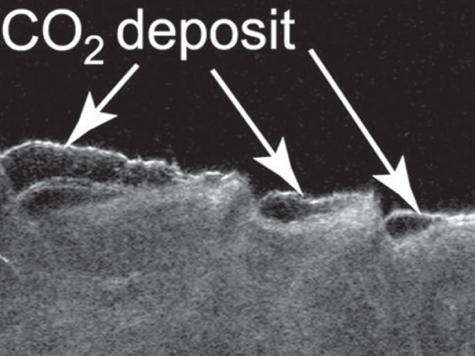
This cross-section view of underground layers near Mars' south pole is a radargram based on data from the Shallow Subsurface Radar (SHARAD) instrument on NASA's Mars Reconnaissance Orbiter. Researchers interpret the zone that is nearly free of radio-wave reflections (hence dark in the radargram) to be composed of frozen carbon dioxide, or "dry ice." The newly found deposit of dry ice contains enough carbon dioxide to dramatically increase the total amount of atmosphere on Mars when the frozen carbon dioxide vaporizes, as climate models suggest it does at times when the planet's tilt increases. Mars' current atmosphere is about 95 percent carbon dioxide, and this deposit contains up to about 80 percent as much carbon dioxide as the atmosphere does. This cross section covers a transect about 330 kilometers (205 miles) long in a region from about 86 degrees to 87 degrees south latitude and 280 degrees to 10 degrees east longitude. The vertical dimension of the graphic is time delay of the radar echoes. The depth of the tallest portion of the cross section corresponds to about 20 microseconds difference in time delay, which can be converted to roughly 1.7 kilometers (about 1 mile). SHARAD was provided by the Italian Space Agency. Its operations are led by Sapienza University of Rome, and its data are analyzed by a joint U.S.-Italian science team. NASA's Jet Propulsion Laboratory, a division of the California Institute of Technology in Pasadena, manages the Mars Reconnaissance Orbiter for the NASA Science Mission Directorate, Washington. Lockheed Martin Space Systems, Denver, built the spacecraft. Image credit: NASA/JPL-Caltech/Sapienza University of Rome/Southwest Research Institute

"We identified the deposit as dry ice by determining the radar signature fit the radio-wave transmission characteristics of frozen carbon dioxide far better than the characteristics of frozen water," said Roberto Seu of Sapienza University of Rome, team leader for the Shallow Radar and a co-author of the new report. Additional evidence came from correlating the deposit to visible sublimation features typical of dry ice.

"When you include this buried deposit, Martian carbon dioxide right now is roughly half frozen and half in the atmosphere, but at other times it can be nearly all frozen or nearly all in the atmosphere," Phillips said.

An occasional increase in the atmosphere would strengthen winds, lofting more dust and leading to more frequent and more intense . Another result is an expanded area on the planet's surface where could persist without boiling. Modeling based on known variation in the tilt of Mars' axis suggests several-fold changes in the total mass of the planet's atmosphere can happen on time frames of 100,000 years or less.

The changes in atmospheric density caused by the carbon-dioxide increase also would amplify some effects of the changes caused by the tilt. Researchers plugged the mass of the buried carbon-dioxide deposit into climate models for the period when Mars' tilt and orbital properties maximize the amount of summer sunshine hitting the south pole. They found at such times, global, year-round average air pressure is approximately 75 percent greater than the current level.
Dry ice lake suggests Mars once had a 'Dust Bowl' (Update)
Enlarge

These images from orbit show an area near Mars' south pole where coalescing or elongated pits are interpreted as signs that an underlying deposit of frozen carbon dioxide, or "dry ice," has been shrinking by sublimation. Image credit: NASA/JPL-Caltech/Univ. of Arizona

"A tilted Mars with a thicker carbon-dioxide atmosphere causes a greenhouse effect that tries to warm the , while thicker and longer-lived polar ice caps try to cool it," said co-author Robert Haberle, a planetary scientist at NASA's Ames Research Center in Moffett Field, Calif. "Our simulations show the polar caps cool more than the greenhouse warms. Unlike Earth, which has a thick, moist atmosphere that produces a strong greenhouse effect, Mars' atmosphere is too thin and dry to produce as strong a greenhouse effect as Earth's, even when you double its carbon-dioxide content."

The Shallow Radar, one of the Mars Reconnaissance Orbiter's six instruments, was provided by the Italian Space Agency, and its operations are led by the Department of Information Engineering, Electronics and Telecommunications at Sapienza University of Rome. NASA's Jet Propulsion Laboratory, a division of the California Institute of Technology in Pasadena, manages the Reconnaissance Orbiter project for NASA's Science Mission Directorate at the agency's headquarters in Washington. Lockheed Martin Space Systems in Denver built the spacecraft.

Provided by NASA

Filter


Move the slider to adjust rank threshold, so that you can hide some of the comments.


Display comments: newest first

that_guy
Apr 21, 2011

Rank: 5 / 5 (3)
So there are no martians anymore because of the great dustbowl of 600,000BC
technicalengeneering
Apr 21, 2011

Rank: 5 / 5 (1)
poor martians
Ross_Barber
Apr 21, 2011

Rank: 1 / 5 (1)
IF mars has been teraformed into darkness , why would we risk bringing that back to earth ,
look at the technical advantage america got from the moon ,
imagine what they will get form mars ,
biosecurity of the earth is paramount , especially sinec e they found an alien in siberia
jscroft
Apr 21, 2011

Rank: not rated yet
Collapse pits caused by dry ice sublimation and other clues suggest the deposit is in a dissipating phase, adding gas to the atmosphere each year.


Soooo... Mars is experiencing global warming? What, didn't they get the memo about freedom and incandescent light bulbs and stuff?
Kedas
Apr 22, 2011

Rank: not rated yet
If the past from Mars start to look closer and closer to the future of Earth then we should start to worry.

Unless they all live underground there on Mars ;)
Rank 5 /5 (6 votes)
Relevant PhysicsForums posts
  • revamping general concept and cosmological principle
    createdMay 25, 2012
  • Transiting Exoplanet Light Curve
    createdMay 25, 2012
  • Math behind Theoretical Physics
    createdMay 24, 2012
  • Do we know whats at the center of galaxies yet?
    createdMay 23, 2012
  • Structure of the Milky Way?
    createdMay 20, 2012
  • What would it take to terraform Pluto and Charon?
    createdMay 19, 2012
  • More from Physics Forums - General Astronomy

More news stories

SpaceX capsule has 'new car' smell, astronauts say (Update)

SpaceX's Dragon cargo vessel smells like a new car, said astronauts at the International Space Station after opening the hatches Saturday following the spacecraft's landmark mission to the orbiting lab.

Space & Earth / Space Exploration

created 20 hours ago | popularity 4.5 / 5 (20) | comments 0

Astronomers seize last chance in lifetime for Venus Transit

Astronomers are gearing for one the rarest events in the Solar System: an alignment of Earth, Venus and the Sun that will not be seen for another 105 years.

Space & Earth / Astronomy

created 20 hours ago | popularity 5 / 5 (3) | comments 2

Australia hails surprise super-telescope decision

Australia has hailed a surprise decision giving it a role in a radio telescope project aimed at revolutionising astronomy, vowing to draw on its decades of experience in space science.

Space & Earth / Astronomy

created 20 hours ago | popularity 5 / 5 (4) | comments 1

Astronauts enter world's 1st private supply ship

(AP) -- Space station astronauts floated into the Dragon on Saturday, a day after its heralded arrival as the world's first commercial supply ship.

Space & Earth / Space Exploration

created 20 hours ago | popularity 5 / 5 (6) | comments 0

Sophisticated simulations predict future warming

The chances of our planet being hit by a global warming of 3 degrees Celsius by 2050 is as likely as it being hit by an increase of 1.4 degrees, new research shows. Presented in the journal Nature Geoscience, the British study ...

Space & Earth / Earth Sciences

created May 22, 2012 | popularity 4.4 / 5 (9) | comments 51


Scientist: Evolution debate will soon be history

(AP) -- Richard Leakey predicts skepticism over evolution will soon be history. Not that the avowed atheist has any doubts himself.

Dell tablet leak: 10.1-inch display, two-battery choice

(Phys.org) -- Headline after headline talks about vendors’ tablets in the wings as likely number-one contenders for the iPad. Such claims have justifiably been taken with a grain of salt, considering ...

SpotterRF debuts Radar Backpack Kit (w/ Video)

(Phys.org) -- SpotterRF has announced a special radar backpack kit designed to enhance situational awareness for soldiers on the ground. The company says its special radar is designed for warfighters as part ...

Thousands of shellfish found dead in Peru

Thousands of crustaceans were found dead off the coast of Lima following the mystery mass death of dolphins and pelicans, the Peruvian Navy said Friday.

Keep food safety in mind this memorial day weekend

(HealthDay) -- Picnics, parades and cookouts are as much a part of Memorial Day weekend as tributes to the United States' war veterans.

Family history of Alzheimer's affects functional connectivity

(HealthDay) -- Cognitively normal individuals with a family history of late-onset Alzheimer's disease (AD) may display lower resting state functional connectivity in the default mode network (DMN) of the brain, ...