Study maps hotspots of genetic rearrangement
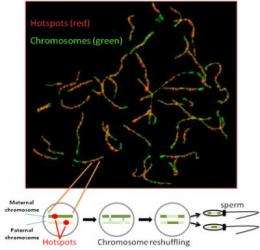
Researchers have zoomed in on mouse chromosomes to map hotspots of genetic recombination — sites where DNA breaks and reforms to shuffle genes. The findings of the scientists at the National Institutes of Health and Uniformed Services University of Health Sciences (USU) have the potential to improve the detection of genes linked to disease and to help understand the root causes of genetic abnormalities. The research, published online April 3 in Nature, moves scientists one step closer to understanding how mammals evolve and respond to their environments.
In this image, hundredfold magnification of a single sperm precursor cell shows the chromosomes – in green – and the places where these chromosomes are most likely to break apart and re-form, called genetic recombination hotspots – in red. Genetic rearrangements at these hotspots have the potential to shuffle maternal and paternal chromosomes, the end results of which ensure that the genetic information in every sperm cell is unique. Source: Fatima Smagulova, Ph.D., USU, and Kevin Brick, Ph.D., NIDDK, NIH.Genetic recombination occurs at hotspots in cells that form sperm and eggs. At these sites, rearrangements ensure that the combination of genes passed on to every sperm and egg cell is unique. By studying precursors of mouse sperm cells during the early stages of genetic recombination, the scientists have created a precise, first-of-its-kind map of recombination hotspots in a multi-celled organism.
With this map, researchers also hope to pinpoint where, how and why abnormalities in the number of chromosomes can occur. Such abnormalities — for instance, the extra copy of chromosome 21 that gives rise to Down syndrome — are the leading known cause of miscarriages, congenital birth defects, and mental retardation in the United States.
"We wanted to figure out how recombination varied across the genome," said R. Daniel Camerini-Otero, M.D., Ph.D., one of the senior authors on the paper and a researcher at the NIH's National Institute of Diabetes and Digestive and Kidney Diseases (NIDDK). "Hotspots are the starting point for the process that ensures that every person is unique. These hotspots facilitate the adaptation of populations to environmental influences through evolution. Our findings will allow us to explore things like how environment and genetic background affect the recombination landscape."
"Now that we have mapped recombination hotspots genome-wide, we can actually carry out studies on the whole mouse genome. This will be very beneficial in extending our knowledge to organisms as complex as humans," said Galina Petukhova, Ph.D., assistant professor in the USU Department of Biology and one of the paper's senior authors. "Faulty recombination can lead to infertility or birth defects, and this work brings us closer to our ultimate goal of helping to prevent these health issues."
Camerini-Otero compared the map's new level of precision to the difference between being able to zoom in to see a city block to being able to zoom in to see each building on the block. "What we were looking for was resolution that was much higher than ever seen before," said Camerini-Otero. "Now that we can actually see these individual events of genetic recombination, we can begin to understand their molecular structure."
The researchers — including lead authors Fatima Smagulova, Ph.D., of USU, and Ivan V. Gregoretti, Ph.D., of NIDDK — used cutting-edge DNA sequencing technology and lots of computational power to take a snapshot of all the individual pieces of DNA that were taking part in recombination at a given moment in living cells. They then used this snapshot of short DNA pieces to draw a map of where chromosomes have an increased potential to be broken and to come back together in new ways.
Mice were used as subjects for this study because the researchers needed a population that could be created with a specific and identical genetic background. With this initial study a success, they hope to apply the same techniques to study recombination in people in the near future.
The end result is a catalog of about 10,000 hotspots and resembles a detailed map of where diversity can arise in the genome and of sites where such processes may go awry. The researchers next plan to apply what they've seen and learned with this new map to further understand chromosomal abnormalities, genetic recombination, genome stability and evolution.
More information: "Genome-Wide Analysis Reveals Novel Molecular Features of Mouse Recombination Hotspots," published online Sunday, April 3, 2011, in Nature - www.nature.com/nature/journal/ … ull/nature09869.html
Provided by National Institutes of Health


