Heavenly gadgets: Spinoffs from space programmes
April 10, 2011 by Marlowe Hood and Laurent Banguet

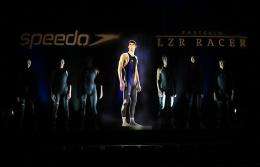
When swimwear maker Speedo set about making a faster suit, it turned to experts at NASA Langley Research Institute

Enlarge

What do ceramic teeth braces, artificial hearts, airbags, insulin pumps and Olympics-calibre swimsuits have in common? Answer: they originated in space.

What do ceramic teeth braces, artificial hearts, airbags, insulin pumps and Olympics-calibre swimsuits have in common?

Answer: they originated in space.

All these gadgets and hundreds more are spinoffs from technologies developed for the multi-billion-dollar space programmes that kicked into high gear 50 years ago when became the first human catapulted into orbit.

Many of these offshoots began with a quest by American, Soviet and European engineers for materials that could perform new tasks or withstand , cosmic rays and the stresses of high or .

So-called memory metals, for example, that flex and recover their shape in response to heat are used for shower valves to prevent scalding, surgical staples and tubing for reinforcing arteries called stents.

Sharper-than-steel scalpels, and even performance-enhancing golf clubs -- stronger than titanium as elastic as plastic -- are today derived from a related class of space-age alloys called .

Likewise the flexible wire rims of your sunglasses... which may also feature a glass coating, developed to protect astronauts' eyes from glint and glare.

Often the product seems quite remote from the technology that spawned it.

When swimwear maker Speedo set about making a faster suit, it turned to experts at NASA Langley Research Institute, who had specialised in studying friction and drag.

The resulting LZR line, launched in February 2008, quickly became de rigueur for competitive swimmers: more than nine out of 10 gold-medal winners at the Beijing Olympics six months later wore them.

Other space-boosted sportsgear includes athletic shoes with a cushioning material designed by NASA for its spacesuits.

Healthcare monitoring devices have also been derived from space-related inventions.

Technology once used to gauge the temperature of distant stars and planets now monitors the body heat of humans by measuring, in less than two seconds, energy emitted by the eardrum.

Automatic pumps that continuously deliver micro-doses of insulin -- eliminating the need for painful daily shots -- are based on NASA satellite components developed for the Viking Mars mission.

Technology created to track the health of astronauts in deep space has now been integrated into fitness machines: an infrared heartbeat transmitter strapped against the chest uses the heart rate to directly modulate exercise intensity.

And an artificial heart-pump, ten times smaller than earlier models, was inspired directly by systems that monitor fuel consumption on space shuttles.

Some applications have gone from cosmic to cosmetic.

Using material from missile-tracking devices, a company working with NASA invented translucent, shatter-resistant braces that have since been worn by hundreds of thousands of smiling adolescents.

Shock-absorbent foams developed to protect astronauts from the brain-jarring effects of g-force are widely used in protective head gear, including for cyclists.

A light-weight, fibrous material five times stronger than steel -- originally made for the Viking space vehicle parachute -- will soon be integrated in radial tires of your next car, according to NASA.

Even gourmet food fans have reason to hail space-based science.

Borrowing technology developed by ESA to study how fluids move in the bodies of weightless astronauts, Spanish producers can now measure with near-absolute precision the level of humidity in their high-priced hams.

(c) 2011 AFP

Filter


Move the slider to adjust rank threshold, so that you can hide some of the comments.


Display comments: newest first

Eikka
Apr 11, 2011

Rank: not rated yet
Answer: they originated in space.


No. Most of them originated on Earth.

For example, the shape memory alloy Nitinol that is used in many of the applications stated was developed by the United States Naval Ordnance Laboratory during the second world war.

Again, politics bending history to drum up more funding to NASA.
Eikka
Apr 11, 2011

Rank: not rated yet
The issue of the matter is that NASA is a second hand source for many of the technologies and inventions. With such broad titles as "shock absorbent foams" or "A light-weight, fibrous material", it's difficult to say what particular materials you are talking about, so it's impossible to track who actually made the invention and what for.

But since it was used in the space program, then NASA must be responsible, right?
whalio
Apr 11, 2011

Rank: not rated yet
You should try not to get your panties so twisted when you get out of bed in the morning.
El_Nose
Apr 11, 2011

Rank: 5 / 5 (1)
NASA is good NASA is great let us thank it for our ... sorry i got confused there a little ---

But seriously -- NASA does what NASA does best if you have a HUGE project - and i mean BIG, something that has not been done before and its gonna happen in outer space then NASA is the best tool for the job.

But if the task is mundane, almost rudimentary because it has been done so many times in the past that the science and the engineering are now proven technologies then it is best handled by companies that cna watch the bottom line.

I don;t know who said it but they said it best when they said ... Nasa should be the body that researches and come up with new propulsion - the newest and biggest space observatories - the driver of inovation --- but once its been done and done well then it should be handed over to private companies to continue the effort. Nasa should use government fund to subsidize new reseach and companies should be allowed to profit.
Rank 5 /5 (3 votes)
Relevant PhysicsForums posts

More news stories

SpotterRF debuts Radar Backpack Kit (w/ Video)

(Phys.org) -- SpotterRF has announced a special radar backpack kit designed to enhance situational awareness for soldiers on the ground. The company says its special radar is designed for warfighters as part ...

Technology / Hi Tech & Innovation

created 20 hours ago | popularity 5 / 5 (5) | comments 12 | with audio podcast report

Probability of contamination from severe nuclear reactor accidents is higher than expected: study

Catastrophic nuclear accidents such as the core meltdowns in Chernobyl and Fukushima are more likely to happen than previously assumed. Based on the operating hours of all civil nuclear reactors and the number ...

Technology / Energy & Green Tech

created May 22, 2012 | popularity 3.6 / 5 (21) | comments 56 | with audio podcast

Delphi gasoline-injection engine technique rivals hybrid's edge

(Phys.org) -- Running a diesel like engine on gasoline is something Delphi is doing in notable fashion. They claim they are on to a promising way to enjoy an engine that gives the vehicle owner high efficiency ...

Technology / Energy & Green Tech

created May 21, 2012 | popularity 4.7 / 5 (18) | comments 37 | with audio podcast report

HyperSolar shows dirty water no barrier to power world

(Phys.org) -- The Santa Barbara, California, company, HyperSolar, is set to transparently share the ups and downs of its research experiences toward the company’s ultimate vision, successfully producing ...

Technology / Energy & Green Tech

created May 24, 2012 | popularity 4.8 / 5 (15) | comments 17 | with audio podcast report

Tesla to launch electric sedan in US on June 22

Tesla Motors said Tuesday it would begin deliveries of "the world's first premium electric sedan" on June 22, slightly ahead of schedule.

Technology / Energy & Green Tech

created May 22, 2012 | popularity 4.5 / 5 (11) | comments 18


Scientist: Evolution debate will soon be history

(AP) -- Richard Leakey predicts skepticism over evolution will soon be history. Not that the avowed atheist has any doubts himself.

Dell tablet leak: 10.1-inch display, two-battery choice

(Phys.org) -- Headline after headline talks about vendors’ tablets in the wings as likely number-one contenders for the iPad. Such claims have justifiably been taken with a grain of salt, considering ...

SpaceX capsule has 'new car' smell, astronauts say (Update)

SpaceX's Dragon cargo vessel smells like a new car, said astronauts at the International Space Station after opening the hatches Saturday following the spacecraft's landmark mission to the orbiting lab.

Thousands of shellfish found dead in Peru

Thousands of crustaceans were found dead off the coast of Lima following the mystery mass death of dolphins and pelicans, the Peruvian Navy said Friday.

Astronomers seize last chance in lifetime for Venus Transit

Astronomers are gearing for one the rarest events in the Solar System: an alignment of Earth, Venus and the Sun that will not be seen for another 105 years.

Australia hails surprise super-telescope decision

Australia has hailed a surprise decision giving it a role in a radio telescope project aimed at revolutionising astronomy, vowing to draw on its decades of experience in space science.