And now the good news about oil rigs
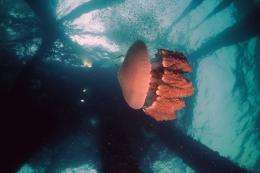
Brunei underwater platform and sea life. Picture courtesy of Shell
(PhysOrg.com) -- It might seem surprising that marine scientists are proposing a way for the oil and gas industry to save billions of dollars decommissioning old offshore rigs, but it's a plan where the main beneficiary is intended to be the environment.
In a new paper for the journal Frontiers of Ecology and the Environment, published by the Ecological Society of America, three scientists from the University of Technology, Sydney propose a large-scale expansion of the so-called "rigs-to-reefs" concept leaving decommissioned rigs where they stand or moving them elsewhere to create artificial reefs.
Professor David Booth, Dr Peter Macreadie and Ashley Fowler have formed the Decommissioning Ecology Group to promote consideration of the idea, which Professor Booth took to the national congress of the Australian Petroleum Production and Exploration Association in Perth this week.
"The oil and gas industry worldwide is looking at the decommissioning of 6500 offshore rigs by 2025," Professor Booth said. "In Australia more than 60 rigs face decommissioning soon and government policy is still not set. Policy based on science is badly needed in this area.
"A rigs-to-reef project in the Gulf of Mexico dates back to 1979, but most other regions of the US and the world still require complete removal of subsea structures. With mandatory removal targets set to increase, removal and disposal activities will cost the industry billions and would leave a major carbon footprint."
In their article Macreadie, Fowler and Booth caution that a lot more research is needed, but artificial reefs potentially have important benefits in deep-sea locations.
"Rigs themselves have been described as 'de facto marine protected areas' because they exclude trawl fishing and their large internal spaces offer shelter to fish and other organisms," the authors said.
"Deep-sea communities in particular may benefit because the characteristics of their species (longevity, slow growth, late reproduction, low fecundity) make them highly vulnerable to exploitation.
"We suggest that a rigs-to-reef program in the deep sea, in conjunction with the establishment of marine protected areas, may offer a means of conserving deep-sea communities.
"Partnerships between scientists and industry, such as the SERPENT project, will improve the capacity for further research.
"We recommend that industry savings from a rigs-to-reef program should support independent research and monitoring to evaluate the effectiveness of rigs in fulfilling their intended purpose as artificial reefs in the deep sea."
More information: http://www.esajour … .1890/100112
Provided by University of Technology, Sydney
-
From lemons to lemonade: Reaction uses carbon dioxide to make carbon-based semiconductor,
32 comments
-
Thioridazine kills cancer stem cells in human while avoiding toxic side-effects of conventional cancer treatments,
3 comments
-
SpaceX private rocket blasts off for space station (Update),
42 comments
-
Climate scientists say they have solved riddle of rising sea,
30 comments
-
Research team claims to have found evidence Lake Cheko is impact crater for Tunguska Event,
18 comments
Katrina and Rita provide glimpse of what could happen to offshore drilling if Gustav hits Gulf
-
Hypothetical desert earth
6 hours ago
-
More human population = greater mass?
May 25, 2012
-
Conversion from aircraft bearing to normal degrees
May 23, 2012
-
Interpretation/Analysis of the Lab results(HEPA filter)
May 22, 2012
-
Has anyone here attended the The Urbino Summer School in Paleoclimatology?
May 22, 2012
-
Earthquakes: Mag 6 N. Italy and Mag 5.6 W. Bulgaria
May 21, 2012
- More from Physics Forums - Earth
More news stories
SpaceX capsule has 'new car' smell, astronauts say (Update)
SpaceX's Dragon cargo vessel smells like a new car, said astronauts at the International Space Station after opening the hatches Saturday following the spacecraft's landmark mission to the orbiting lab.
Space & Earth / Space Exploration
20 hours ago |
4.5 / 5 (20) |
0
Astronomers seize last chance in lifetime for Venus Transit
Astronomers are gearing for one the rarest events in the Solar System: an alignment of Earth, Venus and the Sun that will not be seen for another 105 years.
20 hours ago |
5 / 5 (3) |
2
Australia hails surprise super-telescope decision
Australia has hailed a surprise decision giving it a role in a radio telescope project aimed at revolutionising astronomy, vowing to draw on its decades of experience in space science.
20 hours ago |
5 / 5 (4) |
1
Astronauts enter world's 1st private supply ship
(AP) -- Space station astronauts floated into the Dragon on Saturday, a day after its heralded arrival as the world's first commercial supply ship.
Space & Earth / Space Exploration
20 hours ago |
5 / 5 (6) |
0
Sophisticated simulations predict future warming
The chances of our planet being hit by a global warming of 3 degrees Celsius by 2050 is as likely as it being hit by an increase of 1.4 degrees, new research shows. Presented in the journal Nature Geoscience, the British study ...
Space & Earth / Earth Sciences
May 22, 2012 |
4.4 / 5 (9) |
51
Scientist: Evolution debate will soon be history
(AP) -- Richard Leakey predicts skepticism over evolution will soon be history. Not that the avowed atheist has any doubts himself.
Dell tablet leak: 10.1-inch display, two-battery choice
(Phys.org) -- Headline after headline talks about vendors tablets in the wings as likely number-one contenders for the iPad. Such claims have justifiably been taken with a grain of salt, considering ...
SpotterRF debuts Radar Backpack Kit (w/ Video)
(Phys.org) -- SpotterRF has announced a special radar backpack kit designed to enhance situational awareness for soldiers on the ground. The company says its special radar is designed for warfighters as part ...
Thousands of shellfish found dead in Peru
Thousands of crustaceans were found dead off the coast of Lima following the mystery mass death of dolphins and pelicans, the Peruvian Navy said Friday.
Keep food safety in mind this memorial day weekend
(HealthDay) -- Picnics, parades and cookouts are as much a part of Memorial Day weekend as tributes to the United States' war veterans.
Family history of Alzheimer's affects functional connectivity
(HealthDay) -- Cognitively normal individuals with a family history of late-onset Alzheimer's disease (AD) may display lower resting state functional connectivity in the default mode network (DMN) of the brain, ...
Apr 12, 2011
Rank: 1.5 / 5 (2)
What about the carbon footprint it would save by recycling these materials as compared to mining and refining more metals?
You geniuses ever think of that?
Apr 12, 2011
Rank: 4.5 / 5 (2)
Apr 12, 2011
Rank: 3.3 / 5 (3)
Hey moron, how about the carbon footprint of removing it from the sea, moving it across land, tear it apart, move it across land and THEN to recycle it?
Apr 12, 2011
Rank: 2.5 / 5 (2)
Realy dude are you that ignorant? I watched these guys sink a ww2 aircraft carrier for the same purpose. Why not let the navy use it for target practice, then i realized how dumb i sounded? kind of like you.
Apr 12, 2011
Rank: 4.3 / 5 (3)
This has nothing to do with the environment. Look at all the "Could" and "mights" in the quotes. Like saying, "sure, dumping large quantities of mercury in the ocean COULD have certain benefits". Notice how there is no reciprocity, they do not even mention the POTENTIONAL harmful effects, and trust me, there are plenty.
Apr 12, 2011
Rank: 4 / 5 (2)
Then again, the could POTENTIALLY NOT
Then again, they MAY NOT
Then again, it MAY NOT
Read carefully folks. There hasn't been any conclusive evidence that it is good for the environment, then again, there hasn't been any to the contrary. Fake of the matter, use common sense. Increasing the iron content of our oceans doesn't seem like an intentful thing to do, why do it? In my mind, an artificial reef is just as ugly as a garbage pile. Oil rings are full of toxic residues and byproducts. When one species benefits another is always hindered, why mess with something that has evolved to point perfection over billions of years.
I see no environmental advantage, humans have not yet been able to do better than nature.
Apr 12, 2011
Rank: 2 / 5 (1)
Apr 13, 2011
Rank: not rated yet
lol, that would be overkill. You just need a buoy for environmental sampling. Again, letting these things rust and increase the iron content of our oceans isnt a good idea. Our planet started with a high concentration of iron in our oceans and a high concentration of carbon in the atmosphere. Its like these guys are intentfully trying to de-evolve the entire planet.
Apr 13, 2011
Rank: not rated yet
Apr 14, 2011
Rank: 1 / 5 (1)
I believe iron is a mineral for plankton, plankton has decreased so they take up less carbon. More iron could mean more plankton.
Correct me if i am wrong.
Apr 18, 2011
Rank: not rated yet
Then again, it could not.
-Iron is needed for all life budy, not just plankton. What you are proposing is equivalent to the following: "All life needs food and and the zoo animals are hungry, therefore lets dump 300 tons of food in the 10x10x10 bear cage".
-Just because an element is needed for life, does not by any means mean that increasing that element will increase life.
-Plankton numbers are down because of our actions (or the apocolyps if your one of those). We need to live with our mistakes and not make matters worse, especially when we use environmental justifications for disposing of industrial waste.