Finding genetic changes behind moths' coloration
April 17, 2011 By Amina Khan
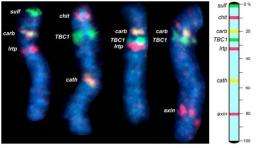
BAC-FISH mapping of genes on chromosome 17 in Biston betularia. Image credit: Science/DOI:10.1126/science.1203043
During the Industrial Revolution in 19th-century England, black moths started appearing - because they blended in better on pollution-darkened tree trunks than did normal, speckled moths. Now scientists are closing in on the genetic change responsible for that classic example of natural selection.
The peppered moth is a black-and-white-spattered moth that clings to trees in the daytime. In 1800s England, dark soot from the factories began to coat trees once covered with pale lichen. That was when the black-bodied version began showing up in the population - and some 1950s experiments showed why: In polluted areas, birds devoured the light, speckled moths in greater numbers than the black ones, because they were easier to see. (In clean areas, the opposite held true: Birds ate more of the dark moths.)
Ilik Saccheri, an evolutionary biologist at the University of Liverpool, and colleagues decided to use modern molecular tools to figure out what DNA changes caused the shift.
To do so, the researchers conducted extensive moth breeding and scoured the insects' genomes for little genetic variations that always showed up when the bodies were black. They traced the mutation to a DNA region in a particular place on one of the moth chromosomes, which implied that the gene causing the black color must lie in that region.
The scientists were also interested in knowing whether black moths had arisen many times independently during the period of pollution. To study that, they sampled black moths found in 80 different locations in the United Kingdom. In all cases, they found the same DNA fingerprint - suggesting that the mutation for black coloration came from one original moth.
The scientists still don't know precisely what gene caused the blackness, however - Saccheri said that would take further study.
"This is only the beginning, really," he said.
The team also noted that the chromosome region in which the gene lies is known, in many species of butterflies, to influence the patterns on wings. This chromosome segment may have been of great importance in driving shape and color changes during moth and butterfly evolution, said Robert Reed, a University of California, Irvine, evolutionary geneticist who was not involved in the study.
The study was published in the journal Science.
More information: Industrial Melanism in British Peppered Moths Has a Singular and Recent Mutational Origin, Science, DOI:10.1126/science.1203043
(c) 2011, Los Angeles Times.
Distributed by McClatchy-Tribune Information Services.
-
From lemons to lemonade: Reaction uses carbon dioxide to make carbon-based semiconductor,
32 comments
-
Thioridazine kills cancer stem cells in human while avoiding toxic side-effects of conventional cancer treatments,
3 comments
-
SpaceX private rocket blasts off for space station (Update),
42 comments
-
Climate scientists say they have solved riddle of rising sea,
30 comments
-
Research team claims to have found evidence Lake Cheko is impact crater for Tunguska Event,
18 comments
-
What would stain as translucent on light-coloured fabric?
10 hours ago
-
How do I identify different bacteria on culture plates?
20 hours ago
-
Why Do Dogs do Strange things...
May 25, 2012
-
What does exophillic and endophillic mean in terms of mosquito and their control?
May 24, 2012
-
Semen stains glows under black lights (uv light)?
May 23, 2012
-
Question on Human Chromosome 2
May 23, 2012
- More from Physics Forums - Biology
More news stories
Scientist: Evolution debate will soon be history
(AP) -- Richard Leakey predicts skepticism over evolution will soon be history. Not that the avowed atheist has any doubts himself.
10 hours ago |
3.3 / 5 (10) |
22
Thousands of shellfish found dead in Peru
Thousands of crustaceans were found dead off the coast of Lima following the mystery mass death of dolphins and pelicans, the Peruvian Navy said Friday.
20 hours ago |
4.8 / 5 (4) |
6
More plant species responding to global warming than previously thought
(Phys.org) -- Far more wild plant species may be responding to global warming than previous large-scale estimates have suggested.
May 22, 2012 |
4.6 / 5 (14) |
18
|
Totally rad: Scientists create rewritable digital data storage in DNA
(Phys.org) -- Scientists from Stanford's Department of Bioengineering have devised a method for repeatedly encoding, storing and erasing digital data within the DNA of living cells.
May 21, 2012 |
4.9 / 5 (17) |
11
|
For monogamous sparrows, it doesn't pay to stray (but they do it anyway)
It's quite common for a female song sparrow to stray from her breeding partner and mate with the male next door, but a new study shows that sleeping around can be costly.
May 22, 2012 |
5 / 5 (1) |
7
|
Dell tablet leak: 10.1-inch display, two-battery choice
(Phys.org) -- Headline after headline talks about vendors tablets in the wings as likely number-one contenders for the iPad. Such claims have justifiably been taken with a grain of salt, considering ...
SpotterRF debuts Radar Backpack Kit (w/ Video)
(Phys.org) -- SpotterRF has announced a special radar backpack kit designed to enhance situational awareness for soldiers on the ground. The company says its special radar is designed for warfighters as part ...
SpaceX capsule has 'new car' smell, astronauts say (Update)
SpaceX's Dragon cargo vessel smells like a new car, said astronauts at the International Space Station after opening the hatches Saturday following the spacecraft's landmark mission to the orbiting lab.
Astronomers seize last chance in lifetime for Venus Transit
Astronomers are gearing for one the rarest events in the Solar System: an alignment of Earth, Venus and the Sun that will not be seen for another 105 years.
Australia hails surprise super-telescope decision
Australia has hailed a surprise decision giving it a role in a radio telescope project aimed at revolutionising astronomy, vowing to draw on its decades of experience in space science.
Keep food safety in mind this memorial day weekend
(HealthDay) -- Picnics, parades and cookouts are as much a part of Memorial Day weekend as tributes to the United States' war veterans.
Apr 17, 2011
Rank: not rated yet
That is not surprising, but it is surprising that anyone would be surprised by it.