Researchers create functioning synapse using carbon nanotubes
Apr 21, 2011
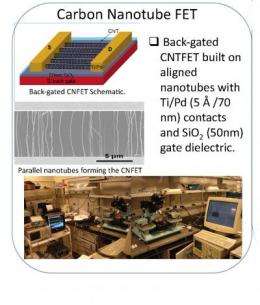
This image shows nanotubes used in synthetic synapse and apparatus used to create them. Credit: USC Viterbi School of Engineering

Engineering researchers the University of Southern California have made a significant breakthrough in the use of nanotechnologies for the construction of a synthetic brain. They have built a carbon nanotube synapse circuit whose behavior in tests reproduces the function of a neuron, the building block of the brain.

The team, which was led by Professor Alice Parker and Professor Chongwu Zhou in the USC Viterbi School of Engineering Ming Hsieh Department of Electrical Engineering, used an interdisciplinary approach combining circuit design with nanotechnology to address the complex problem of capturing .

In a paper published in the proceedings of the IEEE/NIH 2011 Life Science Systems and Applications Workshop in April 2011, the Viterbi team detailed how they were able to use carbon nanotubes to create a synapse.

Carbon nanotubes are molecular carbon structures that are extremely small, with a diameter a million times smaller than a pencil point. These nanotubes can be used in , acting as metallic conductors or semiconductors.

"This is a necessary first step in the process," said Parker, who began the looking at the possibility of developing a synthetic in 2006. "We wanted to answer the question: Can you build a circuit that would act like a neuron? The next step is even more complex. How can we build structures out of these circuits that mimic the function of the brain, which has 100 billion neurons and 10,000 synapses per neuron?"

Parker emphasized that the actual development of a synthetic brain, or even a functional brain area is decades away, and she said the next hurdle for the research centers on reproducing in the circuits.

The human brain continually produces new neurons, makes new connections and adapts throughout life, and creating this process through analog circuits will be a monumental task, according to Parker.

She believes the ongoing research of understanding the process of human intelligence could have long-term implications for everything from developing prosthetic nanotechnology that would heal traumatic brain injuries to developing intelligent, safe cars that would protect drivers in bold new ways.

For Jonathan Joshi, a USC Viterbi Ph.D. student who is a co-author of the paper, the interdisciplinary approach to the problem was key to the initial progress. Joshi said that working with Zhou and his group of nanotechnology researchers provided the ideal dynamic of circuit technology and nanotechnology.

"The interdisciplinary approach is the only approach that will lead to a solution. We need more than one type of engineer working on this solution," said Joshi. "We should constantly be in search of new technologies to solve this problem."

Explore further: Professor's coatings could help medical implants function better

Related Stories

Cat brain: A step toward the electronic equivalent

Apr 14, 2010

A cat can recognize a face faster and more efficiently than a supercomputer. That's one reason a feline brain is the model for a biologically-inspired computer project involving the University of Michigan.

Neurons hard wired to tell left from right

Mar 31, 2008

It's well known that the left and right sides of the brain differ in many animal species and this is thought to influence cognitive performance and social behaviour. For instance, in humans, the left half of the brain is ...

Recommended for you

Sweet solutions for detecting disease

37 minutes ago

Based at the Institute of Chemistry in the Slovak Academy of Sciences, Ján Tkáč's research combines glycomics – the study of sugars in organisms – with biochip sensors based on nanoparticles and nanotubes. ...

Hybrid nanostructures: Getting to the core

1 hour ago

Material scientists expect the new multifunctional properties of hybrid nanostructures will transform the development of high-performance devices, including batteries, high-sensitivity sensors and solar cells. ...

3D printing tiny batteries

18 hours ago

(Phys.org) —3D printing can now be used to print lithium-ion microbatteries the size of a grain of sand. The printed microbatteries could supply electricity to tiny devices in fields from medicine to communications, ...

World's most powerful microscope ready for research

23 hours ago

(Phys.org) —The world's most powerful microscope, which resides in a specially constructed room at the University of Victoria, has now been fully assembled and tested, and has a lineup of scientists and businesses eager ...

User comments : 7

Adjust slider to filter visible comments by rank

Display comments: newest first

Kieseyhow
not rated yet Apr 21, 2011
Cybernetics and robotics, here we come!
that_guy
not rated yet Apr 21, 2011
Settle down folks, settle down. She said that the first functioning electronic brains based on this technology are at lease a few decades away.

That gives us some time to arm ourselves before the inevitable robot uprising.
jamesrm
not rated yet Apr 22, 2011
"That gives us some time to arm ourselves before the inevitable robot uprising."

you mean "Cyber-Z0mbie Ragnark"©
Mastoras
not rated yet Apr 22, 2011
We could threaten them that if they attack, then we will switch all our laptops to Windows.
-.
ashraf_alsaqer
not rated yet Apr 23, 2011
so mutch for skynet now
abz
not rated yet Apr 25, 2011
If only we could connect our brain cells to synthetic ones we could ultimately live on indefinitely. This also would eliminate disease, cancer and a host of other limitations which plague our current organic bodies.
jamesrm
not rated yet Apr 26, 2011
"its life Jim but not as we know it"

More news stories

Hybrid nanostructures: Getting to the core

Material scientists expect the new multifunctional properties of hybrid nanostructures will transform the development of high-performance devices, including batteries, high-sensitivity sensors and solar cells. ...

Sweet solutions for detecting disease

Based at the Institute of Chemistry in the Slovak Academy of Sciences, Ján Tkáč's research combines glycomics – the study of sugars in organisms – with biochip sensors based on nanoparticles and nanotubes. ...

3D printing tiny batteries

(Phys.org) —3D printing can now be used to print lithium-ion microbatteries the size of a grain of sand. The printed microbatteries could supply electricity to tiny devices in fields from medicine to communications, ...

Future looks bright for carbon nanotube solar cells

(Phys.org) —In an approach that could challenge silicon as the predominant photovoltaic cell material, University of Wisconsin-Madison materials engineers have developed an inexpensive solar cell that exploits ...

DNA constructs antenna for solar energy

Researchers at Chalmers University of Technology have found an effective solution for collecting sunlight for artificial photosynthesis. By combining self-assembling DNA molecules with simple dye molecules, ...