Free-floating electrons on top of liquid helium yield insights into their transport behavior
April 1, 2011

Electrons set free

Enlarge

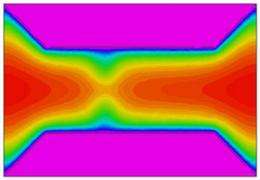
Figure 1: A graphical representation of the calculated electrostatic potential on the surface of liquid helium within a constricted passage on a silicon chip. Red colors indicate regions of lower energy. © 2011 David Rees

The multibillion dollar computer industry hinges on the ability to efficiently pass an electric current through a material. However, in any electronic device such as a computer transistor, the influence of the materials atom’s inevitably masks the interactions between the electrons. Using a custom-designed system, a research team from the RIKEN Advanced Science Institute, Wako, in collaboration with colleagues from the University of Konstanz, Germany, has completed the first study of the transport of single floating electrons free of external influences.

Trapping electrons outside of matter and keeping them in order is difficult, but liquid helium is ideally suited to the task. Electrostatic charges in the liquid can attract electrons towards its surface but, owing to a lack of energy, the electrons cannot penetrate the surface and enter the liquid. Instead, caught between these competing influences, the electrons hover above the liquid helium, forming a two-dimensional electron system. “This is a unique system for studying the fundamental properties of electrons, as the electrostatic interactions between them are effectively unscreened,” says team member David Rees.

To measure the transport properties of this liquid-like system of electrons, the researchers fabricated a channel on the surface of a silicon chip that they filled with . In one location, they physically narrowed the width of this channel and applied an electric field across the constriction, which provided further control over the effective channel width using electrostatic forces (Fig. 1).

When the channel width was sufficiently narrow, only one electron could pass through it at a time—the others were blocked by electrostatic repulsion. When the researchers slightly widened the channel by lowering the electric field across it, two electrons could pass through at the same time. Further widening would allow more electrons to pass through.

In addition to confirming the importance of electrostatic repulsions, these experiments open the door to further fundamental studies of electron behavior. If cooled to temperatures below one degree above absolute zero, the randomly floating electrons would arrange into a periodic and ordered array. This could provide the first opportunity to investigate the dynamics of a crystalline electron system, rather than a disordered liquid passing through a narrow constriction.

This model system of strongly interacting may have other roles to play. According to Rees and team leader Kimitoshi Kono, if applied to other systems where the interactions between particles are strong, these findings could be used to understand the transport of particles such as ions in biological organisms.

More information: Rees, D.G., Kuroda, I., Marrache-Kikuchi, C.A., Höfer, M., Leiderer, P. & Kono, K. Point-contact transport properties of strongly correlated electrons on liquid helium. Physical Review Letters 106, 026803 (2011). http://dx.doi.org/ … t.106.026803

Provided by RIKEN search and more info website


Rank 5 /5 (1 vote)
Relevant PhysicsForums posts
  • Writing a book so im learning about things, i have some general questions please read
    created3 hours ago
  • Question about induced E field.
    created4 hours ago
  • Charging a capacitor in a tesla coil
    created4 hours ago
  • Water Rocket
    created7 hours ago
  • why do trucks have bigger brakes?
    created12 hours ago
  • Solar Sail Physics - Do they work on a large scale?
    created13 hours ago
  • More from Physics Forums - General Physics

More news stories

Is a classical electrodynamics law incompatible with special relativity?

(Phys.org) -- The laws of classical electromagnetism that were developed in the 19th century are the same laws that scientists use today. They include Maxwell’s four equations along with the Lorentz la ...

Physics / General Physics

created May 24, 2012 | popularity 4.7 / 5 (15) | comments 39 | with audio podcast feature

Landmark calculation clears the way to answering how matter is formed

(Phys.org) -- An international collaboration of scientists, including Thomas Blum, associate professor of physics, is reporting in landmark detail the decay process of a subatomic particle called a kaon – ...

Physics / General Physics

created May 25, 2012 | popularity 4.2 / 5 (21) | comments 47 | with audio podcast

Lying in wait for WIMPs: Researchers seek to dramatically increase sensitivity of Large Underground Xenon detector

Although it's invisible, dark matter accounts for at least 80 percent of the matter in the universe. No one knows what it is, but most scientists would bet on weakly interacting massive particles, or WIMPs.

Physics / General Physics

created May 23, 2012 | popularity 4 / 5 (7) | comments 15 | with audio podcast

Hall effect at the speed of light: How can you demonstrate relativistic effects with your mobile phone?

The relativistic Hall effect describing objects rotating at speeds comparable with the speed of light has been reported.

Physics / General Physics

created May 21, 2012 | popularity 4.3 / 5 (3) | comments 8

Cloak of invisibility: Engineers use plasmonics to create an invisible photodetector

A team of engineers at Stanford and the University of Pennsylvania has for the first time used "plasmonic cloaking" to create a device that can see without being seen - an invisible machine that detects light. It is the first ...

Physics / General Physics

created May 21, 2012 | popularity 4.8 / 5 (16) | comments 7 | with audio podcast


Scientist: Evolution debate will soon be history

(AP) -- Richard Leakey predicts skepticism over evolution will soon be history. Not that the avowed atheist has any doubts himself.

Dell tablet leak: 10.1-inch display, two-battery choice

(Phys.org) -- Headline after headline talks about vendors’ tablets in the wings as likely number-one contenders for the iPad. Such claims have justifiably been taken with a grain of salt, considering ...

SpotterRF debuts Radar Backpack Kit (w/ Video)

(Phys.org) -- SpotterRF has announced a special radar backpack kit designed to enhance situational awareness for soldiers on the ground. The company says its special radar is designed for warfighters as part ...

SpaceX capsule has 'new car' smell, astronauts say (Update)

SpaceX's Dragon cargo vessel smells like a new car, said astronauts at the International Space Station after opening the hatches Saturday following the spacecraft's landmark mission to the orbiting lab.

Thousands of shellfish found dead in Peru

Thousands of crustaceans were found dead off the coast of Lima following the mystery mass death of dolphins and pelicans, the Peruvian Navy said Friday.

Astronomers seize last chance in lifetime for Venus Transit

Astronomers are gearing for one the rarest events in the Solar System: an alignment of Earth, Venus and the Sun that will not be seen for another 105 years.