Formaldehyde: Poison could have set the stage for the origins of life
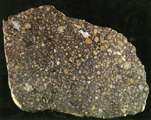
This is a cross-section of a chondritic meteorite.
(PhysOrg.com) -- Formaldehyde, a poison and a common molecule throughout the universe, is likely the source of the solar system's organic carbon solidsabundant in both comets and asteroids. Scientists have long speculated about the how organic, or carbon-containing, material became a part of the solar system's fabric. New research from Carnegie's George Cody, along with Conel Alexander and Larry Nittler, shows that these complex organic solids were likely made from formaldehyde in the primitive solar system. Their work is published online April 4 by the Proceedings of the National Academy of Sciences.
"We may owe our existence on this planet to interstellar formaldehyde," Cody said. "And what's ironic about it is that formaldehyde is poisonous to life on Earth."
During the early period of the inner solar system's formation, much of the organic carbon that wasn't trapped in primitive bodies was lost to space, along with much of the water. Prior to this study numerous competing ideas emerged to explain the existence of primitive organic solids. Cody, of the Geophysical Laboratory, along with Alexander and Nittler, of the Department of Terrestrial Magnetism, and the team decided to study primitive solar system objects using advanced methods. What they discovered clearly pointed to a polymer formed from formaldehyde.
They tested their conclusion with experiments to reproduce the type of organic matter found in carbonaceous chondrites, a type of organic-rich meteorite, starting with formaldehyde. They found that their formaldehyde-synthesized organic material was not only similar to that found in carbonaceous chondrites, but also similar to organic material found in a comet named 81P/Wild 2, pieces of which were collected in space by NASA's Stardust mission, as well as in interplanetary dust particles, or particles from space that likely originated from comets and asteroids.
Their results make sense, because formaldehyde is relatively abundant throughout the galaxy and the polymerization process would have been possible under conditions of the primitive solar system.
"Establishing the likely origin of the principal source of organic carbon in primitive solar system bodies is extremely satisfying," Cody said.
Provided by Carnegie Institution
-
From lemons to lemonade: Reaction uses carbon dioxide to make carbon-based semiconductor,
32 comments
-
Thioridazine kills cancer stem cells in human while avoiding toxic side-effects of conventional cancer treatments,
3 comments
-
SpaceX private rocket blasts off for space station (Update),
42 comments
-
Climate scientists say they have solved riddle of rising sea,
30 comments
-
Research team claims to have found evidence Lake Cheko is impact crater for Tunguska Event,
18 comments
-
Schwartz reagent-- NMR/MS/IR
18 hours ago
-
High school chemistry EEI
May 25, 2012
-
oxidation of I- by KMnO4
May 25, 2012
-
Inversion temp
May 25, 2012
-
Hybridization of SnCl3 -
May 25, 2012
-
Electrons And Radiation
May 25, 2012
- More from Physics Forums - Chemistry
More news stories
From lemons to lemonade: Reaction uses carbon dioxide to make carbon-based semiconductor
(Phys.org) -- A materials scientist at Michigan Technological University has discovered a chemical reaction that not only eats up the greenhouse gas carbon dioxide, it also creates something useful. And, by ...
May 21, 2012 |
4.7 / 5 (88) |
32
|
New CO2-removing catalyst can take the heat
(Phys.org) -- The current method of removing the greenhouse gas carbon dioxide (CO2) from the flues of coal-fired power plants uses so much energy that no one bothers to use it. So says Roger Aines, principal ...
May 24, 2012 |
5 / 5 (7) |
7
|
High-speed method to aid search for solar energy storage catalysts
Eons ago, nature solved the problem of converting solar energy to fuels by inventing the process of photosynthesis.
May 25, 2012 |
5 / 5 (3) |
4
|
Researchers demonstrate possible primitive mechanism of chemical info self-replication
(Phys.org) -- When scientists think about the replication of information in chemistry, they usually have in mind something akin to what happens in living organisms when DNA gets copied: a double-stranded molecule ...
May 25, 2012 |
5 / 5 (4) |
2
|
Castor oil: Action mechanism of one of the oldest drugs known to man elucidated
Castor oil is known primarily as an effective laxative; however, it was also used in ancient times with pregnant women to induce labour. Only now have scientists at the Max Planck Institute for Heart and Lung ...
May 21, 2012 |
3 / 5 (2) |
3
|
Scientist: Evolution debate will soon be history
(AP) -- Richard Leakey predicts skepticism over evolution will soon be history. Not that the avowed atheist has any doubts himself.
Dell tablet leak: 10.1-inch display, two-battery choice
(Phys.org) -- Headline after headline talks about vendors tablets in the wings as likely number-one contenders for the iPad. Such claims have justifiably been taken with a grain of salt, considering ...
SpotterRF debuts Radar Backpack Kit (w/ Video)
(Phys.org) -- SpotterRF has announced a special radar backpack kit designed to enhance situational awareness for soldiers on the ground. The company says its special radar is designed for warfighters as part ...
SpaceX capsule has 'new car' smell, astronauts say (Update)
SpaceX's Dragon cargo vessel smells like a new car, said astronauts at the International Space Station after opening the hatches Saturday following the spacecraft's landmark mission to the orbiting lab.
Thousands of shellfish found dead in Peru
Thousands of crustaceans were found dead off the coast of Lima following the mystery mass death of dolphins and pelicans, the Peruvian Navy said Friday.
Astronomers seize last chance in lifetime for Venus Transit
Astronomers are gearing for one the rarest events in the Solar System: an alignment of Earth, Venus and the Sun that will not be seen for another 105 years.