Firm uses genetic modification to coax spider silk from silkworms
April 14, 2011 by Bob Yirka report

silkworms

Enlarge

(PhysOrg.com) -- In what many in the textile industry have for years been calling the holy grail of materials science, genetic engineers from Kraig Biocraft Laboratories Inc. have succeeded, using Sigma Life Science technology, in creating genetically modified silkworms that are able to produce a silkworm/spider silk combination that is much stronger and more elastic than natural silk, paving the way for improved products such as sutures, other medical devices and even airbags.

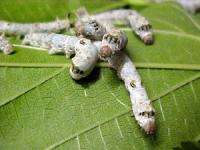
The effort, conducted with research partners from the University of Notre Dame and the University of Wyoming, strove to combine the advantages of created by , with silk created by . Spiders create webs from silk that has a very high tensile strength and is very elastic; it can be stretched to almost one and a half times its own length without a problem; but unfortunately, spiders aren’t big producers of such silk, needing only to create a simple web. Silkworms on the other hand are big producers of silk, due to their natural inclination to use it for creating a cocoon. Thus, it was deduced, if silkworms could be induced to create the same kind of silk as spiders, and at the same rate they normally produce regular silk, we humans could benefit by garnering rapidly produced strong silk.

The research was led by Malcolm J. Fraser Jr., professor of biological sciences at Notre Dame and was founded on a process he has developed called the piggyBac, which is where a piece of DNA can be made to insert itself into the genetic material of a cell. Used in conjunction with Sigma's proprietary CompoZr® Zinc Finger Nuclease (ZFN) technology, genes were transferred to silkworm cells, causing silkworms to produce a type of silk that is a combination of their natural silk, and that of the silk produced by a spider. The new silk, as yet unnamed, is far stronger and more flexible than any other silk ever produced by silkworms and the researchers believe that by removing some of the DNA material from the silkworm genes prior to the addition of spider material, they can produce something even better in the near future.

Because techniques have already been developed for producing mass quantities of regular silk using silkworms, all of the parties involved are confident that they will soon be able to produce a silk so strong it might one day replace Kevlar in bullet proof vests, or provide surgeons with sutures strong enough, and elastic enough to allow them to perform life-saving procedures in far less time. It’s possible that one day this new super-silk might make regular silk something that’s only used for creating very soft comfortable clothes.

© 2010 PhysOrg.com

4.6 /5 (5 votes)  

Filter


Move the slider to adjust rank threshold, so that you can hide some of the comments.


Display comments: newest first

jscroft
Apr 14, 2011

Rank: not rated yet
Why does this read like an advertisement, hmmm? There's a spam button for comments; maybe we need one for articles as well.
Objectivist
Apr 14, 2011

Rank: 5 / 5 (1)
Why does this read like an advertisement, hmmm? There's a spam button for comments; maybe we need one for articles as well.

Except this is quite an accomplishment worth mentioning. In case you didn't know a lot of research in the world is privately funded.
J-n
Apr 14, 2011

Rank: 5 / 5 (1)
While i think that this article does talk about a MAJOR advance in silk techonology, and shows another genetic modification success. I will say that with the lack of hard numbers (How much more elastic, strong etc is the silk, how much stronger, elastic do they think they can make it, how does it compare to kevlar that they say it could one day replace... etc etc etc) that it does seem much more like a press release created to garner financial support (investors, advance sales) than it is to inform on a scientific level.

So i guess i can safely say that i agree with both jscroft and Objectivist on this one.
Sin_Amos
Apr 14, 2011

Rank: not rated yet
This is so old.
Parsec
Apr 15, 2011

Rank: not rated yet
Do you guys have any idea what impact this can have on our society? Access to tons of spider silk will turn the textile industry on its head. Any progress at all in convincing silkworms to create more spider like silk is amazing.
Djincss
Apr 15, 2011

Rank: not rated yet
All I see is GM smallheads haters pissed off hahahaahaa
Like it or not we will see tons and tons of new GMOs, which are more environmental friendly, smart and everything, so better use to it than to trow...punks.
Wolf358
Apr 15, 2011

Rank: not rated yet
"Spilk"
Rank 4.6 /5 (5 votes)
Relevant PhysicsForums posts

More news stories

Scientist: Evolution debate will soon be history

(AP) -- Richard Leakey predicts skepticism over evolution will soon be history. Not that the avowed atheist has any doubts himself.

Biology / Evolution

created 9 hours ago | popularity 3.4 / 5 (8) | comments 21

Thousands of shellfish found dead in Peru

Thousands of crustaceans were found dead off the coast of Lima following the mystery mass death of dolphins and pelicans, the Peruvian Navy said Friday.

Biology / Ecology

created 19 hours ago | popularity 4.8 / 5 (4) | comments 6

More plant species responding to global warming than previously thought

(Phys.org) -- Far more wild plant species may be responding to global warming than previous large-scale estimates have suggested.

Biology / Ecology

created May 22, 2012 | popularity 4.6 / 5 (14) | comments 18 | with audio podcast

Totally rad: Scientists create rewritable digital data storage in DNA

(Phys.org) -- Scientists from Stanford's Department of Bioengineering have devised a method for repeatedly encoding, storing and erasing digital data within the DNA of living cells.

Biology / Biotechnology

created May 21, 2012 | popularity 4.9 / 5 (17) | comments 11 | with audio podcast

For monogamous sparrows, it doesn't pay to stray (but they do it anyway)

It's quite common for a female song sparrow to stray from her breeding partner and mate with the male next door, but a new study shows that sleeping around can be costly.

Biology / Plants & Animals

created May 22, 2012 | popularity 5 / 5 (1) | comments 7 | with audio podcast


Dell tablet leak: 10.1-inch display, two-battery choice

(Phys.org) -- Headline after headline talks about vendors’ tablets in the wings as likely number-one contenders for the iPad. Such claims have justifiably been taken with a grain of salt, considering ...

SpotterRF debuts Radar Backpack Kit (w/ Video)

(Phys.org) -- SpotterRF has announced a special radar backpack kit designed to enhance situational awareness for soldiers on the ground. The company says its special radar is designed for warfighters as part ...

SpaceX capsule has 'new car' smell, astronauts say (Update)

SpaceX's Dragon cargo vessel smells like a new car, said astronauts at the International Space Station after opening the hatches Saturday following the spacecraft's landmark mission to the orbiting lab.

Astronomers seize last chance in lifetime for Venus Transit

Astronomers are gearing for one the rarest events in the Solar System: an alignment of Earth, Venus and the Sun that will not be seen for another 105 years.

Keep food safety in mind this memorial day weekend

(HealthDay) -- Picnics, parades and cookouts are as much a part of Memorial Day weekend as tributes to the United States' war veterans.

Australia hails surprise super-telescope decision

Australia has hailed a surprise decision giving it a role in a radio telescope project aimed at revolutionising astronomy, vowing to draw on its decades of experience in space science.