DNA nanoparticles to carry drugs and gene therapy
April 22, 2011 By Bill Steele

DNA nanoparticles to carry drugs and gene therapy

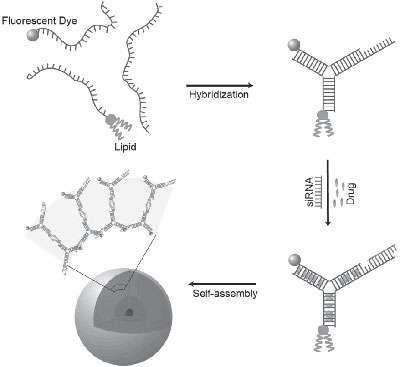
DNAsomes begin with short chains of synthetic DNA designed to be complementary over part of their length so they will join into microscopic Y-shapes. A lipid molecule is attached, and fluorescent dyes can be attached for tracking. Drugs or RNA are chemically bonded to the Y-shaped unit, then many units assembled into a sphere, about the size of a virus, that can enter cells and deliver their payload.

(PhysOrg.com) -- DNA isn't just for genetics anymore. Cornell researchers are using synthetic DNA to make nanoparticles, dubbed DNAsomes, that can deliver drugs and genetic therapy to the insides of cells.

Dan Luo, professor of biological and environmental engineering, and colleagues report their work in the Jan. 3 issue of the journal Small.

DNAsomes, Luo said, can carry multiple drugs as well as RNA molecules designed to block the expression of genes, an improvement over other drug-delivery systems such as liposomes (tiny wrappers of the phospholipid molecules that make up cell membranes) or polymer . Also, some other delivery systems can be toxic to cells, the researchers said.

In its natural habitat in the nucleus of a cell, consists of long chain molecules that are complementary, attaching to one another like a string of Lego blocks over their entire length to form the famous . The Luo research group creates short chains of designed to attach over only part of their length so they will join into shapes like crosses, Ts or Ys.

DNAsomes are assembled from Y-shaped units, each made up of three strands of DNA. A lipid molecule is attached to the tail of the Y, and drugs to be delivered are chemically bonded to the arms. When the goal is to block the expression of genes with molecules of siRNA (), the synthetic DNA can be designed with a section complementary to the RNA so that the RNA will loosely attach to it. Delivering siRNA has been a particular challenge for other drug-delivery systems, the researchers noted.

In water solution, the combination of DNA, which is attracted to water molecules, and lipids, which are repelled by water, causes the Y units to self-assemble into hollow spheres from 100 to 5,000 nanometers in diameter, consisting of multiple layers of DNA, lipid and cargo.

"The beauty of this is that the body of the thing is also a body of drugs," Luo said. About the size of a virus, the DNAsome will be engulfed by the and taken into a cell in a similar way as a virus, he explained. The DNAsome can be tagged with molecules that target a particular kind of cell, such as a cancer cell.

What happens inside the cell to release the drugs is still a "black box," Luo said, as it is with other drug-delivery systems, but tests show that the cargo is delivered. The researchers loaded DNAsomes with a fluorescent dye and introduced them into a culture of hamster ovarian cells. Microphotos showed the ovarian cells glowing under ultraviolet light. Notably, the researchers found, the cargo had been delivered both to the cytoplasm and nucleus of the cells, an important consideration for multiple drug delivery, since different drugs might have different targets in the cell. In later experiments the researchers verified the ability of DNAsomes to deliver multiple drugs as well as siRNA.

DNAsomes are named by analogy with liposomes. The suffix --some comes from a Latin word meaning "body."

The lead researcher on the study is Young Hoon Roh, who was a graduate student in the Luo group and has just received his Ph.D. David Muller, professor of applied and engineering physics, and his research group collaborated in the project.

Provided by Cornell University search and more info website

Filter


Move the slider to adjust rank threshold, so that you can hide some of the comments.


Display comments: newest first

ahmedgnz
Apr 22, 2011

Rank: not rated yet
The suffix -some does not come from Latin, but from the GREEK soma (stem somat-) meaning "body." The Latin word for body would be "corpus". Greek, not Latin, is usually the source language for a many if not most scientific terms. I don't know if this faux pas reflects on the liberal arts education of scientists in general, but it certainly does on that of this particular science writer.
lebooo
Apr 22, 2011

Rank: not rated yet
i wonder how an immune system would react to these particles
Rank 4 /5 (1 vote)
Relevant PhysicsForums posts

More news stories

Dopant gives graphene solar cells highest efficiency yet

(Phys.org) -- By taking advantage of graphene’s favorable electrical and optical properties, and then adding an organic dopant, researchers have achieved the highest power conversion efficiency yet for ...

Nanotechnology / Nanophysics

created May 21, 2012 | popularity 5 / 5 (10) | comments 14 | with audio podcast feature

Nanomedicine: Quantum dots appear safe in pioneering study on primates

A pioneering study to gauge the toxicity of quantum dots in primates has found the tiny crystals to be safe over a one-year period, a hopeful outcome for doctors and scientists seeking new ways to battle diseases ...

Nanotechnology / Bio & Medicine

created May 20, 2012 | popularity 4.3 / 5 (3) | comments 8 | with audio podcast

In nanorod crystal growth, nanoparticles seen as artificial atoms

In the growth of crystals, do nanoparticles act as "artificial atoms" forming molecular-type building blocks that can assemble into complex structures? This is the contention of a major but controversial theory ...

Nanotechnology / Nanophysics

created May 24, 2012 | popularity 4.8 / 5 (6) | comments 0 | with audio podcast

First direct observation of oriented attachment in nanocrystal growth

Berkeley Lab researchers have reported the first direct observation of nanoparticles undergoing oriented attachment, the critical step in biomineralization and the growth of nanocrystals. A better understanding ...

Nanotechnology / Nanophysics

created May 24, 2012 | popularity 4.7 / 5 (3) | comments 0 | with audio podcast

Synthetic nano-waste does not disappear

(Phys.org) -- Tiny particles of cerium oxide do not burn or change in the heat of a waste incineration plant. They remain intact on combustion residues or in the incineration system, as a new study by Swiss ...

Nanotechnology / Bio & Medicine

created May 25, 2012 | popularity 5 / 5 (2) | comments 1 | with audio podcast


Scientist: Evolution debate will soon be history

(AP) -- Richard Leakey predicts skepticism over evolution will soon be history. Not that the avowed atheist has any doubts himself.

Dell tablet leak: 10.1-inch display, two-battery choice

(Phys.org) -- Headline after headline talks about vendors’ tablets in the wings as likely number-one contenders for the iPad. Such claims have justifiably been taken with a grain of salt, considering ...

SpotterRF debuts Radar Backpack Kit (w/ Video)

(Phys.org) -- SpotterRF has announced a special radar backpack kit designed to enhance situational awareness for soldiers on the ground. The company says its special radar is designed for warfighters as part ...

SpaceX capsule has 'new car' smell, astronauts say (Update)

SpaceX's Dragon cargo vessel smells like a new car, said astronauts at the International Space Station after opening the hatches Saturday following the spacecraft's landmark mission to the orbiting lab.

Thousands of shellfish found dead in Peru

Thousands of crustaceans were found dead off the coast of Lima following the mystery mass death of dolphins and pelicans, the Peruvian Navy said Friday.

Astronomers seize last chance in lifetime for Venus Transit

Astronomers are gearing for one the rarest events in the Solar System: an alignment of Earth, Venus and the Sun that will not be seen for another 105 years.