Defective plastics repair themselves
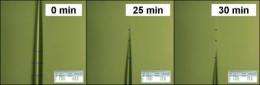
Indestructible things are a figment of the imagination of advertising. Even plastic components that have to stand up to major mechanical loads can break. The reason for this are microcracks that may be found in any component part. Researchers have now come up with elastic polymers that heal themselves to put an end to the growth of cracks.
It can be a total surprise: car tires burst, sealing rings fail and even your dearly beloved panton chair or your freely oscillating plastic chair develops cracks and the material gets fatigued. The reason for this often sudden and unforeseen material failure is triggered by microcracks that may be found in any component. You may hardly see these cracks and they may grow fast or slow. This also applies to fractures in components made of plastic that can be elastically formed. Sealing rings or tires are made of these elastomers and they can withstand mechanical loads especially well.
In the OSIRIS project of the German Federal Ministry of Education and Research BMBF, researchers at the Fraunhofer Institute for Environmental, Safety and Energy Technology UMSICHT in Oberhausen, Germany have come up with self-healing elastomers that can repair themselves autonomously, in order to put a stop to the growth of cracks already from the start while avoiding spontaneous material failure. The source of their inspiration was the caoutchouc tree hevea brasiliensis and plants that conduct latex, such as the Weeping Benjamin. This latex contains capsules that are filled with the protein hevein. If the caoutchouc tree is damaged, the latex escapes and the capsules break open to release hevein, which also links the latex particles in the latex to form a wound closure.
The scientists have applied this principle to elastomers. Dr. Anke Nellesen, who is a scientist at the Fraunhofer Institute for Environmental, Safety and Energy Technology, provides the explanation: "We loaded microcapsules with a one-component adhesive (polyisobutylene) and put it in elastomers made of synthetic caoutchouc to stimulate a self-healing process in plastics. If pressure is put on the capsules, they break open and separate this viscous material. Then this mixes with the polymer chains of the elastomers and closes the cracks. We were successful at making capsules stable to production, although they did not provide the self-healing effect we wanted." However, the researchers obtained good results by putting the self-healing component (i.e., the polyisobutylene) into the elastomer uncapsulised. Various test bodies from different synthetic caoutchoucs indicated clear self-healing properties, since the restored tension expansion was 40 percent after a healing period of 24 hours.
The experts even achieved better results by supplying elastomers with ions. Here, the caoutchouc tree also acted as the model for this method. The hevein proteins that are released when there is damage link up to each other through ions and stick in this process so that the crack closes. Therefore, if the elastomer material is damaged, the particles with opposite charges are looking for a new bonding partner – in other words, a plus ion attracts a minus ion, which makes it adhere. Anke Nellesen points out the advantage in relation to the microcapsule process: "We make sure that the wound closure is stable by charging the elastomers with ions, which means that the healing process can take place as often as needed. The scientist remarks that "there are already duromers with self-healing functions in the form of self-repairing paints in cars. We still haven't developed elastomers that can close their cracks without interference from outside."
The automobile industry could profit from this latest development, which is why you can see the prototype of self-repairing muffler suspension at the Hannover Fair in Hannover, Germany from April 4-8 at the joint Biokon stand in Hall 2.
Provided by Fraunhofer-Gesellschaft


