Dead midges reveal living conditions of fish
April 4, 2011

Dead midges reveal living conditions of fish

Enlarge

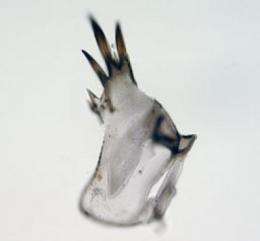
The mandibles of Chaoborus midges range in size from 0.1 to 0.4 millimeters. The mandibles found in lake-bottom sediments are species-specific and show which other Chaoborus midge species were present in the lake in different periods of time. Credit: Fredrik Palm

Microscopic remains of dead Phantom midge larvae (Chaoborus spp.) may explain a few hundred years of history of the living conditions of fish, acidification and fish death in Swedish lakes. Researchers at the University of Gothenburg, Sweden, have developed a method of using lake-bottom sediments to show when and how fish life disappeared from acidified lakes – invaluable knowledge for lake restorations in acidified regions.

"It is actually just like a journey through time. hardly leave any remains of their own when they die, but if we instead study the presence of organisms that are affected by fish, we can find clear traces. By studying mandibles (mouth parts) from Chaoborus larvae in sediments, we can recreate the history of the lake back to the early 19th century," says Fredrik Palm of the Department of Zoology at the University of Gothenburg.

of soil and water is one of the greatest environmental problems of modern times. A large proportion of Swedish lakes show clear signs of acidification, resulting in extensive fish death and severely reduced biodiversity.
Dead midges reveal living conditions of fish
Enlarge

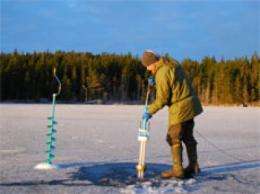
Sediment samples are collected from an ice-covered lake. Credit: Fredrik Palm

Recent research has pointed to a clear correlation between fish death and the presence of Chaoborus larvae in lakes. Mandibles from Chaoborus larvae preserved in lake-bottom sediments can therefore be used to identify fish death and other fish changes in severely acidified lakes.

History in the rear-view mirror

The new method makes it possible to study the effects of acidification in lakes where no samples have previously been collected and where there are no historical data on fish community alterations. As it is also possible to determine the age of sediment samples, this method can additionaly reveal when different changes have occurred.

"By analysing Chaoborus mandibles that we recover in the bottom sediments we can tell how different fish communities have changed. Not only can we infer whether fish has disappeared, we can also see how different fish species have been affected. Roach, for example, are more sensitive to acidification than perch, and we have been able to show whether lakes historically have contained cyprinid fish or not. Remains of acid sensitive zooplankton can simultaneously be used to show trends of progressive acidification in lakes.

Providing a basis for restoration

As the method reveals how the fish community in a lake has changed over the last few centuries, it can also be used to turn the clock back as a way of deciding how biological restoration of an acidified lake should proceed. The historical perspective of the method also makes it possible to analyse natural variations in lake ecosystems.

Palm and his colleagues have therefore carried out their studies in the counties of Västra Götaland and Bohuslän, Sweden, focusing in primarily on the Lake Gårdssjön area in Ucklum, which has been a centre of Swedish acidification research for many decades.

Provided by University of Gothenburg search and more info website


Rank 5 /5 (1 vote)
Relevant PhysicsForums posts

More news stories

SpaceX capsule has 'new car' smell, astronauts say (Update)

SpaceX's Dragon cargo vessel smells like a new car, said astronauts at the International Space Station after opening the hatches Saturday following the spacecraft's landmark mission to the orbiting lab.

Space & Earth / Space Exploration

created 19 hours ago | popularity 4.5 / 5 (20) | comments 0

Astronomers seize last chance in lifetime for Venus Transit

Astronomers are gearing for one the rarest events in the Solar System: an alignment of Earth, Venus and the Sun that will not be seen for another 105 years.

Space & Earth / Astronomy

created 19 hours ago | popularity 5 / 5 (3) | comments 2

Australia hails surprise super-telescope decision

Australia has hailed a surprise decision giving it a role in a radio telescope project aimed at revolutionising astronomy, vowing to draw on its decades of experience in space science.

Space & Earth / Astronomy

created 19 hours ago | popularity 5 / 5 (4) | comments 1

Astronauts enter world's 1st private supply ship

(AP) -- Space station astronauts floated into the Dragon on Saturday, a day after its heralded arrival as the world's first commercial supply ship.

Space & Earth / Space Exploration

created 19 hours ago | popularity 5 / 5 (5) | comments 0

Sophisticated simulations predict future warming

The chances of our planet being hit by a global warming of 3 degrees Celsius by 2050 is as likely as it being hit by an increase of 1.4 degrees, new research shows. Presented in the journal Nature Geoscience, the British study ...

Space & Earth / Earth Sciences

created May 22, 2012 | popularity 4.4 / 5 (9) | comments 51


Scientist: Evolution debate will soon be history

(AP) -- Richard Leakey predicts skepticism over evolution will soon be history. Not that the avowed atheist has any doubts himself.

Dell tablet leak: 10.1-inch display, two-battery choice

(Phys.org) -- Headline after headline talks about vendors’ tablets in the wings as likely number-one contenders for the iPad. Such claims have justifiably been taken with a grain of salt, considering ...

SpotterRF debuts Radar Backpack Kit (w/ Video)

(Phys.org) -- SpotterRF has announced a special radar backpack kit designed to enhance situational awareness for soldiers on the ground. The company says its special radar is designed for warfighters as part ...

Thousands of shellfish found dead in Peru

Thousands of crustaceans were found dead off the coast of Lima following the mystery mass death of dolphins and pelicans, the Peruvian Navy said Friday.

Keep food safety in mind this memorial day weekend

(HealthDay) -- Picnics, parades and cookouts are as much a part of Memorial Day weekend as tributes to the United States' war veterans.

Family history of Alzheimer's affects functional connectivity

(HealthDay) -- Cognitively normal individuals with a family history of late-onset Alzheimer's disease (AD) may display lower resting state functional connectivity in the default mode network (DMN) of the brain, ...