Say hello to cheaper hydrogen fuel cells: Scientists document utility of non-precious-metal catalysts
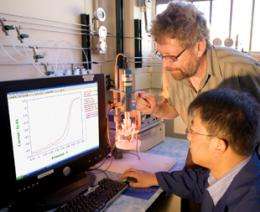
(PhysOrg.com) -- Los Alamos National Laboratory scientists have developed a way to avoid the use of expensive platinum in hydrogen fuel cells, the environmentally friendly devices that might replace current power sources in everything from personal data devices to automobiles.
In a paper published today in Science, Los Alamos researchers Gang Wu, Christina Johnston, and Piotr Zelenay, joined by researcher Karren More of Oak Ridge National Laboratory, describe the use of a platinum-free catalyst in the cathode of a hydrogen fuel cell. Eliminating platinuma precious metal more expensive than goldwould solve a significant economic challenge that has thwarted widespread use of large-scale hydrogen fuel cell systems.
Polymer-electrolyte hydrogen fuel cells convert hydrogen and oxygen into electricity. The cells can be enlarged and combined in series for high-power applications, including automobiles. Under optimal conditions, the hydrogen fuel cell produces water as a "waste" product and does not emit greenhouse gasses. However, because the use of platinum in catalysts is necessary to facilitate the reactions that produce electricity within a fuel cell, widespread use of fuel cells in common applications has been cost prohibitive. An increase in the demand for platinum-based catalysts could drive up the cost of platinum even higher than its current value of nearly $1,800 an ounce.
The Los Alamos researchers developed non-precious-metal catalysts for the part of the fuel cell that reacts with oxygen. The catalystswhich use carbon (partially derived from polyaniline in a high-temperature process), and inexpensive iron and cobalt instead of platinumyielded high power output, good efficiency, and promising longevity. The researchers found that fuel cells containing the carbon-iron-cobalt catalyst synthesized by Wu not only generated currents comparable to the output of precious-metal-catalyst fuel cells, but held up favorably when cycled on and offa condition that can damage inferior catalysts relatively quickly.
Moreover, the carbon-iron-cobalt catalyst fuel cells effectively completed the conversion of hydrogen and oxygen into water, rather than producing large amounts of undesirable hydrogen peroxide. Inefficient conversion of the fuels, which generates hydrogen peroxide, can reduce power output by up to 50 percent, and also has the potential to destroy fuel cell membranes. Fortunately, the carbon- iron-cobalt catalysts synthesized at Los Alamos create extremely small amounts of hydrogen peroxide, even when compared with state-of-the-art platinum-based oxygen-reduction catalysts.
Because of the successful performance of the new catalyst, the Los Alamos researchers have filed a patent for it.
"The encouraging point is that we have found a catalyst with a good durability and life cycle relative to platinum-based catalysts," said Zelenay, corresponding author for the paper. "For all intents and purposes, this is a zero-cost catalyst in comparison to platinum, so it directly addresses one of the main barriers to hydrogen fuel cells."
The next step in the team's research will be to better understand the mechanism underlying the carbon-iron-cobalt catalyst. Micrographic images of portions of the catalyst by researcher More have provided some insight into how it functions, but further work must be done to confirm theories by the research team. Such an understanding could lead to improvements in non-precious-metal catalysts, further increasing their efficiency and lifespan.
Provided by
Los Alamos National Laboratory
-
From lemons to lemonade: Reaction uses carbon dioxide to make carbon-based semiconductor,
32 comments
-
Thioridazine kills cancer stem cells in human while avoiding toxic side-effects of conventional cancer treatments,
3 comments
-
SpaceX private rocket blasts off for space station (Update),
42 comments
-
Climate scientists say they have solved riddle of rising sea,
30 comments
-
Research team claims to have found evidence Lake Cheko is impact crater for Tunguska Event,
18 comments
-
Schwartz reagent-- NMR/MS/IR
17 hours ago
-
Inversion temp
22 hours ago
-
High school chemistry EEI
May 25, 2012
-
oxidation of I- by KMnO4
May 25, 2012
-
Invesion temp
May 25, 2012
-
Hybridization of SnCl3 -
May 25, 2012
- More from Physics Forums - Chemistry
More news stories
From lemons to lemonade: Reaction uses carbon dioxide to make carbon-based semiconductor
(Phys.org) -- A materials scientist at Michigan Technological University has discovered a chemical reaction that not only eats up the greenhouse gas carbon dioxide, it also creates something useful. And, by ...
May 21, 2012 |
4.7 / 5 (88) |
32
|
New CO2-removing catalyst can take the heat
(Phys.org) -- The current method of removing the greenhouse gas carbon dioxide (CO2) from the flues of coal-fired power plants uses so much energy that no one bothers to use it. So says Roger Aines, principal ...
May 24, 2012 |
5 / 5 (7) |
7
|
High-speed method to aid search for solar energy storage catalysts
Eons ago, nature solved the problem of converting solar energy to fuels by inventing the process of photosynthesis.
May 25, 2012 |
5 / 5 (3) |
4
|
Researchers demonstrate possible primitive mechanism of chemical info self-replication
(Phys.org) -- When scientists think about the replication of information in chemistry, they usually have in mind something akin to what happens in living organisms when DNA gets copied: a double-stranded molecule ...
May 25, 2012 |
5 / 5 (4) |
2
|
Castor oil: Action mechanism of one of the oldest drugs known to man elucidated
Castor oil is known primarily as an effective laxative; however, it was also used in ancient times with pregnant women to induce labour. Only now have scientists at the Max Planck Institute for Heart and Lung ...
May 21, 2012 |
3 / 5 (2) |
3
|
Scientist: Evolution debate will soon be history
(AP) -- Richard Leakey predicts skepticism over evolution will soon be history. Not that the avowed atheist has any doubts himself.
Dell tablet leak: 10.1-inch display, two-battery choice
(Phys.org) -- Headline after headline talks about vendors tablets in the wings as likely number-one contenders for the iPad. Such claims have justifiably been taken with a grain of salt, considering ...
SpotterRF debuts Radar Backpack Kit (w/ Video)
(Phys.org) -- SpotterRF has announced a special radar backpack kit designed to enhance situational awareness for soldiers on the ground. The company says its special radar is designed for warfighters as part ...
SpaceX capsule has 'new car' smell, astronauts say (Update)
SpaceX's Dragon cargo vessel smells like a new car, said astronauts at the International Space Station after opening the hatches Saturday following the spacecraft's landmark mission to the orbiting lab.
Thousands of shellfish found dead in Peru
Thousands of crustaceans were found dead off the coast of Lima following the mystery mass death of dolphins and pelicans, the Peruvian Navy said Friday.
Astronomers seize last chance in lifetime for Venus Transit
Astronomers are gearing for one the rarest events in the Solar System: an alignment of Earth, Venus and the Sun that will not be seen for another 105 years.
Apr 21, 2011
Rank: 1 / 5 (2)
Apr 21, 2011
Rank: 5 / 5 (5)
Why am I sighing? The comments coming from left field are about crackpot theories and have nothing to do with the article.
Apr 21, 2011
Rank: not rated yet
Apr 25, 2011
Rank: not rated yet
If we can find a way to store it efficiently. It tends to leak through just about anything.
Apr 29, 2011
Rank: not rated yet