When it comes to carbon footprints, location and lifestyle matter
April 14, 2011 By Robert Sanders
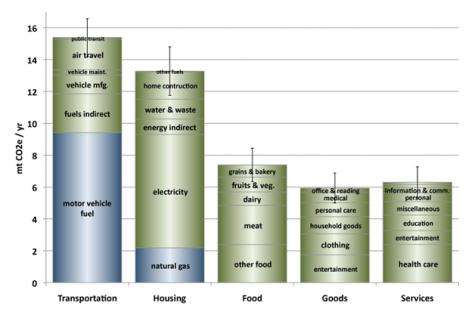
The typical U.S. household dumps 48 tons of carbon dioxide into the atmosphere each year. In this breakdown, blue indicates direct emissions, such as from driving a family car or heating a home. Green indicates indirect emissions, such as carbon emitted by the trucks delivering groceries to a retail store or in the process of growing crops.
Tips to reduce your carbon footprint frequently include buying compact florescent light bulbs, taking your own bag to the grocery store or buying local produce. But how much difference do these actions make?
A new study by researchers at the University of California, Berkeley, suggests that who you are and where you live make a big difference in which activities have the largest impact.
Everyone has a unique carbon footprint, says Christopher M. Jones, lead author of the study and a researcher in UC Berkeleys Renewable and Appropriate Energy Laboratory (RAEL). There is no one-size-fits-all set of actions that people should take.
The study by Jones and RAEL director Daniel Kammen, a UC Berkeley professor of energy and resources who currently is on leave at the World Bank, appears in the current issue of the journal Environmental Science & Technology.
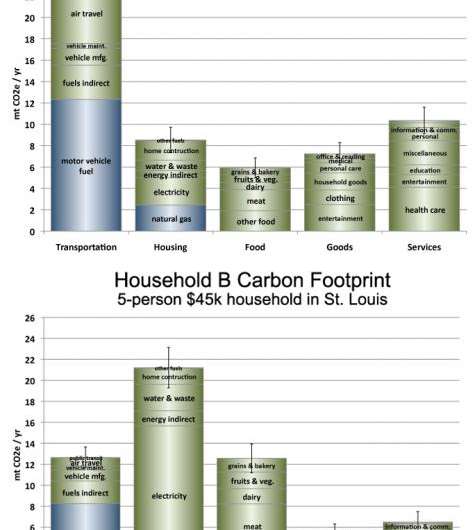
A childless couple in San Francisco has a significantly different carbon footprint (top) than a three-child household in St. Louis. As a result, these households should use different strategies to reduce their carbon output.
Carbon footprints are a measure of the greenhouse gases released during the production, use and disposal of products and services. The production phase includes all processes between the time raw materials are extracted from Earth until they reach consumers as finished products in stores. The study considers the carbon footprint of all household economic activity, including transportation, energy, food, goods, services, water and waste.California vs. Missouri footprint
As an example, the report highlights the carbon footprints of two fictitious households: an upper-income couple living in San Francisco with no children, and a middle-income family with three children living in St. Louis, Mo. Each of these households contributes to the atmosphere about the same amount of greenhouse gases per year, but the sources of those emissions are very different, the study found.
Motor vehicles and air travel are the largest sources of emissions for the San Francisco couple, while electricity and food dominate emissions for the St. Louis family.
As a result, the opportunities to reduce emissions are vastly different. For the West Coast household, improving the fuel efficiency of their motor vehicles from 20 miles per gallon to just 25 miles per gallon would save the equivalent of completely eliminating electricity in their home. In environmentally conscious San Francisco, going further by driving gas-sipping hybrids may also enhance the couples social status.
The Midwest family, on the other hand, can save over $100 per month, or 5 percent of their monthly net income, by making healthier low-carbon food choices, such as reducing calories and buying chicken, fruits and vegetables instead of red meat, dairy and processed foods. Cutting electricity consumption by 20 percent would save them an additional $30 per month. Driving a slightly more efficient vehicle could save the household $50 per month and much more with ultra fuel-efficient vehicles, but this benefit must be balanced with safety concerns and convenience, given the demands of raising three children.
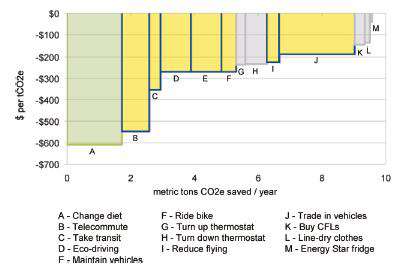
Most U.S. households can reduce their carbon footprints by 20% or more with substantial financial savings typically on the order of $2,000 or more per year with just a handful of actions. Driving more fuel-efficient vehicles and improving diets lead to the most financial and carbon savings across all household types. Energy efficiency saves money and energy, and is a particularly useful carbon reduction strategy where electricity is produced with coal.
In all, the study analyzed typical household carbon footprints in all 50 U.S. states, 28 regions, six households sizes and 12 income brackets for a total of several thousand possible combinations of household types.The results of this analysis have been summarized in an online carbon calculator, located at http://coolclimate … berkeley.edu , that can be used by any consumer to estimate his or her carbon footprint and identify the areas where lifestyle changes would create the largest reduction in greenhouse gas emissions.
Our primary message is simple:If you are concerned about reducing your carbon footprint, or the carbon footprint of others through policy, it is important to focus on the actions that lead to the greatest reductions, said Kammen. Our online tool can help people do just that.
Users can get a quick estimate of their carbon footprint profile by typing in their location, household size and income, then spend a few minutes answering basic questions about lifestyle for more personalized estimates. They can then compare their results to similar households and get a customized action plan.
Comparative feedback is very important. People want to know how well they are doing compared to people like themselves, Jones said.
Users also can create accounts and join groups of similar households to share their carbon footprint profiles and reduction strategies. An online competition allows cities, counties, community groups and businesses to compete against each other.
CoolCalifornia.org
With the help of Jones and Kammen, the California Air Resources Board (ARB) has launched a similar website, CoolCalifornia.org, designed to be a one-stop-shop to motivate and connect the millions of Californians who are taking action to minimize carbon footprints.
CoolCalifornia.org provides a wide range of tools and resources to help Californians make sustainable choices, said Bart Croes director of research at ARB. The carbon calculators under development by UC Berkeley are at the heart of CoolCalifornia.org, and are an important tool to help individuals, local governments, schools and community groups reduce their carbon footprints.
For typical U.S. households, the newly published report claims about one-third of emissions are from transportation, a little more than 20 percent are from household energy, and about 15 percent are from food. All other emissions are from goods, services, housing construction, water and waste.
Jones noted that information alone is not enough. Program designers need to understand the motivations behind peoples actions and how to design programs to reduce barriers to adopting sustainable behavior and tap into social motivations that move individuals.
If you want an effective program to reduce emissions, it is essential to recognize that individuals have different values, attitudes, beliefs, habits and abilities, Jones said. The next stage for the CoolClimate Network (CCN), a RAEL project to analyze carbon footprints, is to recruit hundreds of households to systematically measure the effectiveness of various programs based on behavioral science.
These ideas will also be explored at the Behavior, Energy and Climate Change Conference, which is being coordinated in part by the UC Berkeley team and will be held in Washington, D.C., from Nov. 29 to Dec. 2.
Most people are willing and many are actively seeking how to live more climate-friendly lifestyles. The question is whether we can do it fast enough to reduce some of the worst impacts of climate change. Figuring out what makes the greatest impact seems like a good first place to start, Jones said.
More information: Environmental Science & Technology paper
Provided by
University of California - Berkeley
-
From lemons to lemonade: Reaction uses carbon dioxide to make carbon-based semiconductor,
32 comments
-
Thioridazine kills cancer stem cells in human while avoiding toxic side-effects of conventional cancer treatments,
3 comments
-
SpaceX private rocket blasts off for space station (Update),
42 comments
-
Climate scientists say they have solved riddle of rising sea,
30 comments
-
Research team claims to have found evidence Lake Cheko is impact crater for Tunguska Event,
18 comments
-
Hypothetical desert earth
5 hours ago
-
More human population = greater mass?
May 25, 2012
-
Conversion from aircraft bearing to normal degrees
May 23, 2012
-
Interpretation/Analysis of the Lab results(HEPA filter)
May 22, 2012
-
Has anyone here attended the The Urbino Summer School in Paleoclimatology?
May 22, 2012
-
Earthquakes: Mag 6 N. Italy and Mag 5.6 W. Bulgaria
May 21, 2012
- More from Physics Forums - Earth
More news stories
SpaceX capsule has 'new car' smell, astronauts say (Update)
SpaceX's Dragon cargo vessel smells like a new car, said astronauts at the International Space Station after opening the hatches Saturday following the spacecraft's landmark mission to the orbiting lab.
Space & Earth / Space Exploration
19 hours ago |
4.5 / 5 (20) |
0
Astronomers seize last chance in lifetime for Venus Transit
Astronomers are gearing for one the rarest events in the Solar System: an alignment of Earth, Venus and the Sun that will not be seen for another 105 years.
19 hours ago |
5 / 5 (3) |
2
Australia hails surprise super-telescope decision
Australia has hailed a surprise decision giving it a role in a radio telescope project aimed at revolutionising astronomy, vowing to draw on its decades of experience in space science.
19 hours ago |
5 / 5 (4) |
1
Astronauts enter world's 1st private supply ship
(AP) -- Space station astronauts floated into the Dragon on Saturday, a day after its heralded arrival as the world's first commercial supply ship.
Space & Earth / Space Exploration
19 hours ago |
5 / 5 (5) |
0
Sophisticated simulations predict future warming
The chances of our planet being hit by a global warming of 3 degrees Celsius by 2050 is as likely as it being hit by an increase of 1.4 degrees, new research shows. Presented in the journal Nature Geoscience, the British study ...
Space & Earth / Earth Sciences
May 22, 2012 |
4.4 / 5 (9) |
51
Scientist: Evolution debate will soon be history
(AP) -- Richard Leakey predicts skepticism over evolution will soon be history. Not that the avowed atheist has any doubts himself.
Dell tablet leak: 10.1-inch display, two-battery choice
(Phys.org) -- Headline after headline talks about vendors tablets in the wings as likely number-one contenders for the iPad. Such claims have justifiably been taken with a grain of salt, considering ...
SpotterRF debuts Radar Backpack Kit (w/ Video)
(Phys.org) -- SpotterRF has announced a special radar backpack kit designed to enhance situational awareness for soldiers on the ground. The company says its special radar is designed for warfighters as part ...
Thousands of shellfish found dead in Peru
Thousands of crustaceans were found dead off the coast of Lima following the mystery mass death of dolphins and pelicans, the Peruvian Navy said Friday.
Keep food safety in mind this memorial day weekend
(HealthDay) -- Picnics, parades and cookouts are as much a part of Memorial Day weekend as tributes to the United States' war veterans.
Family history of Alzheimer's affects functional connectivity
(HealthDay) -- Cognitively normal individuals with a family history of late-onset Alzheimer's disease (AD) may display lower resting state functional connectivity in the default mode network (DMN) of the brain, ...

Apr 14, 2011
Rank: not rated yet
Apr 14, 2011
Rank: 3 / 5 (2)
It's the alleged amount of CO2 that the activities of an individual or group produces.
However, no "brownie points" are given to people who own forest land or large fields or other such things which produce oxygen and sequester CO2, so it's often an arbitrary and unfair system.
How can dairy be less than meat when they both come from cows?
Apr 14, 2011
Rank: not rated yet
If you own forested land or a field and it was like that when you got it there is no change in the carbon equation and no points. If you cut it down then you should lose points. If you re-forest an area then you should get points. Oxygen is not a greenhouse gas so it doesn't count (but I am fond of it).
Some meat comes from animals other than cows. Other differences come from the way they are processed and shipped. Milk will often come from nearer locations than beef. Brazilian beef has a huge carbon footprint when they deforest the Amazon to make pasture-land. Also, people may consume more meat on average than dairy. Not a fair comparison.
Calculating carbon exactly is tricky but it's still good enough to see the broad patterns.
Apr 14, 2011
Rank: 5 / 5 (1)
I think you missed the point. People's "carbon footprints" are different, therefore no one size fits all prescription, whether suggested or mandated by law works for everyone. Furthermore, as the article suggests, most people can save money by looking at wasteful parts of their carbon footprint. Duh! You can do the same by looking at your budget and seeing where you are spending more than the return you get. Or looking at household paper consumption (my big gripe overpackaged items in grocery and retail stores).
The point is that if you live a conservative (in several senses of the word) lifestyle, you leave more planet and money to your grandchildren.
And if you just write (or e-mail to save paper) your congressman and get him or her to vote to end the ethanol fuel programs and subsidies, we can all breath a lot easier.