Biosensors: A handy kit
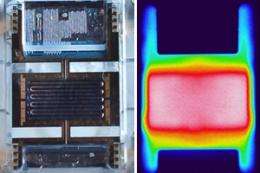
Photograph of the PCR microfluidic chip mounted on a sample delivery and electronic measurement system (left), and an infrared image showing the uniform thermal distribution across the PCR chamber during thermal cycling (right).
(PhysOrg.com) -- A silicon-based microfluidic chip that distinguishes different viral strains shows potential for the quick on-site diagnosis of infectious diseases.
The control of infectious diseases such as the 2009 H1N1 pandemic influenza hinges on handy analytical tools that can rapidly and accurately identify infected patients at the doctors office or at an airport. For this reason, there has been much interest in technologies that could enable replacement of the bulky instruments used at present with point-of-care testing devices. Linus Tzu-Hsiang Kao and co-workers at the A*STAR Institute of Microelectronics and the Genome Institute of Singapore have now developed a silicon-based microfluidic system that is able to sense and differentiate the H1N1 virus from other seasonal influenza strains in ultrasmall specimens.
The detection and characterization of viral strains is now routinely performed using an assay method called real-time reverse transcription polymerase chain reaction (RT-PCR), a method that typically calls for specialized laboratory instruments and skilled personnel. Kaos team, however, was able to integrate the PCR function into a compact two-module microfluidic chip using standard semiconductor technology. The system will be suitable for use as a portable diagnostic tool for on-the-spot screening of highly contagious viruses, such as the influenza A H1N1 strain, says Kao.
Because untreated influenza samples usually contain minute amounts of viral RNA mixed with other nucleic acids and proteins, the researchers designed an on-chip PCR module that amplifies target sequences for both H1N1 and seasonal viruses at the same time. The key to their compact screening technology, however, is the silicon-nanowire sensing module used for virus identification. The nanowires in the module are modified with nucleic acid-containing polymers that specifically bind the target DNA, which results in a change in electrical resistance in proportion to the concentration of target DNA present in the sample.
The team fabricated the PCR module, which includes a reaction chamber connected to small aluminum heaters and temperature sensors through tiny channels, directly into a silicon chip using an etching technique. They then constructed the silicon nanowires by optical lithography and finally immobilized the nucleic acid-containing polymers.
Experiments revealed that the small size of the PCR chamber gave it a uniform temperature distribution (see image), providing an ideal environment for efficient RNA amplification. The PCR module also responded much faster to heating/cooling cycles than standard instruments because of the small sample volumeleading to quicker diagnoses.
The team is currently planning to improve the sample extraction module. We are in the process of building a fully automated and integrated prototype, which will allow us to proceed to clinical validation with our collaborators, says Kao.
More information: Kao, L. T.-H. et al. Multiplexed detection and differentiation of the DNA strains for influenza A (H1N1 2009) using a silicon-based microfluidic system. Biosensors and Bioelectronics 26, 20062011 (2011).
Provided by Agency for Science, Technology and Research (A*STAR)
-
From lemons to lemonade: Reaction uses carbon dioxide to make carbon-based semiconductor,
32 comments
-
Thioridazine kills cancer stem cells in human while avoiding toxic side-effects of conventional cancer treatments,
3 comments
-
SpaceX private rocket blasts off for space station (Update),
42 comments
-
Climate scientists say they have solved riddle of rising sea,
30 comments
-
Research team claims to have found evidence Lake Cheko is impact crater for Tunguska Event,
18 comments
-
Schwartz reagent-- NMR/MS/IR
17 hours ago
-
Inversion temp
22 hours ago
-
High school chemistry EEI
May 25, 2012
-
oxidation of I- by KMnO4
May 25, 2012
-
Invesion temp
May 25, 2012
-
Hybridization of SnCl3 -
May 25, 2012
- More from Physics Forums - Chemistry
More news stories
From lemons to lemonade: Reaction uses carbon dioxide to make carbon-based semiconductor
(Phys.org) -- A materials scientist at Michigan Technological University has discovered a chemical reaction that not only eats up the greenhouse gas carbon dioxide, it also creates something useful. And, by ...
May 21, 2012 |
4.7 / 5 (88) |
32
|
New CO2-removing catalyst can take the heat
(Phys.org) -- The current method of removing the greenhouse gas carbon dioxide (CO2) from the flues of coal-fired power plants uses so much energy that no one bothers to use it. So says Roger Aines, principal ...
May 24, 2012 |
5 / 5 (7) |
7
|
High-speed method to aid search for solar energy storage catalysts
Eons ago, nature solved the problem of converting solar energy to fuels by inventing the process of photosynthesis.
May 25, 2012 |
5 / 5 (3) |
4
|
Researchers demonstrate possible primitive mechanism of chemical info self-replication
(Phys.org) -- When scientists think about the replication of information in chemistry, they usually have in mind something akin to what happens in living organisms when DNA gets copied: a double-stranded molecule ...
May 25, 2012 |
5 / 5 (4) |
2
|
Castor oil: Action mechanism of one of the oldest drugs known to man elucidated
Castor oil is known primarily as an effective laxative; however, it was also used in ancient times with pregnant women to induce labour. Only now have scientists at the Max Planck Institute for Heart and Lung ...
May 21, 2012 |
3 / 5 (2) |
3
|
Scientist: Evolution debate will soon be history
(AP) -- Richard Leakey predicts skepticism over evolution will soon be history. Not that the avowed atheist has any doubts himself.
Dell tablet leak: 10.1-inch display, two-battery choice
(Phys.org) -- Headline after headline talks about vendors tablets in the wings as likely number-one contenders for the iPad. Such claims have justifiably been taken with a grain of salt, considering ...
SpotterRF debuts Radar Backpack Kit (w/ Video)
(Phys.org) -- SpotterRF has announced a special radar backpack kit designed to enhance situational awareness for soldiers on the ground. The company says its special radar is designed for warfighters as part ...
SpaceX capsule has 'new car' smell, astronauts say (Update)
SpaceX's Dragon cargo vessel smells like a new car, said astronauts at the International Space Station after opening the hatches Saturday following the spacecraft's landmark mission to the orbiting lab.
Thousands of shellfish found dead in Peru
Thousands of crustaceans were found dead off the coast of Lima following the mystery mass death of dolphins and pelicans, the Peruvian Navy said Friday.
Astronomers seize last chance in lifetime for Venus Transit
Astronomers are gearing for one the rarest events in the Solar System: an alignment of Earth, Venus and the Sun that will not be seen for another 105 years.