Bacteria have evolved a unique chemical mechanism to become antibiotic-resistant
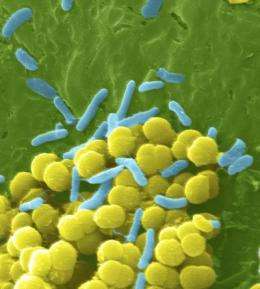
Scientists have discovered a novel strategy by which antibiotic-resistant bacteria change their genetic make-up to evade multiple antibiotics. For the first time, scientists have been able to paint a detailed chemical picture of how a particular strain of bacteria has evolved to become resistant to antibiotics. The research is a key step toward designing compounds to prevent infections by recently evolved, drug-resistant "superbugs" that often are found in hospitals, as well as in the general population. A paper describing the research, by a team led by Squire Booker at Penn State University, will be posted by the journal Science on its early-online Science Express site on April 28, 2011. Credit: National Institutes of Health
For the first time, scientists have been able to paint a detailed chemical picture of how a particular strain of bacteria has evolved to become resistant to antibiotics. The research is a key step toward designing compounds to prevent infections by recently evolved, drug-resistant "superbugs" that often are found in hospitals, as well as in the general population.
A paper describing the research, by a team led by Squire Booker, an associate professor in the department of chemistry and the department of biochemistry and molecular biology at Penn State University, will be posted by the journal Science on its early-online Science Express site on 28 April. This paper is a continuation of research led by Booker published in another paper in Science earlier this month.
The team began by studying a protein made by a recently evolved "superbug." Booker explained that, several years ago, genetic studies had revealed that Staphylococcus sciuri -- a non-human bacterial pathogen -- had evolved a new gene called cfr. The protein created by this gene had been found to play a key role in one of the bacterium's mechanisms of antibiotic resistance. Later, the same gene was found to have crossed over into a strain of Staphylococcus aureus -- a very common kind of bacteria that constitutes part of the flora living in the human nose and on the skin, and which is now the cause of various antibiotic-resistant infections. Because this gene often is found within a mobile DNA element, it can move easily from a non-human pathogen to other species of bacteria that infect humans. "The gene, which has been found in Staphylococcus aureus isolates in the United States, Mexico, Brazil, Spain, Italy, and Ireland, effectively renders the bacteria resistant to seven classes of antibiotics," Booker explained. "Clearly, bacteria with this gene have a distinct evolutionary advantage. However, until now, the detailed process by which the protein encoded by that gene affected the genetic makeup of the bacteria was unclear; that is, we didn't have a clear 3D picture of what was going on at the molecular level."
To solve the chemical mystery of how such bacteria outsmart so many antibiotics, Booker and his team investigated how the Cfr protein accomplishes a task called methylation -- a process by which enzymes add a small molecular tag to a particular location on a nucleotide -- a molecule that is the structural unit of RNA and DNA. When this molecular tag is added by a protein called RlmN, it facilitates the proper functioning of the bacterial ribosome -- a gigantic macromolecular machine that is responsible for making proteins that bacteria need to survive. Many classes of antibiotics bind to the ribosome, disrupting its function and thereby killing the bacteria. The Cfr protein performs an identical function as the RlmN protein, but it adds the molecular tag at a different location on the same nucleotide. The addition of the tag blocks binding of antibiotics to the ribosome without disrupting its function. "What had perplexed scientists is that the locations to which RlmN and Cfr add molecular tags are chemically different from all others to which tags routinely are appended, and should be resistant to modification by standard chemical methods," Booker said. "What we've discovered here is so exciting because it represents a truly new chemical mechanism for methylation. We now have a very clear chemical picture of a very clever mechanism for antibiotic resistance that some bacteria have evolved."
Booker also said he believes the next step will be to use this new information to design compounds that could work in conjunction with typical antibiotics. "Because we know the specific mechanism by which bacterial cells evade several classes of antibiotics, we can begin to think about how to disrupt the process so that standard antibiotics can do their jobs," he said.
Provided by
Pennsylvania State University
-
From lemons to lemonade: Reaction uses carbon dioxide to make carbon-based semiconductor,
32 comments
-
Thioridazine kills cancer stem cells in human while avoiding toxic side-effects of conventional cancer treatments,
3 comments
-
SpaceX private rocket blasts off for space station (Update),
42 comments
-
Climate scientists say they have solved riddle of rising sea,
30 comments
-
Research team claims to have found evidence Lake Cheko is impact crater for Tunguska Event,
18 comments
-
Schwartz reagent-- NMR/MS/IR
17 hours ago
-
Inversion temp
22 hours ago
-
High school chemistry EEI
May 25, 2012
-
oxidation of I- by KMnO4
May 25, 2012
-
Invesion temp
May 25, 2012
-
Hybridization of SnCl3 -
May 25, 2012
- More from Physics Forums - Chemistry
More news stories
From lemons to lemonade: Reaction uses carbon dioxide to make carbon-based semiconductor
(Phys.org) -- A materials scientist at Michigan Technological University has discovered a chemical reaction that not only eats up the greenhouse gas carbon dioxide, it also creates something useful. And, by ...
May 21, 2012 |
4.7 / 5 (88) |
32
|
New CO2-removing catalyst can take the heat
(Phys.org) -- The current method of removing the greenhouse gas carbon dioxide (CO2) from the flues of coal-fired power plants uses so much energy that no one bothers to use it. So says Roger Aines, principal ...
May 24, 2012 |
5 / 5 (7) |
7
|
High-speed method to aid search for solar energy storage catalysts
Eons ago, nature solved the problem of converting solar energy to fuels by inventing the process of photosynthesis.
May 25, 2012 |
5 / 5 (3) |
4
|
Researchers demonstrate possible primitive mechanism of chemical info self-replication
(Phys.org) -- When scientists think about the replication of information in chemistry, they usually have in mind something akin to what happens in living organisms when DNA gets copied: a double-stranded molecule ...
May 25, 2012 |
5 / 5 (4) |
2
|
Castor oil: Action mechanism of one of the oldest drugs known to man elucidated
Castor oil is known primarily as an effective laxative; however, it was also used in ancient times with pregnant women to induce labour. Only now have scientists at the Max Planck Institute for Heart and Lung ...
May 21, 2012 |
3 / 5 (2) |
3
|
Scientist: Evolution debate will soon be history
(AP) -- Richard Leakey predicts skepticism over evolution will soon be history. Not that the avowed atheist has any doubts himself.
Dell tablet leak: 10.1-inch display, two-battery choice
(Phys.org) -- Headline after headline talks about vendors tablets in the wings as likely number-one contenders for the iPad. Such claims have justifiably been taken with a grain of salt, considering ...
SpotterRF debuts Radar Backpack Kit (w/ Video)
(Phys.org) -- SpotterRF has announced a special radar backpack kit designed to enhance situational awareness for soldiers on the ground. The company says its special radar is designed for warfighters as part ...
SpaceX capsule has 'new car' smell, astronauts say (Update)
SpaceX's Dragon cargo vessel smells like a new car, said astronauts at the International Space Station after opening the hatches Saturday following the spacecraft's landmark mission to the orbiting lab.
Thousands of shellfish found dead in Peru
Thousands of crustaceans were found dead off the coast of Lima following the mystery mass death of dolphins and pelicans, the Peruvian Navy said Friday.
Astronomers seize last chance in lifetime for Venus Transit
Astronomers are gearing for one the rarest events in the Solar System: an alignment of Earth, Venus and the Sun that will not be seen for another 105 years.
Apr 28, 2011
Rank: 5 / 5 (3)
Apr 28, 2011
Rank: not rated yet
"Because this gene often is found within a mobile DNA element, it can move easily from a non-human pathogen to other species of bacteria that infect humans."
Apr 28, 2011
Rank: not rated yet
Apr 28, 2011
Rank: 5 / 5 (2)
Even if that number was 80%, it's still be unflattering.
Apr 29, 2011
Rank: 1 / 5 (3)
The argument could very well be that such a remarkable step in the organisms efficiency must be contributed to the 'Hand of God.' Everything we humans experienced since we are banned from Paradise is punishment, and the punishment is ongoing.
Apr 29, 2011
Rank: not rated yet
Some of us think that, instead of being "banned from Paradise", we were given the priceless gift of Independence.
Apr 30, 2011
Rank: not rated yet
May 01, 2011
Rank: not rated yet
What an absolutely miserable and defeatist worldview. No wonder it was so popular during the Dark Ages.
May 01, 2011
Rank: 5 / 5 (1)
comunity - Community
ventelation - Ventilation
sterlize - Sterilize
thier - Their
exhust - Exhaust
alot - A lot
:)
May 03, 2011
Rank: not rated yet
You are talking about the same crap jebus supposedly died to atone for right?
Did you just refer to something being "contributed to the hand of God." Typos are one thing. Not using words correctly is another.
Your explanation still requires a mechanism. Magic man and Magic is not a mechanism. Perhaps you should have CONTRIBUTED more to your education and less to tithes.
May 03, 2011
Rank: 5 / 5 (1)
Or the Matrix.
May 03, 2011
Rank: not rated yet
Yep, real terrible punishment going on. If anything, it appears paradise really sucks compared to punishment. Are you sure your god is benevolent?