Novel ash analysis validates volcano no-fly zones
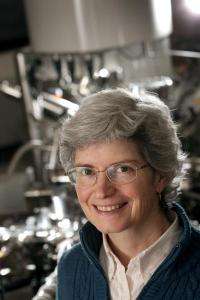
Planes were grounded all over Europe when the Eyjafjallajokull volcano erupted in Iceland last year. But no one knew if the no fly zone was really necessary. And the only way to find out would have been to fly a plane through the ash cloud - a potentially fatal experiment. Now a team of researchers from the University of Copenhagen and the University of Iceland have developed a protocol for rapidly providing air traffic authorities with the data they need for deciding whether or not to ground planes next time ash threatens airspace safety.
A study by the teams of Professors Susan Stipp from the Nano-Science Centre of the University of Copenhagen and Sigurdur Gislason from the University of Iceland is reported this week in the internationally recognized journal PNAS (Proceedings of the National Academy of Sciences).
Volcanic ash could crash planes if the particles are small enough to travel high and far, if they are sharp enough to sandblast the windows and bodies of airplanes, or if they melt inside jet engines. The ash from the Eyjafjallajökull eruption was dangerous on all counts, so the authorities certainly made the right decision in April 2010. That's one conclusion from the Copenhagen/Iceland paper but Professor Stipp thinks the team's most important contribution is a method for quickly assessing future ash.
"I was surprised to find nothing in the scientific literature or on the web about characterising ash to provide information for aviation authorities. So we decided to do something about it", explains Stipp.
Some 10 million travellers were affected by the ash plume, which cost an estimated two and a half billion Euros.
"Aviation authorities were sitting on a knife-edge at the centre of a huge dilemma. If they closed airspace unnecessarily, people, families, businesses and the economy would suffer, but if they allowed air travel, people and planes could be put at risk, perhaps with tragic consequences," says Professor Stipp.
So Susan Stipp phoned her colleague and friend in Reykjavik, Siggi Gislason and while the explosive eruptions were at their worst, he and a student donned protective clothing, collected ash as it fell and sent some samples to Denmark. "In the Nano-Science Centre at the University of Copenhagen, we have analytical facilities and a research team that are unique in the world for characterising natural nanoparticles and their reaction with air, water and oil." explains Professor Susan Stipp
The newly developed protocol for assessing future ash can provide information for safety assessment in less than 24 hours. Within an hour of receiving the samples, scientists can tell how poisonous they are for the animals and people living closest to the eruption. Half a day enables them to predict the danger of sandblasting on aircraft, and assess the risk of fouling jet engines. Within a day they can tell the size of the particles, providing data for predicting where and how far the ash cloud will spread. Susan Stipp hopes that because of the analysis protocol, aviation authorities will not face such an impossible dilemma next time fine-grained ash threatens passenger safety. "Some of the analytical instruments needed are standard equipment in Earth science departments and some are commonly used by materials scientists, so with our protocol, aviation authorities ought to be able to get fast, reliable answers," concludes Professor Stipp.
Provided by University of Copenhagen


