Ancient corals provide insight on the future of Caribbean reefs
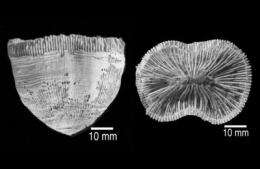
This is the extinct Pliocene free-living coral Trachyphyllia bilobata collected from the northern Dominican Republic. Credit: Neogene Marine Biota of Tropical America (NMITA) website hosted by the University of Iowa
Climate change is already widely recognized to be negatively affecting coral reef ecosystems around the world, yet the long-term effects are difficult to predict. University of Miami (UM) scientists are using the geologic record of Caribbean corals to understand how reef ecosystems might respond to climate change expected for this century. The findings are published in the current issue of the journal Geology.
The Pliocene epoch--more than 2.5 million years ago--can provide some insight into what coral reefs in the future may look like. Estimates of carbon dioxide and global mean temperatures of the period are similar to environmental conditions expected in the next 100 years, explains James Klaus, assistant professor in the Department of Geological Sciences, College of Arts and Sciences, at UM and lead investigator of this project.
"If the coming century truly is a return to the Pliocene conditions, corals will likely survive, while well-developed reefs may not," says Klaus, who has a secondary appointment in the Rosenstiel School of Marine and Atmospheric Science (RSMAS), at UM. "This could be detrimental to the fish and marine species that rely on the reef structure for their habitat."
The study looks at the fossil records of coral communities from nine countries around the Caribbean region to better understand the nature of these ecosystems during the Pliocene. Today, fossil reefs are often found far from the sea, exposed in road cuts, quarry excavations, or river canyons due to uplift and higher ancient sea levels.
In studying the fossil reefs, the researchers uncovered a striking difference between modern and Pliocene coral communities. The Pliocene epoch was characterized by a great diversity of free-living corals. Unlike most reef corals, these corals lived unattached to the sea floor. Free-living corals were well suited to warm, nutrient-rich seas of the Pliocene. Between eight and four million years ago the origination of new free-living coral species approximately doubled that of other corals. However, free-living corals experienced abrupt extinction as seawater cooled, nutrient levels decreased, and suitable habitat was eliminated in the Caribbean. Of the 26 species of free-living corals that existed during the Pliocene, only two remain in the Caribbean today. The modern Caribbean coral fauna is comprised of those coral species that survived this extinction event.
The scientists argue that the effects of ongoing climate change are reminiscent of conditions present during the Pliocene and opposite to the environmental factors that caused the extinction and gave rise to modern Caribbean corals. So, how might the Caribbean coral fauna respond to a predicted return to Pliocenelike conditions within this century? The free-living corals of the Pliocene would have been well suited to ocean conditions projected for this century. However, the modern reef-building coral fauna may not, explains Donald McNeill, senior scientist in the Division of Marine Geology and Geophysics at UM and co-author of the study.
"Like the Pliocene, we might expect shallow reefs to be increasingly patchy with lower topographic relief," says McNeill. "Rising levels of carbon dioxide will lower the pH in the oceans, a process known as ocean acidification, and will make it difficult for corals to build their limestone skeletons."
Climate change may also increase nutrients in the oceans, boosting populations of marine life that degrade the coral into fine white sand, a process called bioerosion. Reefs built by corals in areas with high bioerosion will be affected the most. Mesophotic reefs, those growing in depths between 30 and 150 meters, have reduced rates of both calcification and bioerosion and thus may be affected less.
Provided by
University of Miami
-
From lemons to lemonade: Reaction uses carbon dioxide to make carbon-based semiconductor,
32 comments
-
Thioridazine kills cancer stem cells in human while avoiding toxic side-effects of conventional cancer treatments,
3 comments
-
SpaceX private rocket blasts off for space station (Update),
42 comments
-
Climate scientists say they have solved riddle of rising sea,
30 comments
-
Research team claims to have found evidence Lake Cheko is impact crater for Tunguska Event,
18 comments
-
Hypothetical desert earth
5 hours ago
-
More human population = greater mass?
May 25, 2012
-
Conversion from aircraft bearing to normal degrees
May 23, 2012
-
Interpretation/Analysis of the Lab results(HEPA filter)
May 22, 2012
-
Has anyone here attended the The Urbino Summer School in Paleoclimatology?
May 22, 2012
-
Earthquakes: Mag 6 N. Italy and Mag 5.6 W. Bulgaria
May 21, 2012
- More from Physics Forums - Earth
More news stories
SpaceX capsule has 'new car' smell, astronauts say (Update)
SpaceX's Dragon cargo vessel smells like a new car, said astronauts at the International Space Station after opening the hatches Saturday following the spacecraft's landmark mission to the orbiting lab.
Space & Earth / Space Exploration
19 hours ago |
4.5 / 5 (20) |
0
Astronomers seize last chance in lifetime for Venus Transit
Astronomers are gearing for one the rarest events in the Solar System: an alignment of Earth, Venus and the Sun that will not be seen for another 105 years.
19 hours ago |
5 / 5 (3) |
2
Australia hails surprise super-telescope decision
Australia has hailed a surprise decision giving it a role in a radio telescope project aimed at revolutionising astronomy, vowing to draw on its decades of experience in space science.
19 hours ago |
5 / 5 (4) |
1
Astronauts enter world's 1st private supply ship
(AP) -- Space station astronauts floated into the Dragon on Saturday, a day after its heralded arrival as the world's first commercial supply ship.
Space & Earth / Space Exploration
19 hours ago |
5 / 5 (5) |
0
Sophisticated simulations predict future warming
The chances of our planet being hit by a global warming of 3 degrees Celsius by 2050 is as likely as it being hit by an increase of 1.4 degrees, new research shows. Presented in the journal Nature Geoscience, the British study ...
Space & Earth / Earth Sciences
May 22, 2012 |
4.4 / 5 (9) |
51
Scientist: Evolution debate will soon be history
(AP) -- Richard Leakey predicts skepticism over evolution will soon be history. Not that the avowed atheist has any doubts himself.
Dell tablet leak: 10.1-inch display, two-battery choice
(Phys.org) -- Headline after headline talks about vendors tablets in the wings as likely number-one contenders for the iPad. Such claims have justifiably been taken with a grain of salt, considering ...
SpotterRF debuts Radar Backpack Kit (w/ Video)
(Phys.org) -- SpotterRF has announced a special radar backpack kit designed to enhance situational awareness for soldiers on the ground. The company says its special radar is designed for warfighters as part ...
Thousands of shellfish found dead in Peru
Thousands of crustaceans were found dead off the coast of Lima following the mystery mass death of dolphins and pelicans, the Peruvian Navy said Friday.
Keep food safety in mind this memorial day weekend
(HealthDay) -- Picnics, parades and cookouts are as much a part of Memorial Day weekend as tributes to the United States' war veterans.
Family history of Alzheimer's affects functional connectivity
(HealthDay) -- Cognitively normal individuals with a family history of late-onset Alzheimer's disease (AD) may display lower resting state functional connectivity in the default mode network (DMN) of the brain, ...
Apr 07, 2011
Rank: not rated yet
Apr 08, 2011
Rank: not rated yet