New research aims to improve natural gas production
Natural gas is an abundant energy resource for the United States, but much of it remains trapped in shale or tight-sand formations. Researchers at Missouri University of Science and Technology hope to develop a way to extract that gas by studying the energy source at the molecular level.
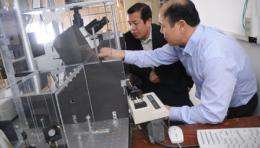
Dr. Baojun Bai, assistant professor of petroleum engineering, is leading the research, which involves looking at how natural gas behaves in these constricted environments. Working with Bai is Dr. Yinfa Ma, Curators' Teaching Professor of chemistry, whose single-molecule imaging system will allow the researchers to examine the flow properties of natural gas on a small scale.
The U.S. Geological Survey estimates that tight sands and shale formations may hold up to 460 trillion cubic feet of natural gas, enough to meet current U.S. demand for nearly 21 years. (According to the Natural Gas Supply Association, Americans consume about 22 trillion cubic feet of natural gas a year).
But traditional methods of extracting natural gas will not work in these tight formations, Bai says.
"The problem is that the pore size is so small - only a few nanometers," he says. In conventional natural gas reservoirs, the gas flows through pores that are a few micrometers in width.
The difference between nanometers and micrometers is significant. A single nanometer is one billionth of a meter. A micrometer is one millionth of a meter. That means that a micrometer is 1,000 times larger than a nanometer.
At the nanometer scale, materials behave differently. No one really knows how natural gas flows at that level, Bai says. So he, Ma and some Missouri S&T graduate students are trying to find out.
"We want an improved understanding of how the gas flows through the pore space - specifically, how natural gas in a nanoscale pore behaves," Bai says. "The flow behavior will be different than the conventional behavior, but we don't know how exactly."
"With the novel single-molecule imaging system I designed, we can directly monitor the flowing behavior of natural gas, polymer solutions and surfactants in nano-pores, individually or simultaneously," Ma says. "This can be used for new flow model developments and correlated with mathematical models developed by our project partners."
The S&T researchers will also study how the materials used to crack shale in tight formations in order to extract natural gas - the fluids, polymers and surfactants - will affect gas flow. "We want to find out how to reduce the polymer and surfactant impact on the formation," Bai says, "because its impact on the formation impacts the gas flow."
The project is funded through a three-year, $1.2 million grant from the Research Partnership to Secure Energy for America under a U.S. Department of Energy contract. Through this grant and other funding from research partners, Bai and Ma's team will study the effect of introducing those materials on "natural gas transportation properties" such as capillary pressure (the force required to squeeze natural gas through a pore), absolute and relative permeability (how well the gas flows through minerals), and non-Darcy flow (which results in turbulence).
Much of the work will take place in Ma's laboratory, where the researchers will use Ma's single-molecule imaging system to construct a 3-D model of pores in, for example, a shale natural gas formation. First, however, they will examine cross-sections of shale by using Missouri S&T's focused ion beam microscope, or FIB, which is capable of magnifying objects up to a million times their actual size.
The shale samples will come from S&T's partners on the project: two Houston-based firms, Baker Hughes (formerly BJ Services) and Hess Corp., and other shale-gas operators.
Once they have the FIB-created images of the pores from shale cross-sections, they will reconstruct the cross-sections to create their 3-D model.
"I expect that we can create a new mathematical model to predict the gas flow through the nano-level pores," Bai says.
In addition, Bai and Ma hope to "comprehensively characterize the pore distribution in the shale, because not all of the rock is homogeneous," Bai says.
The research should prove useful to the natural gas industry, says Bai, whose background is in enhanced oil recovery.
Provided by Missouri University of Science and Technology


