Are we living in an age of giant quakes?
April 8, 2011 By Becky Ham
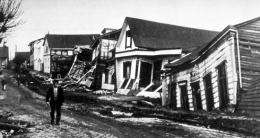
Street scene from Valdivia, Chile, after the 1960 magnitude-9.5 earthquake -- the largest ever recorded. Credit: NOAA | Pierre St. Arnand
Searching for patterns in the occurrence of large magnitude earthquakes after a succession of large tremors -- surpassed by the recent magnitude-9.0 quake in Japan -- has researchers wondering if the amount of big quakes is on the rise.
The devastating 2004 Indonesian tsunami, with its death toll of as many as 250,000 people, was caused by the first magnitude-9.0 earthquake since 1967. A succession of smaller but still destructive tremors in Haiti, Chile, and New Zealand -- surpassed by this year's magnitude-9.0 quake in Japan -- has some researchers wondering whether the number of large earthquakes is on the rise.
An earthquake represents the abrupt release of seismic strain that has built up over the years as plates of the Earth's crust slowly grind and catch against each other. Giant earthquakes live up to their fearsome name. The biggest ever recorded was the magnitude-9.5 Chile earthquake of 1960. It accounts for about a quarter of the total seismic strain released worldwide since 1900. In just three minutes, the recent quake in Japan unleashed one-twentieth of that global total according to geophysicist Richard Aster at the New Mexico Institute of Mining and Technology in Socorro.
The Indonesian quake "reinvigorated interest in these giants," said Aster, who is also president of the Seismological Society of America. The Chile and Japan earthquakes -- along with a magnitude-9.2 quake in Alaska in 1964 -- also triggered catastrophic tsunamis.
After a lull in large quakes in the 1980s and 1990s, we may now be in the middle of a new age of large earthquakes, Aster added.
Records from the past century reveal some periods that have seen an unusual number of giant earthquakes, defined as those with magnitude 8.0 or higher. For example, global seismic data show a dramatic spike in the rate of large earthquakes from 1950-67. But there have also been quiet periods with fewer large quakes. And with only 100 years worth of records to consult, researchers aren't sure what these patterns of large quakes might mean -- or whether they mean anything at all.
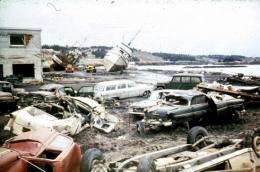
Tsunami damage along the waterfront of Kodiak, Alaska, after the 1964 magnitude-9.2 quake. Credit: USGS
Even if clusters of giant earthquakes are a real phenomenon, Aster noted, researchers don't have any good ideas on how one big quake can trigger another big one in a different part of the world.
Earthquakes are well known to generate smaller aftershocks, including some at great distance. The Japan quake spawned small tremors as far away as Nebraska.
But Andrew Michael, a geophysicist at the U.S. Geological Survey in Menlo Park, Calif., has studied the patterns in large earthquake occurrences that remain once aftershocks are removed from the picture. "Overall, the pattern is random," he said. Apparent clusters of large quakes can be explained simply as statistical flukes.
"Random doesn't mean evenly spaced out," Michael added. That's why quakes can seem to bunch together in the historical record. He cautioned that such clusters may not mean anything for predicting future earthquakes, or for explaining how a cluster of quakes might occur.
He compared the pattern to a baseball player's hitting slump. "It could mean that he needs to change something in his game. Or it could just be a random streak," Michael said.
Further evidence against the significance of apparent clustering came in a recent study by Don Parsons of the U.S. Geological Survey in Menlo Park and Aaron Velasco of the University of Texas at El Paso, published in Nature Geosciences. They found that large earthquakes do not generate other large quakes on a global scale.
Aster acknowledged that the rarity of large earthquakes means that questions about possible connections between them are difficult to answer. "We see magnitude-7 earthquakes only 15 or so times a year and magnitude-9 earthquakes only a few times a century," he said.
Michael said that until researchers know more about why the rate of large earthquakes varies over time "we shouldn't be worrying less, but there's no need for panic either."
The recent spate of giant earthquakes may not signal more to come, but Aster said that "it's undeniable that we're becoming more and more vulnerable to the effects of earthquakes in general."
Aster added that many rapidly growing cities around the world aren't prepared for a large quake, while at the same time coastal communities are expanding into tsunami-prone areas. "We just have more people in precarious places," he said.
Source:
Inside Science News Service
-
From lemons to lemonade: Reaction uses carbon dioxide to make carbon-based semiconductor,
32 comments
-
Thioridazine kills cancer stem cells in human while avoiding toxic side-effects of conventional cancer treatments,
3 comments
-
SpaceX private rocket blasts off for space station (Update),
42 comments
-
Climate scientists say they have solved riddle of rising sea,
30 comments
-
Research team claims to have found evidence Lake Cheko is impact crater for Tunguska Event,
18 comments
-
Hypothetical desert earth
5 hours ago
-
More human population = greater mass?
May 25, 2012
-
Conversion from aircraft bearing to normal degrees
May 23, 2012
-
Interpretation/Analysis of the Lab results(HEPA filter)
May 22, 2012
-
Has anyone here attended the The Urbino Summer School in Paleoclimatology?
May 22, 2012
-
Earthquakes: Mag 6 N. Italy and Mag 5.6 W. Bulgaria
May 21, 2012
- More from Physics Forums - Earth
More news stories
SpaceX capsule has 'new car' smell, astronauts say (Update)
SpaceX's Dragon cargo vessel smells like a new car, said astronauts at the International Space Station after opening the hatches Saturday following the spacecraft's landmark mission to the orbiting lab.
Space & Earth / Space Exploration
19 hours ago |
4.5 / 5 (20) |
0
Astronomers seize last chance in lifetime for Venus Transit
Astronomers are gearing for one the rarest events in the Solar System: an alignment of Earth, Venus and the Sun that will not be seen for another 105 years.
19 hours ago |
5 / 5 (3) |
2
Australia hails surprise super-telescope decision
Australia has hailed a surprise decision giving it a role in a radio telescope project aimed at revolutionising astronomy, vowing to draw on its decades of experience in space science.
19 hours ago |
5 / 5 (4) |
1
Astronauts enter world's 1st private supply ship
(AP) -- Space station astronauts floated into the Dragon on Saturday, a day after its heralded arrival as the world's first commercial supply ship.
Space & Earth / Space Exploration
19 hours ago |
5 / 5 (5) |
0
Sophisticated simulations predict future warming
The chances of our planet being hit by a global warming of 3 degrees Celsius by 2050 is as likely as it being hit by an increase of 1.4 degrees, new research shows. Presented in the journal Nature Geoscience, the British study ...
Space & Earth / Earth Sciences
May 22, 2012 |
4.4 / 5 (9) |
51
Scientist: Evolution debate will soon be history
(AP) -- Richard Leakey predicts skepticism over evolution will soon be history. Not that the avowed atheist has any doubts himself.
Dell tablet leak: 10.1-inch display, two-battery choice
(Phys.org) -- Headline after headline talks about vendors tablets in the wings as likely number-one contenders for the iPad. Such claims have justifiably been taken with a grain of salt, considering ...
SpotterRF debuts Radar Backpack Kit (w/ Video)
(Phys.org) -- SpotterRF has announced a special radar backpack kit designed to enhance situational awareness for soldiers on the ground. The company says its special radar is designed for warfighters as part ...
Thousands of shellfish found dead in Peru
Thousands of crustaceans were found dead off the coast of Lima following the mystery mass death of dolphins and pelicans, the Peruvian Navy said Friday.
Keep food safety in mind this memorial day weekend
(HealthDay) -- Picnics, parades and cookouts are as much a part of Memorial Day weekend as tributes to the United States' war veterans.
Family history of Alzheimer's affects functional connectivity
(HealthDay) -- Cognitively normal individuals with a family history of late-onset Alzheimer's disease (AD) may display lower resting state functional connectivity in the default mode network (DMN) of the brain, ...

Apr 08, 2011
Rank: 3.2 / 5 (9)
When you see a new mountain range, 1000 meters high, appear, jutting out of the earth, where prior was only a grassy plain, then you will have experienced a giant quake.
Apr 08, 2011
Rank: 4.2 / 5 (5)
NO
Apr 08, 2011
Rank: 4.4 / 5 (7)
Might that make it easier for quakes to affect each other?
Surely the large movement of the north japan section will affect the probability of a south japan slip, the stresses and forces will have changed??
If they don't affect each other, then WHY don't they - that is my question.
Apr 08, 2011
Rank: 5 / 5 (6)
two things have changed probably, to make us more aware of the big ones--
increased population & sprawl mean that people are affected by quakes in what were once remote areas---
and we have more measuring instruments, more sophisticated ways to crunch the data--
and of course our media have '20/20 hindsight' so that yesterday's big news stories cause similar events to be reported more (as in that cluster of bird deaths recently)
Apr 08, 2011
Rank: 1.8 / 5 (4)
Apr 08, 2011
Rank: 4 / 5 (10)
1) Nibiru approaches
2) Nemesis approaches
3) Tevatron created a black hole awhile back which is swimming around in the core
4) Mag pole shift
5) Something else
What to expect:
1) SF/LA san andreas
2) Cascadia
3) Mauna Loa subsea landslide
4) Yellowstone
5) Methane eruption- gulf, arkansas
6) Bardarbunga eruption (pending)
7) Loch Ness supervolcano
8) Alaska
9) TOKYO/Mt Fuji
10) 21 Indonesian volcanoes 'ready to erupt'
11) La Palma flank collapse
12) Something unexpected but just as bad
Apr 08, 2011
Rank: 1 / 5 (2)
Apr 08, 2011
Rank: not rated yet
Apr 08, 2011
Rank: 1 / 5 (4)
If we lay aside prejudice* we may discover that earthquakes are partially induced by continuously changing gravitational and magnetic interactions between the Earth, the Sun, the Moon and the planets.
*Scientists became so annoyed with astrologers for trying to predict the future of everything by the positions of these objects that they may have overlooked one obvious variable that may contribute to earthquakes.
Again, I am pleased to see an increased interest in earthquakes.
With kind regards,
Oliver K. Manuel
Former NASA Principal
Investigator for Apollo
Apr 08, 2011
Rank: 5 / 5 (1)
#1 and #2 are discountable, since there is no indisputable evidence even of the *existence* of Nibiru and Nemesis, much less of supposed gravitational effects thereof.
#3 is also a non-issue. First, Tevatron is very unlikely to be able to create a mini black hole; the LHC might, with a very small probability, be able to do it. Even if it did, the hole would evaporate via Hawking radiation very quickly, never being able to trouble the core (or anything else).
#4 is also ignorable. The magnetic poles do shift, but only very slowly. Field reversals are also slow, and their intervals are on the order of tens to hundreds of thousands of years.
Most importantly, magnetic field changes do not affect tectonic structures.
Apr 08, 2011
Rank: 1 / 5 (1)
-Perhaps but they just can't stop talking about it. Que the aether guy.
http://www.scienc...chtype=a
Even more important than that, is we don't yet know all there is to know.
http://www.mnn.co...l-pole-r
We'll leave it on the table.
Apr 08, 2011
Rank: 1 / 5 (7)
Apr 08, 2011
Rank: 4.3 / 5 (6)
Apr 08, 2011
Rank: 5 / 5 (1)
Apr 09, 2011
Rank: not rated yet
Apr 09, 2011
Rank: not rated yet
There might be sufficient data, but there would be nobody to analyse it.
Apr 09, 2011
Rank: 1 / 5 (2)
Apr 09, 2011
Rank: not rated yet
As mentioned in the text, there may be a cycle of large earth quakes around the 60 year period, allthough accurate data for this is very limited. I do find it suprisingly coincidental that our own numerical system is based on the hexadecimal system. This cycle crops up in all sorts of places, even economics. It is also the approximate period for the alignment of Saturn and Jupiter.
We are constantly reminded that the the crust is still rebounding in places from the end of the last ice age.
We have our selves just started to remove, at ever increasing speed the remainder of the ice. How we can expect to move such large volumes of water to different positions around the globe without some effect on techtonics is beyound me.
I would expect the initial effects to be stronger, then over a long period the effects to tail off until - cont.
Apr 09, 2011
Rank: 1 / 5 (1)
equilibrium is again reached and the normal cycle returns.
I am amazed at the apparantly coincidentl number of times that a strong 7+ magnitude earth quake is closely followed be a large quake on the opposite side of the globe. This occurs far more frequently than can be explaind by chance, allthough in every case we are assured by experts that ther was no conection. I think that in the case of large earthquakes the energy released is also transmited, and focused to the antipode. If there is a fault allready under strain in this region enough energy is transfered to trigger that fault to slip. In some extreme cases it can be like watching ping pong.
Anyway call me a crack pot if you like, and will keep watching the experts change there minds.
Bogey
Apr 09, 2011
Rank: 1 / 5 (1)
Apr 09, 2011
Rank: 1 / 5 (1)
I was under the impression that the kind of changes you are talking about don't generally happen at once. Where are you getting this scenario, is there real data for the description of this event or this an opinion?
I would rate 9.0 as a giant quake anywhere. Someone mentioned it isn't in the lexicon of descriptions that would allow even more freedom to throw the word around casually. So what would come after major quake as a description?
Apr 10, 2011
Rank: 3 / 5 (2)
;-)
Apr 10, 2011
Rank: not rated yet
We have our selves just started to remove, at ever increasing speed the remainder of the ice. How we can expect to move such large volumes of water to different positions around the globe without some effect on techtonics is beyound me."
Bogey
Apr 10, 2011
Rank: not rated yet
A recent artical on this site calculated the volume of ice melt from greenland and the antartic. In 1000s of gigatons.
To quote a current popular phrase.
"Its gonna get worse befor it gets better."
Bogey
Apr 11, 2011
Rank: not rated yet
With human history as a base? A few hundred thousand lives = Nothing.
Apr 11, 2011
Rank: not rated yet
Was that Harpo's instrument?
HAARP has been blamed for everything bad except some older religions.
Apr 11, 2011
Rank: not rated yet
Apr 11, 2011
Rank: not rated yet
They had dominoes in the Bible?
Apr 11, 2011
Rank: not rated yet
Apr 12, 2011
Rank: not rated yet
My little nephew always says that.
Apr 13, 2011
Rank: not rated yet
does this make sense or do i need to rewrite it?
Apr 14, 2011
Rank: not rated yet
Apr 14, 2011
Rank: not rated yet