Wheels up for extensive survey of Arctic ice
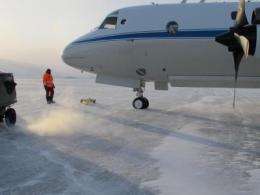
Researchers and flight crew arrived in Thule, Greenland, on Monday, March 14, for the start of NASA's 2011 Operation IceBridge, an airborne mission to study changes in Arctic polar ice. This year's plans include surveys of Canadian ice caps and expanded international collaboration.
The state of Earth's polar ice sheets, glaciers and sea ice is an important indicator of climate change and plays a key role in regulating global climate. With IceBridge, NASA is pushing ahead with its commitment to keep an eye on changes to polar ice to better understand the effects of climate change.
Since 2009, Operation IceBridge has flown annual campaigns over the Arctic starting in March and over Antarctica starting in October. The mission extends the multi-year record of ice elevation measurements made by NASA's Ice Cloud and land Elevation Satellite (ICESat), which stopped collecting data in 2009, and the upcoming ICESat-2, scheduled for launch in 2016.
"Each successive IceBridge campaign has broadened in scope," said IceBridge project scientist Michael Studinger of Goddard Earth Sciences and Technology Center at the University of Maryland. "This year, we have more flight hours and flight plans than ever before. We are looking forward to a busy, fruitful campaign."
The first science flight is scheduled for this week, pending favorable weather. For almost 10 weeks, researchers will operate an array of airborne instruments collecting data over Arctic land and sea ice.
Among the highest priority flights is an overnight transit to Fairbanks, Alaska, to collect sea ice thickness data across a slice of the Arctic Ocean. Sea ice is thought to be thinning in recent years in addition to shrinking in the area covered. Another high-priority flight plan is to fly over the Barnes and Devon ice caps of the Canadian Arctic Archipelago.
"The Canadian ice caps are notably smaller than the Greenland and Antarctic ice sheets, but are still significant potential contributors to sea-level change in the next few decades," said Charles Webb, deputy cryosphere program manager at NASA's Goddard Space Flight Center in Greenbelt, Md. "They also serve as potential early-warning indicators, responding more sensitively to temperature changes than the more massive ice sheets."
The IceBridge campaign also plans to fly for the first time over the European Space Agency's ground-based calibration sites for their ice-observing satellite, CryoSat-2. Flights over calibration sites ultimately are expected to provide data to evaluate and improve remote-sensing measurements.
Still other IceBridge missions will retrace paths flown in previous years, such as flights over Petermann, Jacobshavn, Kangerlussuak and Helheim glaciers. With this multi-year data, scientists can begin to see how such glaciers -- the outlets through which Greenland loses mass from its ice sheet -- are changing, where ice loss is slowing or accelerating, and why.
The P-3B aircraft from NASA's Wallops Flight Facility in Wallops Island, Va., will fly from Thule and Kagerlussuaq, Greenland, carrying a suite of instruments. The Airborne Topographic Mapper measures changes in the surface elevation of the ice by reflecting lasers from the ground back to the aircraft and converting the readings into elevation maps.
Radar instruments onboard the P-3B from the University of Kansas' Center for Remote Sensing of Ice Sheets in Lawrence, Kan., allow scientists to see snow and ice characteristics at the surface and down to the bedrock. A gravity instrument from Columbia University's Lamont-Doherty Earth Observatory in Palisades, N.Y., is used to peer below floating ice to determine the shape of water-filled cavities below.
Another laser altimeter, the Land, Vegetation, and Ice Sensor, operates at higher altitudes to survey large areas. This altimeter will fly solo out of Kangerlussuaq on the King Air B-200, an aircraft based at NASA's Langley Research Center in Hampton, Va.
The IceBridge campaign is led by Goddard. The Earth Science Project Office at NASA's Ames Research Center in Moffett Field, Calif., is responsible for integration of science experiments on the aircraft and mission logistics.
Provided by NASA's Goddard Space Flight Center


