'We need to see ahead'
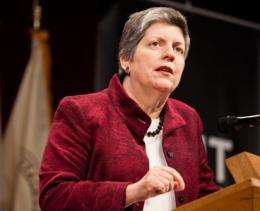
U.S. Secretary of Homeland Security Janet Napolitano emphasized the importance of science and technology research as a means of keeping the nation safe in an address at MIT on Monday, while outlining a series of ways the government would like to enlist talented academic researchers in public service.
“Today we have to expand government’s collaboration with science, well beyond the areas where that collaboration is already strong," said Napolitano, who delivered the annual Karl Taylor Compton Lecture in Kresge Auditorium. “A deeper partnership on homeland security must be one of these areas. We need the minds and talents of individuals who are excited about coming into an emerging field.”
From ensuring safe travel for Americans and safe trade for American business, to protecting the country’s infrastructure, “we need to see ahead, and we need scientists to help us do that,” added Napolitano, who was introduced by MIT President Susan Hockfield, and is the first woman ever to deliver the prestigious Compton Lecture.
Tackling ‘the big data problem’
In her speech, titled “The Future of Science as Public Service,” Napolitano discussed a number of specific research areas in which the government wants to invest further, from materials science to information theory. New technologies developed in these fields could then be applied to a variety of security tasks.
Given the terrorist attacks of Sept. 11, 2001, aviation security remains one of the country's highest security priorities; as Napolitano noted, the United States has two million air passengers daily at more than 300 airports, and needs to find passenger-screening systems that are both reliable and efficient, so that currently cumbersome screening procedures at airports can be made faster, while not losing their thoroughness. “Technology can help us leap ahead of our adversaries,” Napolitano said.
Intelligence organizations also face a distinct challenge as rapidly growing amounts of data are being circulated around the globe. Every day, Napolitano noted, U.S. intelligence sifts through more digital information than is contained in the Library of Congress’ collection of printed texts, and must identify the significant parts of it, a process she referred to as "the big data problem” in her remarks.
“It’s about discovering meaning and information from millions and billions of data points,” Napolitano said. “We therefore can’t overstate the need for software engineers, and information systems engineers. We need communications and data-security experts. And we need that kind of talent working together to find new and faster ways to identify and separate relevant data from non-relevant data.”
Further research in nanotechnology and materials science, Napolitano observed, could help protect the nation’s infrastructure by creating resilient structures better able to withstand the shocks of terrorist attacks or natural disasters.
Inviting scholars into government
Napolitano also said the federal government, including the Department of Homeland Security, is making a renewed effort to support the research of young scholars in academia whose research is relevant to the country’s security goals.
“We want to become better at inviting talented scientists into government,” Napolitano said.
The department has already begun a program, she noted, giving 100 scholarships, fellowships and internships for students who would like to pursue research projects. It has also instituted a new fast-track process for speeding along the review of promising research ideas.
Additionally, the department is beginning a new cyber-workforce initiative with the aim of hiring 1,000 new researchers and workers to handle its growing needs in computer science and information technology.
To be sure, Napolitano added, “Science and technology alone cannot guarantee security.” Moreover, she added, quoting an address former British Prime Minister Winston Churchill made at MIT in 1949, “science must be a servant and not the master of man.” Still, Napolitano concluded, “we will need scientific and technological expertise to turn ideas into reality.”
The Compton Lectures were established in 1957 in honor of Karl Taylor Compton, who served as MIT’s president from 1930 to 1948, and as chairman of the MIT Corporation from 1948 to 1954. Among other accomplishments, Compton helped oversee the development of radar at MIT’s Radiation Lab during World War II. Recent speakers directly addressing issues of scientific research include Energy Secretary Steven Chu, in 2009, and Sen. Jeff Bingaman of New Mexico, in 2008.
This story is republished courtesy of MIT News (web.mit.edu/newsoffice/), a popular site that covers news about MIT research, innovation and teaching.
Provided by Massachusetts Institute of Technology


