Voice command-based robot feeding arm unveiled (w/ video)
Mar 22, 2011 by Katie Gatto weblog

(PhysOrg.com) -- Eating a good meal is one of the few things in life that is both absolutely necessary, and extremely pleasurable at the same time. But what would you do if you could not pick up the knife and fork to eat with? You would have to rely on a caregiver to help you feed yourself. Up until now that caregiver has been a human, but what if it could be a robot?

No, I'm not playing with you. Someone has developed a robot. That someone is an undergraduate student named Isao Wakabayashi, who studies at Chukyo University in .

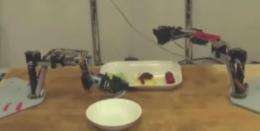
The robot works simply enough. It detects the food on your plate, and feeds you what you want to eat. How does it know what you want to eat? Simple, you tell it. The robot has the ability to understand a limited set of . So, if you tell it to feed you the broccoli, it will pick up the green stalk and bring it right to your mouth.

This video is not supported by your browser at this time.

The body of the robot was made from a Rascal set by Robix, but Isao Wakabayashi wrote the image processing software that allows the system to tell meatloaf from pudding, and this is the that really sets this feeding bot apart. Companies, such as the Japanese Secom, have been selling feeding robots as feeding assistants for the differently abeled, for several years now, but the voice system will help to make the robots more user friendly, as most current models cannot be used independently unless the user can operate a joy stick.

No word yet about when this product will come to market, or at what cost.

Explore further: High-Access Survey Robot begins work at nuclear power station

More information: via IEEE Spectrum

Related Stories

Care-O-bot 3: Always at your service

Jul 01, 2008

Who doesn’t long for household help at times? Service robots will soon be able to relieve us of heavy, dirty, monotonous or irksome tasks. Research scientists have now presented a new generation of household ...

Korea to sell programmable robot

Aug 21, 2006

South Korean scientists say they plan to begin marketing an advanced robot that can be programmed by personal computers.

Simple Robot Climbs Through Tubes (w/ Video)

May 12, 2010

Last week was the IEEE's International Conference on Robotics and Automation, held in Anchorage, Alaska. One of the most interesting robots was a simple -- and fast -- bot designed to climb easily through tubes.

Introducing Japan’s new singing robot (w/ Video)

Oct 15, 2010

(PhysOrg.com) -- A new humanoid robot, the HRP-4, has been unveiled at the CEATEC Japan 2010 trade show. The robot, nicknammed "diva-bot," has learned to sing by mimicking a human singer, enabling it to sound ...

Recommended for you

Flying robots get off the ground

Jun 17, 2013

Attaching a platform to a high-rise building to evacuate people in an emergency, or creating a landing stage for an aircraft on uneven terrain - these are just two areas in which flying robots could have ...

China supercomputer world's fastest: report

Jun 17, 2013

A Chinese supercomputer is the fastest in the world, according to survey results announced Monday, comfortably overtaking a US machine which now ranks second.

A robot that runs like a cat (w/ Video)

Jun 17, 2013

Thanks to its legs, whose design faithfully reproduces feline morphology, EPFL's 4-legged 'cheetah-cub robot' has the same advantages as its model: It is small, light and fast.

User comments : 0

More news stories

A robot that runs like a cat (w/ Video)

Thanks to its legs, whose design faithfully reproduces feline morphology, EPFL's 4-legged 'cheetah-cub robot' has the same advantages as its model: It is small, light and fast.

AMD unveils first-ever 5 GHz processor 

AMD today unveiled its most powerful member of the AMD FX family of CPUs, the world's first commercially available 5 GHz CPU processor, the AMD FX-9590. These 8-core CPUs deliver new levels of gaming and ...

Study suggests new approach to fight lung cancer

Recent research has shown that cancer cells have a much different – and more complex – metabolism than normal cells. Now, scientists at The University of Texas at Dallas have found that exploiting these differences might ...