Virtual reality in a Michigan Tech lab
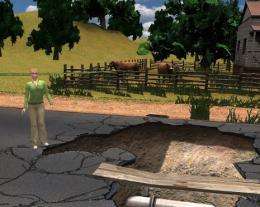
I am in Room 314 in Rekhi Hall, arms spread wide, tippy-toeing across a rickety board and trying oh-so-hard not to fall into a gaping hole beneath my feet. One misstep and I join the dead cow at the bottom of the pit.
This is Scott Kuhl’s lab. An assistant professor of computer science at Michigan Technological University, he is holding an open house, inviting members of his department to experience virtual reality via a setup that includes a headset, cameras and a computer. Associate Professor Zhenlin Wang pulls on the headset, which covers his eyes with an opaque shield. He flinches. “Honestly, it’s a little bit scary,” he admits, as he carefully places one foot in front of the other. “I have to trick myself to do this.”
The anxiety is natural, Kuhl assures him. “Some people can’t do it.”
What Wang sees is displayed in two dimensions on a computer monitor: a country road, a deep hole in the pavement, a board. Nearby, cows graze on a hillside. Across the hole, a young woman watches quizzically.
Wear the headset, and the scene pops into 3D and then some. Look up, there’s that peculiar person silently checking you out. Look down, a chasm yawns at your feet. To your right, a pleasant little farm where that doomed cow must have come from. Cross that board, and your knees begin to quiver. Yikes.
Here’s how it works. Four cameras, one in each corner of the room, track LEDs on the headset. As you move, the system senses where you are within the virtual world and changes the display within the headset accordingly. It’s not limited to computer-generated imagery, either. Kuhl stitched together a series of photos taken in Utah and loaded the image into the lab equipment, creating a 360-degree, 3D view of Canyonlands National Park.
It seems like an ideal setup for the coolest videogame ever, but fun is not what this is about, Kuhl says. The virtual reality lab can help researchers make other virtual reality programs better. In particular, Kuhl is interested in making virtual reality more like real reality.
“Everyone wants to use virtual reality to train people for things that are dangerous,” he says, from flying helicopters to performing brain surgery. So the more closely simulators approximate the real world, the better the training. Kuhl focuses on a peculiar disconnect: “People almost always judge distances closer in virtual reality and more accurately in the real world,” he says. “And if people are misjudging distance, are they also misjudging size and speed?”
If developers could address such problems, they could make better simulators and improve performance for everyone from pilots to neurosurgeons. But on this day, those of us visiting Kuhl’s lab are just happy to take our leave without breaking our virtual necks.
Provided by Michigan Technological University


