UT professor finds economic importance of bats in the billions
March 31, 2011

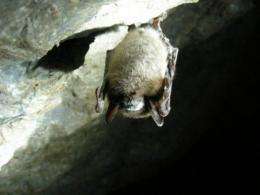
A little brown bat, hanging at Greely Mine in Stockbridge

Enlarge

This undated photo courtesy of the US Fish & Wildlife Service shows the little brown bat hanging at Greely Mine in Stockbridge, Vermont affected by white-nose syndrome. Call them creepy little creatures if you like, but insect-munching bats are so valuable to US agriculture that their deaths could cost the economy billions of dollars per year, experts said Thursday.

Bats in North America are under a two-pronged attack but they are not the only victim – so is the U.S. economy. Gary McCracken, head of the Department of Ecology and Evolutionary Biology at the University of Tennessee, Knoxville, analyzed the economic impact of the loss of bats in North America in agriculture and found it to be in the $3.7 to $53 billion a year range.

McCracken's findings are published in the April edition of Science and can be found online at http://www.sciencemag.org/content/current#PolicyForum. McCracken conducted his study with Justin Boyles of the University of Pretoria in South Africa, Paul Cryan of the U.S. Geological Survey and Thomas Kunz of Boston University.

Since 2006, more than a million have died due to a fungal disease called White-Nose Syndrome (WNS). At the same time, several migratory tree-dwelling species are being killed in unprecedented numbers by wind turbines. This hurts the economy because bats' diet of pest insects reduces the damage the insects cause to crops and decreases the need for pesticides.

In fact, the researchers estimate the value of bats to the agricultural industry is roughly $22.9 billion a year, with the extremes ranging as low as $3.7 and $53 billion a year.

"These estimates include the reduced costs of pesticide applications that are not needed to suppress the insects consumed by bats. However, they do not include the downstream impacts of pesticides on humans, domestic and wild animals and our environment," said McCracken. "Without bats, crop yields are affected. Pesticide applications go up. Even if our estimates were quartered, they clearly show how bats have enormous potential to influence the economics of agriculture and forestry."

According to the researchers, a single colony of 150 big brown bats in Indiana eat nearly 1.3 million insects a year -- insects that could potentially be damaging to crops.

WNS infects the skin of bats while they hibernate. Some species such as the little brown bat are likely to go extinct in parts of . The disease has quickly spread from Canada to Tennessee, Missouri and Oklahoma and actions to slow or stop it have proven unsuccessful.

It is unknown how many bats have died due to wind turbines, but the scientists estimate by 2020, will have killed 33,000 to 111,000 annually in the Mid-Atlantic Highlands alone. Why migratory tree-dwelling species are drawn to the turbines remains a mystery.

Due to the economic and ecological importance, the researchers urge policy-makers to avoid a wait-and-see approach to the issue of widespread declines of bat populations.

"Not acting is not an option because the life histories of these flying, nocturnal mammals -- characterized by long generation times and low reproductive rates -- mean that population recovery is unlikely for decades or even centuries, if at all," said McCracken.

According to McCracken, solutions will only be fueled in the next few years by increased awareness of the benefits of insectivorous bats among the public, policymakers and scientists.

Provided by University of Tennessee at Knoxville


Rank 5 /5 (5 votes)
Relevant PhysicsForums posts

More news stories

Scientist: Evolution debate will soon be history

(AP) -- Richard Leakey predicts skepticism over evolution will soon be history. Not that the avowed atheist has any doubts himself.

Biology / Evolution

created 8 hours ago | popularity 3.4 / 5 (8) | comments 21

Thousands of shellfish found dead in Peru

Thousands of crustaceans were found dead off the coast of Lima following the mystery mass death of dolphins and pelicans, the Peruvian Navy said Friday.

Biology / Ecology

created 18 hours ago | popularity 4.8 / 5 (4) | comments 6

More plant species responding to global warming than previously thought

(Phys.org) -- Far more wild plant species may be responding to global warming than previous large-scale estimates have suggested.

Biology / Ecology

created May 22, 2012 | popularity 4.6 / 5 (14) | comments 18 | with audio podcast

Totally rad: Scientists create rewritable digital data storage in DNA

(Phys.org) -- Scientists from Stanford's Department of Bioengineering have devised a method for repeatedly encoding, storing and erasing digital data within the DNA of living cells.

Biology / Biotechnology

created May 21, 2012 | popularity 4.9 / 5 (17) | comments 11 | with audio podcast

For monogamous sparrows, it doesn't pay to stray (but they do it anyway)

It's quite common for a female song sparrow to stray from her breeding partner and mate with the male next door, but a new study shows that sleeping around can be costly.

Biology / Plants & Animals

created May 22, 2012 | popularity 5 / 5 (1) | comments 7 | with audio podcast


Dell tablet leak: 10.1-inch display, two-battery choice

(Phys.org) -- Headline after headline talks about vendors’ tablets in the wings as likely number-one contenders for the iPad. Such claims have justifiably been taken with a grain of salt, considering ...

SpotterRF debuts Radar Backpack Kit (w/ Video)

(Phys.org) -- SpotterRF has announced a special radar backpack kit designed to enhance situational awareness for soldiers on the ground. The company says its special radar is designed for warfighters as part ...

SpaceX capsule has 'new car' smell, astronauts say (Update)

SpaceX's Dragon cargo vessel smells like a new car, said astronauts at the International Space Station after opening the hatches Saturday following the spacecraft's landmark mission to the orbiting lab.

Astronomers seize last chance in lifetime for Venus Transit

Astronomers are gearing for one the rarest events in the Solar System: an alignment of Earth, Venus and the Sun that will not be seen for another 105 years.

Keep food safety in mind this memorial day weekend

(HealthDay) -- Picnics, parades and cookouts are as much a part of Memorial Day weekend as tributes to the United States' war veterans.

Australia hails surprise super-telescope decision

Australia has hailed a surprise decision giving it a role in a radio telescope project aimed at revolutionising astronomy, vowing to draw on its decades of experience in space science.