Tuberculosis vaccine passes phase I trial
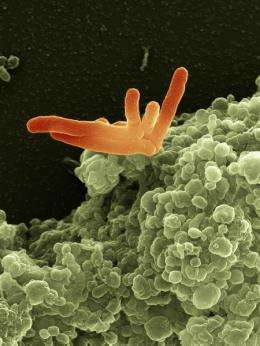
The engulfing of the genetically engineered vaccine bacteria triggers a self-destruct program in the phagocyte known as “programmed cellular death”. As a result, the vaccine antigens are presented to the immune system in an optimal way, generating a stronger immune response and significantly better protection. Credit: Corbis
(PhysOrg.com) -- The currently available tuberculosis vaccine BCG is over 90 years old and its effectiveness is declining. An increasing number of mycobacterial strains are emerging, against which the current vaccine provides no protection. Scientists at the Max Planck Institute for Infection Biology in Berlin have developed an improved vaccine that has being undergoing tests on humans in clinical trials since 2008. The results of the phase I trial show that the vaccine candidate fulfils safety requirements. Initial results of the phase Ib trial indicate that the vaccine candidates active principle is effective.
Scientists have been working on developing an improved vaccine against the tuberculosis (TB) bacterium Mycobacterium tuberculosis for almost 90 years. The vaccine, termed Bacille Calmette-Guérin (BCG), was developed in 1919 and contains weakened M. bovis, the pathogen that causes bovine TB, and that is also transmittable to humans. In most cases, the BCG vaccine protects children against the disease, but not adults. Thus the vaccine has not contributed to reducing the global incidence of TB infection.
The VPM1002 vaccine developed at the Max Planck Institute for Infection Biology is based on the BCG vaccine and contains genetically modified M. bovis. With the help of a built-in gene, the bacteria can be more easily identified by the cells of the immune system. As a result, the organism is protected against developing a disease caused by dangerous TB pathogens.
The vaccination has been licensed to Vakzine Projekt Management (VPM) in Hanover, which tested it clinically on healthy volunteers in Germany in autumn 2008 under the name VPM 1002. The safety profile of an active substance is tested in a phase I trial. The vaccine easily cleared this hurdle and no side effects arose in the course of this trial, says Stefan Kaufmann from the Max Planck Institute in Berlin. The researchers must now establish whether VPM1002 is also safe for people in regions with a high incidence of TB, and that it works as planned. In this kind of Ib trial, the vaccine must prove that its active principle functions - meaning that it works as we expect it to, explains Stefan Kaufmann. VPM1002 also appears to fulfil this criterion, says Bernd Eisele from VPM, which is responsible for the vaccine trials.
Before VPM1002 can be marketed as a vaccine, its effectiveness and safety must be confirmed in further trials on volunteers in areas with a high risk of TB infection. If all goes well and VPM1002 also proves effective and safe in large international trials, the new vaccine could be ready for use in around five years time, hopes Stefan Kaufmann.
VPM1002 is one of twelve vaccine candidates currently under clinical development. It is one of three genetically modified variants of the current BCG vaccine that offer better protection than the BCG vaccine and could replace it. The rest consist of immune-reactive substances that are intended to boost the effect of BCG; the first of these candidates could be ready for use in 2016 at the earliest. Experts estimate that a vaccine that is better than BCG could prevent almost eight million deaths. A new booster vaccine could reduce the number of TB fatalities by a further 40 percent.
Provided by
Max-Planck-Gesellschaft
-
From lemons to lemonade: Reaction uses carbon dioxide to make carbon-based semiconductor,
32 comments
-
Thioridazine kills cancer stem cells in human while avoiding toxic side-effects of conventional cancer treatments,
3 comments
-
SpaceX private rocket blasts off for space station (Update),
42 comments
-
Climate scientists say they have solved riddle of rising sea,
30 comments
-
Research team claims to have found evidence Lake Cheko is impact crater for Tunguska Event,
18 comments
-
Potential Breakthrough in Seizure Control
23 hours ago
-
Popping/Cracked sternum.
May 25, 2012
-
Which Mental Illness Encompasses This Problem?
May 25, 2012
-
A question about drug tolerance
May 23, 2012
-
Poor nutrition leading to overeating?
May 23, 2012
-
Math and dyslexia?
May 21, 2012
- More from Physics Forums - Medical Sciences
More news stories
Keep food safety in mind this memorial day weekend
(HealthDay) -- Picnics, parades and cookouts are as much a part of Memorial Day weekend as tributes to the United States' war veterans.
8 hours ago |
not rated yet |
0
Family history of Alzheimer's affects functional connectivity
(HealthDay) -- Cognitively normal individuals with a family history of late-onset Alzheimer's disease (AD) may display lower resting state functional connectivity in the default mode network (DMN) of the brain, ...
Medicine & Health / Alzheimer's disease & dementia
17 hours ago |
not rated yet |
0
Transvaginal mesh op restores pelvic organ prolapse at price
(HealthDay) -- Transvaginal mesh (TVM) procedures are effective for anatomical restoration of pelvic organ prolapse (POP), but patients report a worsening of sexual function following surgery, according to ...
18 hours ago |
not rated yet |
0
Travel to high altitudes tied to Crohn's, colitis flare-ups
(HealthDay) -- People with inflammatory bowel disease, which includes Crohn's disease and colitis, may be at increased risk for flare-ups when they fly or travel to high altitudes for skiing or mountain climbing, ...
Medicine & Health / Inflammatory disorders
18 hours ago |
not rated yet |
1
|
Weight struggles? Blame new neurons in your hypothalamus
New nerve cells formed in a select part of the brain could hold considerable sway over how much you eat and consequently weigh, new animal research by Johns Hopkins scientists suggests in a study published in the May issue ...
Medicine & Health / Neuroscience
May 21, 2012 |
5 / 5 (1) |
6
|
Scientist: Evolution debate will soon be history
(AP) -- Richard Leakey predicts skepticism over evolution will soon be history. Not that the avowed atheist has any doubts himself.
Dell tablet leak: 10.1-inch display, two-battery choice
(Phys.org) -- Headline after headline talks about vendors tablets in the wings as likely number-one contenders for the iPad. Such claims have justifiably been taken with a grain of salt, considering ...
SpotterRF debuts Radar Backpack Kit (w/ Video)
(Phys.org) -- SpotterRF has announced a special radar backpack kit designed to enhance situational awareness for soldiers on the ground. The company says its special radar is designed for warfighters as part ...
SpaceX capsule has 'new car' smell, astronauts say (Update)
SpaceX's Dragon cargo vessel smells like a new car, said astronauts at the International Space Station after opening the hatches Saturday following the spacecraft's landmark mission to the orbiting lab.
Thousands of shellfish found dead in Peru
Thousands of crustaceans were found dead off the coast of Lima following the mystery mass death of dolphins and pelicans, the Peruvian Navy said Friday.
Astronomers seize last chance in lifetime for Venus Transit
Astronomers are gearing for one the rarest events in the Solar System: an alignment of Earth, Venus and the Sun that will not be seen for another 105 years.